

Creative AI Governance: Production, Creation Records, and Distribution



What you’ll learn
- Where OpenMontage, AIFX, and AdCP each fit across production work, finished-work creation records, and advertising distribution
- Why project numbers, asset numbers, and approved versions must stay consistent from production through distribution
- Which rights reviews, human approvals, and delivery conditions each stage must hand to the next owner
- Which mismatched IDs and missing rights reviews should stop a finished work before delivery
OpenMontage, AIFX, and AdCP Connect Production, Creation Records, and Distribution
A Creative AI Governance reference architecture shows who checks each part of AI-assisted production and how the result moves to the next stage. It ties production decisions, creation records for the finished work, and pre-delivery approval to the same project and version. OpenMontage, AIFX, and AdCP address different handoff gaps between production and distribution.
By the end of this article, you will have practical criteria for answering “How can OpenMontage, AIFX, and AdCP patterns connect evidence from production through distribution?” in your own context.
OpenMontage Handles Production, AIFX Creation Records, and AdCP Advertising Distribution
OpenMontage divides production into research, proposal, script, scenes, source materials, editing, and composition. At each stage, it can keep the draft produced there, the person’s approval, the reason for the decision, and a saved point from which the team can resume after an interruption.[1] The OpenMontage article provides the detailed analysis.
AIFX and AIFI carry a finished work with a record of who created it, when it was created, which AI was used, and a comparison value that reveals whether the file changed. That creator-provided record is not proof of rights or verified identity.[2] The AIFX article examines that boundary.
AdCP provides shared procedures for the party preparing an ad, the party checking it against rules, and the advertising provider delivering it. Its Trust documentation states that the procedures do not automatically guarantee that a rejection stops delivery or that every legal requirement is met.[3][4] The AdCP article covers those operational limits.
The following comparison shows the main users, recorded information, and decisions that each project cannot make alone. It is an author-created synthesis, not a shared official classification from the three projects.
| Pattern used | Main people using it | What they record or check | Problem it helps prevent | What it cannot decide or perform alone |
|---|---|---|---|---|
| OpenMontage | Production owner and reviewers at each stage | Each draft, approval point, decision reason, and place to resume | Required reviews being skipped and work being lost after interruption | Whether contracts and consent are valid or an outside provider stops delivery |
| AIFX and AIFI | Creative, legal or rights, and release-approval owners who manage finished-work records | Finished file, creator-provided record, file-change value, and permitted-use terms | Records becoming separated from the file and unnoticed later file changes | Identity or rights verification and release approval |
| AdCP | Advertiser’s coordinator, separate reviewer, and advertising provider | Request, finished preview, sender-provided production record, outside-check result, rule-check result, approved version, and delivery record | Role and version confusion during delivery | An outside check of the sender-provided record, rights validity, and a guaranteed delivery stop after rejection |
Keep Project Numbers, Asset Numbers, and Approved Versions Consistent Through Distribution
The three systems do not need a direct connection. Shared identifiers and version records need to show whether the finished work moving through the process is the version that people approved.
That requires a shared project number, asset number, and approved version. If the production-approved version differs from the version stored with the creation records or the delivered version, every stage can work correctly while unapproved work is published.
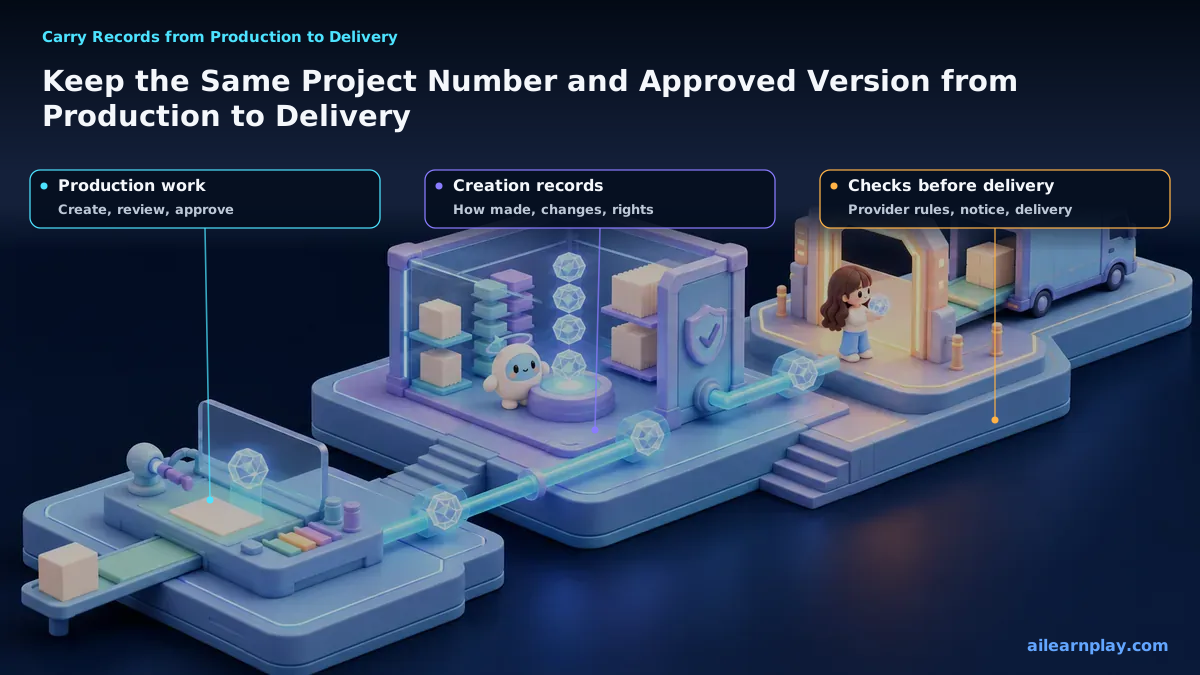
The architecture separates five concerns.
- Production work: the work’s purpose, generation, editing, quality review, human approval, and where work can resume
- Records kept with the finished work: the finished work, revision number, how it was made, source-material locations, a value that reveals file changes, and locations of rights documents
- Checks before delivery: delivery-provider requirements, brand and rule checks, whether to show a notice about AI use, delivery status, and the procedure for removing a problematic ad
- Rules shared by every stage: management numbers, who may view or change the information, approvers, permitted AI services, how sensitive the information is, and how long it must be kept
- One connected decision record: special decisions, changes, approval end dates, problems after delivery, stops, and removals
This design does not require teams to use OpenMontage to manage production, change every finished work into AIFI format, or send ads only through providers that support AdCP. The projects’ public files and explanations provide patterns for responsibility and evidence that teams can apply to existing project management, asset storage, approval workflows, and advertising delivery operations.
Missing Rights Review or Human Approval Must Stop a Finished Work Before Delivery
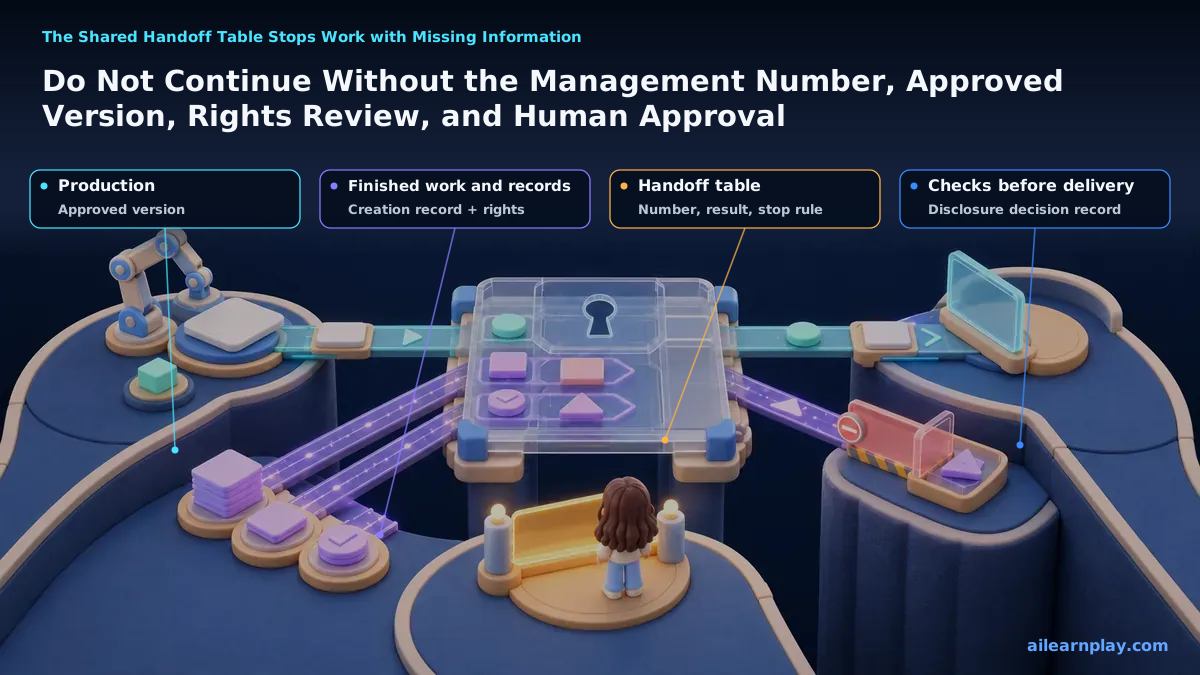
The following Creative AI Governance Interface Contract is an author-created reusable handoff table. It is not a technical protocol for connecting products automatically. Teams use it to agree on the minimum information passed to the next stage, the accountable owner, and the conditions that stop the handoff.
Read each row from left to right: production records the first value, the team maintaining the finished work checks and adds the second, distribution verifies the third before delivery, and the final columns identify the accountable owner and the mistake the row should prevent.
| Shared field | Production provides | Finished-asset evidence provides | Distribution checks | Accountable owner | Problem prevented |
|---|---|---|---|---|---|
Advertising-project number (campaign_id) | Target project | Related project | The advertising project and the place where the ad will be delivered | Overall coordinator | Wrong advertising project |
Ad work number (creative_id) | Stable number from concept onward | Number inside the records kept with the finished work | Number sent to the provider | Production owner | Wrong finished work |
Approved version (asset_version) | Human-reviewed version | Version corresponding to the file-change value | Version waiting for delivery | Production and delivery owners | Unapproved version |
Completed stage (workflow_checkpoint) | Completed stage and recovery point | Reference to creation record | No unfinished required stage | Production owner | Skipped required stage |
Creation-history reference (provenance_ref) | Location of generation and edit history | Creation record and result of checking the record and file | Result of checking the record and file on receipt | Production owner and overall coordinator | Missing creation history |
Rights-review state (rights_status) | Inputs used and review request | Contract, consent, and dates when they end | Match with where and how the work may be used | Legal or rights owner | Unauthorized use |
Human approval (human_approval) | Approver, time, covered version | Approval-record reference | Approval end date and whether the approved file or intended use has since been replaced | Brand and business owners | Expired approval or approval for a different work or use |
Delivery conditions (distribution_policy) | Intended use | Limits on permitted use | Match with the provider’s rules | Delivery owner | Unintended use or destination |
AI-use disclosure decision (disclosure_status) | How AI was used | Record that supports the disclosure decision | Wording, placement, named person responsible | Brand and business owners | Missing required disclosure |
Saved decision record (audit_record) | Decisions and special cases | Checks and updates | Approved-version transfer, delivery, stop, removal | Delivery owner | Inability to determine what happened after a problem |
Stop conditions belong in the contract. A work should return to the named owner instead of moving automatically when a management number or file-change value does not match, rights review is incomplete, approval has ended, or no one has made the AI-use disclosure decision.
Any exception needs a recorded reason, approver, end date, and the work and use it covers.
Choose the First Control Based on the Current Failure
The three areas do not need to be introduced simultaneously. The current problem can determine which action to try first.
| Current problem | First concrete action | First owner to act | Problem prevented |
|---|---|---|---|
| Reviews are missed or work is repeatedly redone | Draw the production steps and mark where a person must approve | Production owner | Required reviews are skipped |
| Creation history and permission records become separated | Make one table for a finished work that brings together its creation record, permission documents, reviewer, and the stop procedure for missing information (an AI Asset Evidence Packet) | Creative and legal or rights owners | The file travels without its records |
| The approved version differs from the delivered version | Connect approval and delivery with the same ad number and version | Delivery owner | The wrong version is delivered |
| Several failures happen together | List shared numbers, required decisions, and reasons to stop in one handoff table | Overall coordinator | One stage accepts incomplete information from another |
A small pilot can limit scope to one advertising project, one type of finished work, and one delivery destination. Creative, legal or rights, brand, and advertising delivery teams can use the same contract to identify which information is captured automatically, which decisions remain human, and where evidence is missing.
Before Adoption, Test Working Features, Existing-Tool Connections, and Rejection Stops
An architectural reference may still lack the functions needed for daily work. Check the following items separately before adoption.
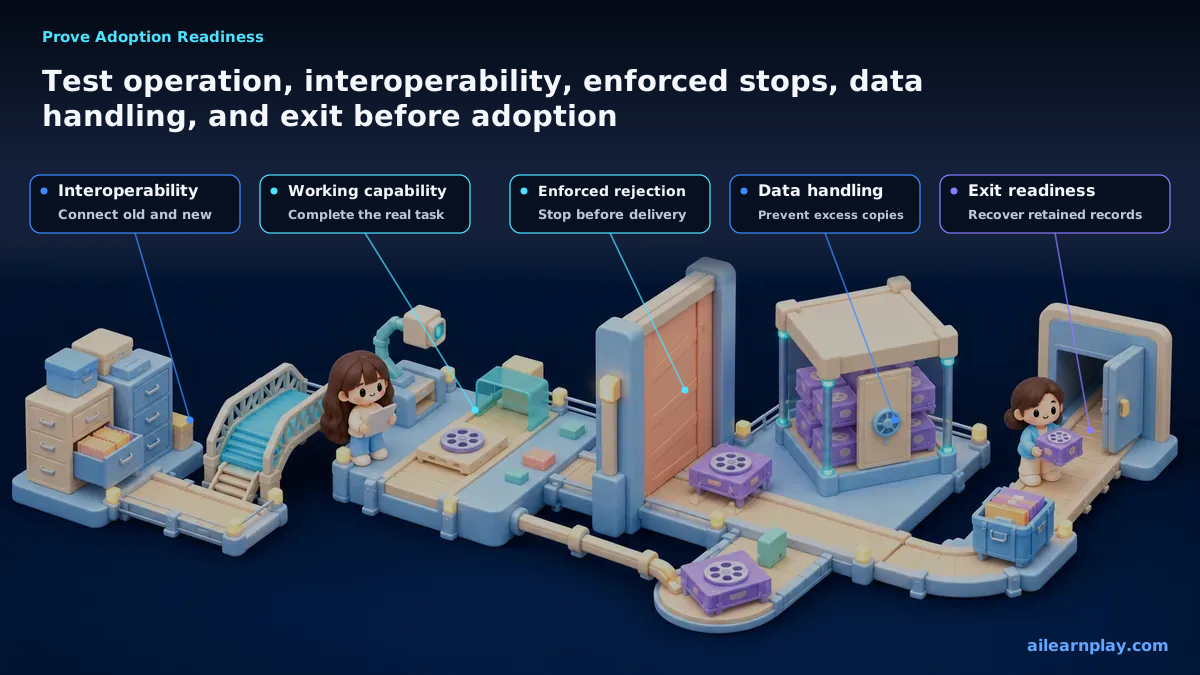
- Whether the needed capability has working tools and information handoffs, not only written documentation
- Whether old and new versions and different tools can read the same records, whether old records can be moved, and whether stored records remain readable
- Whether the delivery side reliably stops work after a rule-check rejection or when an approval expires
- Whether instructions sent to AI, personal data, or unpublished source materials are copied unnecessarily
- Whether the permitted uses meet the organization’s actual business requirements, who operates the system, who responds to failures, and how records can be removed when the organization stops using it
A goal of complete automatic judgment can create a false sense of safety: a box containing text does not prove that someone checked the rights or whether the work is suitable for this particular use. Automation is strongest for management numbers, format, file-change checks, expiry, and movement between stages. People responsible for rights, brand decisions, and exceptions should make those judgments.
Summary: Project IDs, Approved Versions, and Decision Records Connect the Three Stages
OpenMontage, AIFX, and AdCP provide references for three different responsibilities: production process, finished-work evidence, and advertising distribution. A shared creative ID, approved version, rights state, AI-use disclosure decision, and saved decision record connect those responsibilities at each handoff.
When first introducing the design into operations, complete one Interface Contract and trace one advertising project from production to distribution. If missing evidence stops the handoff, returns the work to a named owner, and allows it to resume under the same management number after correction, the design can demonstrate value before the organization chooses its main software.
This article is a general information summary and is not legal advice. Confirm practical decisions with a qualified specialist.
References
- OpenMontage, README
- AI First Exchange, AI-First Exchange
- Ad Context Protocol, AdCP - Advertising Context Protocol
- Ad Context Protocol, Trust & Security
For the latest releases and updates, check the official website and official documentation.