

What Work to Delegate to AI: Three Decision Criteria


What you’ll learn
- How reversibility, scope of impact, and verifiability determine whether to delegate work to AI
- Which decisions people should retain, including direction, permissions, published display, and security
- How to apply the three axes to examples and define both delegation scope and verification steps
Evaluate AI Delegation by Reversibility, Impact, and Verifiability
A task is easier to delegate to AI when it can be reversed, has a limited scope of impact, and produces a result that people can verify. Text organization cannot be treated like changes to public URLs, configuration, permissions, or security. Classify the task on those three axes, then define the decisions and checks that remain with people.
By the end of this article, you will have practical criteria for answering “Which tasks can be delegated to AI, and where should human approval and verification remain?” in your own context.
Set Delegation Boundaries with Three Decision Axes
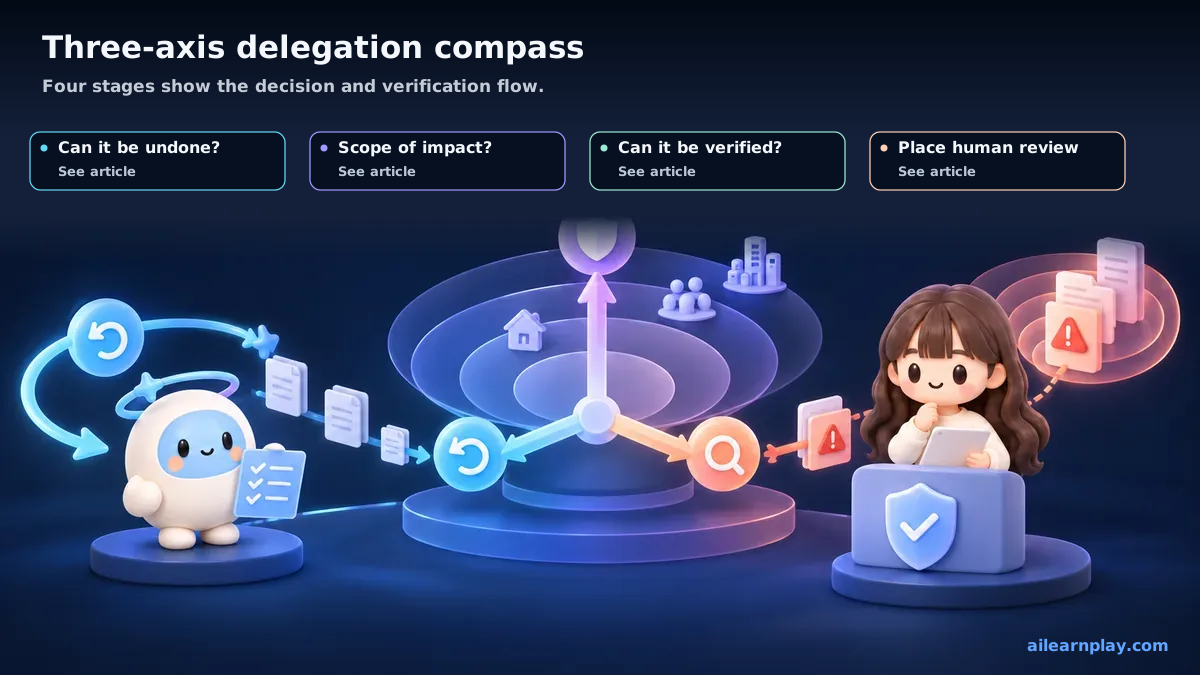
Before giving work to AI, I look first at whether the change can be undone, whether I can see its scope of impact, and whether I can verify the result myself. Without that check, delegating too much leaves me unable to handle problems when they arise. Being too cautious means the work does not move forward.
This article introduces three decision axes I developed through actual work. These axes are my practical decision aid, informed by general risk-management thinking and this site’s operating experience. They are not a standardized official framework.
This article evaluates an individual task before delegation and clarifies what humans still need to verify after the work is delegated.
Reversibility (Can It Be Undone?)
The first question to ask is: “If AI makes a mistake, can I return to the state before the change?”
Reversible → easier to delegate
Changes like updating button color, rewriting a paragraph’s text, or adding a new section are easy to undo. When Git is used, the change history remains, and the change can be reverted if something goes wrong.
Difficult to reverse → verify first
Operations like rewriting the contents of a database, changing a published URL, or sending an email to an external recipient are difficult to undo after the fact. Before delegating these operations, review their content and impact yourself.
Scope of Impact (Where Does the Change Reach?)
The second question is: “How far does this change reach?”
Localized change → easier to delegate
A change like “increase the font size of this heading on this page” affects only one location. Even if there is a problem, it can be caught by checking that one place.
Wide-reaching change → proceed with care
Changes like “restructure the navigation across the entire site,” “modify the authentication system,” or “change styles that are shared across all pages” affect many parts of the site when one location is changed. Before AI makes the change, define how you will verify every affected area.
The wider the scope of impact, the more useful it is to confirm with the AI what will be changed and how before actually making the change.
In addition to reversibility, scope of impact, and ease of verification, I also check confidentiality, permissions, legal or contractual constraints, and whether data will be sent outside the system. When any of these apply, the three axes alone are not enough to treat a task as easy to delegate.
Ease of Verification (How Can the Result Be Confirmed?)
The third question is: “How do I verify what AI has done?”
Verifiable by appearance or behavior → easier to delegate
Design changes, text editing, and link placement can be verified by looking at the display in a browser. A reader can confirm these visible results without specialized implementation knowledge.
Requires specialized knowledge to verify → human must confirm
Security settings, performance optimizations, and connection configurations for external services are cases where correctness is difficult to judge from the display alone. For these tasks, understand the verification method before delegating or involve someone who can verify the result.
Decisions Humans Should Keep
Even when a task is easy to delegate, not every decision should be handed to AI. AI can suggest implementations and options, but humans still decide what to build, which risks are acceptable, and whether the result is ready to publish.
Direction-Setting
Questions like “does this site need this feature,” “what page structure should I use,” and “is this design direction right” need human judgment. AI can suggest implementation options, but the choice of what to adopt belongs to the person responsible for the project.
External Services and Permissions
For connections to Vercel, GitHub, external APIs, and similar services, AI can help organize the steps. The final confirmation of which repository, account, environment variable, and permission is being connected still needs to be done by a human. A mistake in these settings can leave publishing scope or permissions in an unintended state.
Verifying the Published Display
Even if AI changes the code or configuration correctly, humans still need to check whether the published page behaves as intended. Layout differences between desktop and mobile, wrong navigation targets, and wording that changes the intent can be missed if only the file diff is reviewed.
Security-Related Judgment
API keys, passwords, information that should not be public, and settings that send data outside the system should not be judged only from AI’s proposal. AI can investigate and list options, but final confirmation remains a human responsibility.
Tasks That Are Easier to Delegate
The easiest tasks to give AI are those with a clear target, a clear way to undo the change, and a clear verification method.
- Concrete implementation: change a button color, add a link to a paragraph, add a section to a specific page
- Organizing options: compare multiple implementation approaches or configuration options
- Investigating errors: use an error message to identify possible causes and verification steps
Even for these tasks, humans still decide what to execute, which option to adopt, and how the result will be checked.
Compare a UI Change and an Authentication Change Across the Delegation Criteria
“Change the button color on the top page from blue to white”
- Reversibility: high (can be reverted with Git)
- Scope of impact: narrow (one button on one page)
- Ease of verification: high (visible in browser) → Easy to delegate to AI
“Modify the user authentication system”
- Reversibility: low (problems after the change can be complex to address)
- Scope of impact: wide (affects login, registration, and session management)
- Ease of verification: low (security issues cannot be confirmed from the display) → Proceed carefully with a solid understanding of what is being changed
Summary: If Any of the Three Axes Requires Care, Design Human Review First
Using the three axes together with the human decision areas makes the “delegate or not” judgment more concrete.
| Axis | Easier to Delegate | Proceed with Care |
|---|---|---|
| Reversibility | Can be undone | Difficult to undo |
| Scope of Impact | Localized | Wide-reaching |
| Ease of Verification | Visible in browser | Requires specialized knowledge |
When all three fall in the “easier to delegate” column, the task is easier to give AI. If any one of them falls in the “proceed with care” column, I address that axis before moving forward.
The human role in AI-assisted work is not to write every line of code personally. It is to decide what should be built, judge how much to delegate, and verify whether the result matches the intent.
Start with one task you want to delegate and assess its reversibility, scope of impact, and verifiability separately. Legal, security, permission, and publication decisions still require the appropriate owner or specialist even when the three-axis assessment looks manageable.
This article is a general information summary and is not legal advice. Confirm practical decisions with a qualified specialist.