

Copyright and Publication Responsibility in AI-Assisted Writing
What you’ll learn
- Why human creative contribution matters when assessing copyright in AI-generated output
- How AI can support organization and drafting while people retain editorial and publication responsibility
- What to check when disclosing the scope of AI assistance to readers
Separate AI Assistance from Human Publication Responsibility
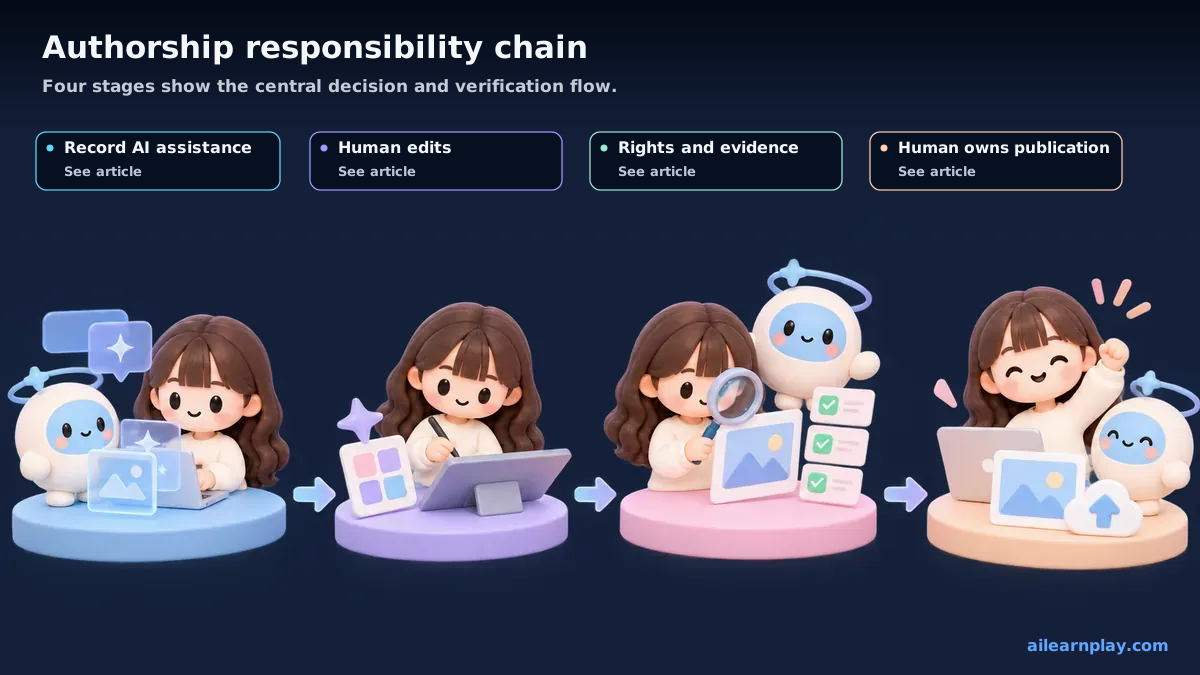
Using AI to organize or draft an article does not transfer fact checking, rights review, editing, or publication responsibility away from people. Copyright analysis and disclosure of AI assistance are separate decisions. On this blog, I disclose the role of AI while retaining human responsibility for direction, editing, fact review, and publication.
By the end of this article, you will have practical criteria for answering “How should AI assistance, copyright review, editorial responsibility, and reader disclosure be separated?” in your own context.
The Boundary I Use for AI Assistance
While writing this blog, there were two questions I wanted to address properly at some point: “Who holds the copyright when AI generates the text?” and “Should I disclose to readers that AI was involved in writing?”
It is a general summary based on Agency for Cultural Affairs materials publicly available as of June 2026, followed by the policy I have adopted for this blog.[1][2][3][4]
A General Summary of AI-Generated Output and Copyright Based on Agency Materials
Japan’s Copyright Act defines a copyrighted work as something that creatively expresses thoughts or feelings. In principle, the author is the person who creates the work. Under certain conditions, a corporation or other organization may be treated as the author of a work made for hire, and copyright can also be transferred by contract.[1]
For AI-generated output, Agency for Cultural Affairs materials organize the issue around human creative intent and creative contribution. Output generated autonomously by AI, without such human contribution, is likely not to qualify as a copyrighted work under Japanese copyright law. The final assessment still depends on the concrete generation process and the nature of human involvement.[1][2]
However, this does not mean “text generated by AI is entirely in the public domain.” According to the Agency for Cultural Affairs, when a human uses AI as a tool and the resulting work reflects creative direction, selection, or editing by that human, copyright for the human’s contribution may be recognized.[1]
What counts as creative human involvement varies by situation. Agency materials are administrative guidance for the current discussion, not a binding legal conclusion for every individual case.[1][2]
How I Use AI on This Blog
The main situations in which I use AI on this blog are as follows.
- Giving instructions about article structure and having a draft generated
- Asking for tone and phrasing adjustments
- Having English translations generated
- Reading through what was generated and revising and adding to it myself
The final article is not simply published AI output. All direction, editing, and fact-checking is handled by me.
This Blog’s Disclosure Policy
I have adopted a policy of not concealing from readers that AI was involved in writing the articles. There are two reasons for this.
The first is a matter of trust with readers. Whether a reader knows that AI contributed to an article affects how they receive it. I want this blog’s use of AI to be something readers can find out about.
The second is a matter of my own integrity. Presenting AI output as my own writing without human review or editing does not accurately describe the production process. On this blog, I disclose the use of AI support and keep final editing and responsibility with a person.
Revisit Copyright Decisions as Laws, Cases, and Official Guidance Change
AI and copyright is an area where technology, law, and practice continue to develop. The Agency for Cultural Affairs continues to publish updated materials, so today’s framework may not remain sufficient in the future.[2][3][4]
The content of this article represents my understanding as of June 2026. If the law changes, new precedents emerge, or official materials are updated, I will revisit this blog’s policy accordingly.[3]
Summary: Record Human Creation, Review, and Publication Responsibility
- AI-generated output without human creative contribution is likely not to qualify as a copyrighted work under the current Agency for Cultural Affairs framework.
- When a human is creatively involved, copyright for that human’s contribution may be recognized.
- On this blog, I use AI as a tool, with all direction, editing, and fact-checking handled by me.
- I follow a policy of disclosing to readers that AI is used.
Both the law and practical norms in this area continue to evolve, and I intend to revisit this periodically.
The first action is to select one planned article and record the human direction, editing, fact review, rights review, and publication approval. A record does not by itself establish copyright or complete rights clearance; individual decisions require current official guidance and qualified advice.
This article is a general information summary and is not legal advice. Confirm practical decisions with a qualified specialist.
References
- Agency for Cultural Affairs (Japan), AIと著作権に関する考え方について, March 2024
- Agency for Cultural Affairs (Japan), AIと著作権Ⅱ
- Agency for Cultural Affairs (Japan), AIと著作権に関するチェックリスト&ガイダンス, July 31, 2024
- Agency for Cultural Affairs (Japan), AIと著作権