

Designing Self-Healing Loops for Coding Agents



What you’ll learn
- The roles of result checks, returned failure information, retries, and human-review boundaries in a self-healing loop
- How to define layered completion and stop conditions instead of relying only on passing tests
- A checklist for separating automation scope by confidentiality and external impact
Verification and Stop Conditions Determine Whether a Loop Can Heal
A self-healing loop lets a coding agent change, verify, diagnose, and retry work until it reaches a completion or stop condition. A change can pass tests while still departing from the intended UI or operating rules, so retries alone do not guarantee quality. Completion checks, stopping rules, permission boundaries, and human handoff must be designed as one operating process.
By the end of this article, you will have practical criteria for answering “Where should a self-healing loop complete, stop, or hand work to a person?” in your own context.
What a Self-Healing Loop Is
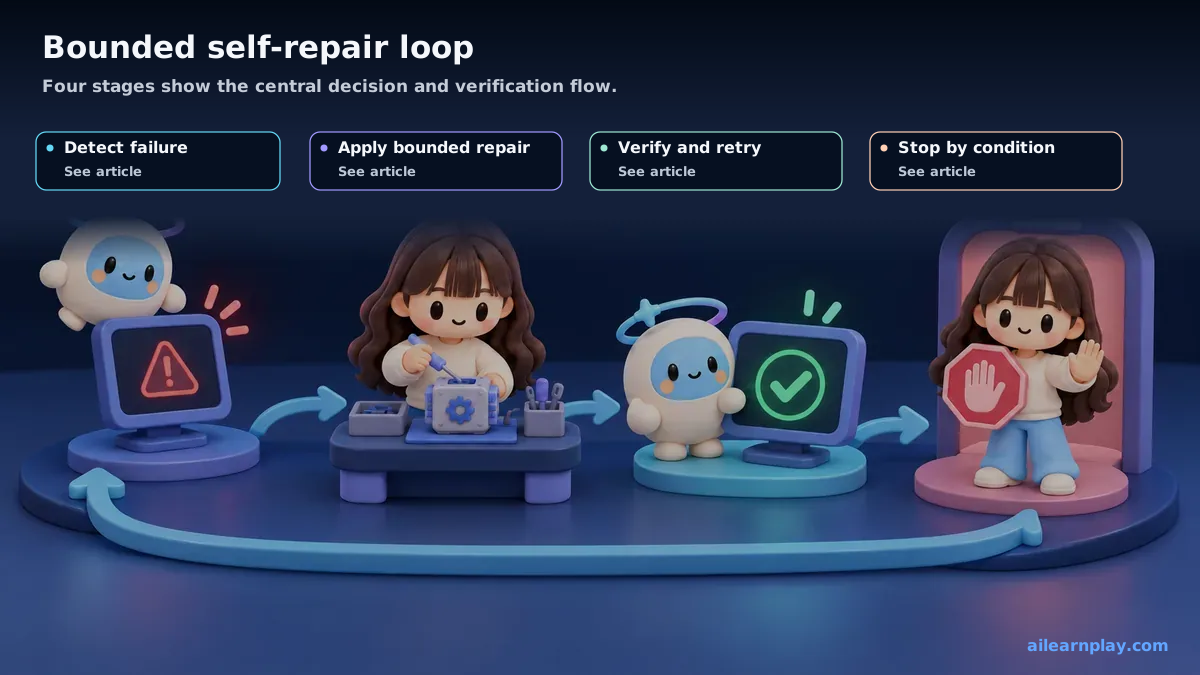
In this article, a self-healing loop is a mechanism in which a coding agent operates within an approved scope, repeatedly changing, verifying, diagnosing, repairing, and re-verifying work until it reaches a completion or stop condition. The goal is not to remove people from the process. It is to automate only the work inside boundaries that people have defined.
The loop has five elements.
- Action: Change code or content.
- Result check: Test behavior, check data format, check document or code structure, compare with requirements, and perform safety checks.
- Returned failure information: Give AI the failure location, expected result, actual result, and steps that reproduce the problem.
- Retry control: Limit the repair scope and attempt count, and stop when the same failure repeats.
- Approval and handoff boundary: Define conditions that the agent must not decide alone, including added permissions, external actions, and specification decisions.
When research on iterative self-improvement from around 2023 was translated into implementations, the emphasis was on repeated generation, self-evaluation, and refinement. By 2026, that pattern is no longer sufficient. The system needs execution results, specifications, checks that differ from the visible tests, and human judgment rather than relying only on the model that produced the answer to evaluate it.
Recent Research Makes Verifier Limitations the Central Problem
The August 2026 research review “Self-Evolving Coding Agents” organizes systems that update AI execution methods, memory, instruction guides, tools, or other components from prior work. It identifies results from actually running the work and information about the whole project as important inputs. It also asks whether those results are reliable, whether the AI adapts too narrowly to evaluation questions, whether it can be maintained safely, and whether cost can be controlled. [1]
“The Verification Horizon” examines the same problem from the verifier side. It describes tests and evaluation rubrics as proxies for human intent rather than intent itself. Verification signals involve tradeoffs among scalability, faithfulness, and robustness, so a fixed verifier is not a one-time solution; it must be updated as generator capabilities and failure patterns change. [2]
“SpecBench” evaluates coding agents using both visible validation tests and held-out tests that combine multiple features. It reports that an implementation can pass the visible suite while still failing to satisfy the user’s intent. [3] A self-healing loop therefore should not define completion only as passing tests that the agent has repeatedly seen and optimized against.
A July 2026 study of coding-agent compliance with repository contribution rules found that the evaluated agents almost never retrieved those rules proactively. Explicit reminders and verifier feedback improved verification and disclosure behavior, but refusal in prohibited repositories and handoff to a person were not reliably enforced. [4] Writing a stop condition in Markdown and enforcing it at runtime are separate design tasks.
Research is also moving toward using failure history for future improvement. “Socratic-SWE” proposes a closed loop that extracts recurring failures and effective repair patterns from prior solving traces (records of the agent’s actions while solving a problem), distills them into skills, and uses execution-validated tasks for the next training cycle. [5] In an operating workflow, this corresponds to retaining failures as candidates for new rules and verifiers instead of consuming them only in the current retry.
These sources include preprints available as of August 8, 2026. I use them as primary sources for verification-design questions, not as guarantees that individual benchmark results will transfer directly to production.
Official Implementations Expand Self-Review into Layered Gates
Official technology-company articles from 2026 show a similar movement from a simple generate-and-retry loop toward layered verification.
- OpenAI’s harness (project rules, tooling, and validation around an agent), described in its Harness Engineering case study, encodes testing, review, feedback handling, and recovery into a repository. Codex can reproduce a bug, implement a fix, validate it by operating the application, respond to reviews, and continue the workflow. The article also states that this autonomy depends heavily on the repository’s specific structure and tooling and should not be assumed to generalize without similar investment. [6]
- Google Gemini CLI Conductor’s Automated Review checks implementation against
plan.mdandspec.md, project guidelines, unit and integration tests, and basic security concerns. The review gate covers the plan and policies as well as passing tests. [7] - GitHub Copilot coding agent performs self-review before opening a pull request and runs code scanning, secret scanning, and dependency vulnerability checks within its workflow before requesting human review. [8]
The three implementations differ in scope, but they share a structure: the agent’s own judgment is not the only completion signal, verification results feed the next repair, and multiple gates run before the work reaches a person.
Split “Tests Pass” into Format, Behavior, Intent, Safety, and Human Judgment
I divide self-healing verification into five layers. Not every task needs every layer; the impact of the change determines which layers apply.
| Layer | Question | Examples |
|---|---|---|
| 1. Format | Can machines read the result? | Data format, document or code structure, configuration fields |
| 2. Behavior | Does it produce the expected input and output? | Tests of individual parts, tests of combined parts, link checks |
| 3. Match with the purpose | Does it satisfy intent beyond tests the AI repeatedly saw? | Completion conditions, tests that earlier behavior remains intact, screen checks, before-and-after review |
| 4. Rules and safety | Is the change permitted to run? | Permissions, change scope, secret information, added components, external data transfer |
| 5. Human judgment | Does any decision remain that machines should not make alone? | Publishing responsibility, current external facts, consistency with first-hand experience, external actions that cannot be undone |
Layer 3 should provide a perspective different from the checks that the repair agent has repeatedly optimized against. Examples include running integration tests outside a unit-test repair loop, reviewing the diff with a procedure separate from the implementation process, or checking a UI change in a real browser. The objective is not to maximize the number of verifiers. It is to select verifiers that do not share the same blind spot.
Define Stop Conditions Together with Success Conditions
Stop the self-healing loop when any of the following conditions is met.
- All relevant checks pass and the diff remains inside the approved scope.
- The same root-cause failure occurs at least twice without a changed repair strategy.
- The attempt, time, or cost limit is reached.
- Each repair expands the diff or breaks a different verifier.
- The task requires a specification decision, current external information, the author’s experience, or another input that cannot be judged mechanically.
- The next step requires added permissions, credentials, a production environment, or an external write.
- Verifiers conflict and a person must decide which result takes priority.
Stopping is not a failure. If the system detects that work has left the autonomous scope and hands a person the diff, passed checks, remaining failure, and next required decision, the loop is operating as designed.
Separate Execution Scope by Confidentiality and External Impact
Mechanical verification does not justify autonomy by itself. Each retry can repeat access and changes, so I separate work by confidentiality and the impact of a change.
| Category | Examples | Recommended handling |
|---|---|---|
| Candidate for AI-only repetition | Public documentation, invented test data, checks on a local computer that cannot affect other environments | Run with limits on change scope and retry count |
| Limited execution after human approval | Reversible changes to non-confidential internal code, checks in an approved environment | Review the before-and-after changes and checking steps, then execute only the authorized scope |
| Outside the loop | Credentials, customer data, access controls, production databases, irreversible external actions | Have AI prepare a plan and decision evidence without confidential data, and have a person execute it |
If the loop requires more information or permissions, the agent should not expand its own authority. It should stop at that point. I describe the separation of planning and execution in more detail in “When to Use /goal and /plan.”
This Site Separates Mechanical Repair from AI Repair
On this site, problems that fixed rules can repair and problems that require contextual judgment do not run in the same loop.
Pair --write with --check in the Repair Layer
npm run dev:check includes scripts that run first with --write for automated repair and then with --check for verification. Topic consistency, public routes for internal links, and learning-time notation follow this pattern. A fixed rule writes the repair, and the immediate check confirms that no residual issue remains. This layer does not need LLM judgment, making the result more reproducible for the same input.
Return Check Results to the Agent in the Verification Layer
Several checking commands detect problems that cannot be fixed by a mechanical process whose result is determined by the input. AI reads the failed file, applicable rule, and evidence inside the project, changes only the necessary locations, and runs the checks again.
At this layer, an error should provide more than a generic failure. It should return the target, expected result, actual state, and relevant rule. When work is interrupted, npm run agent:handoff preserves the current diff and verification state. If failure history exposes a recurring pattern, that pattern becomes a candidate for a skill, rule, or deterministic check rather than remaining an isolated fix.
A Checklist for Introducing a Self-Healing Loop
The following checklist can serve as the completion conditions for one self-healing loop.
Define Scope, Success Criteria, Limits, and Approval Points Before Execution
- Define included and excluded files, services, and environments.
- Specify verification commands and acceptance criteria.
- Add at least one regression or specification check that differs from the visible tests.
- Set attempt, time, and cost limits.
- Define added-permission, external-write, and human-handoff conditions.
Record Cause, Hypothesis, Diff, and Result During Each Attempt
- Record the failure cause and repair hypothesis.
- Limit the change to the smallest scope related to that cause.
- Re-run the same verification conditions and preserve the result.
- Check whether the diff expanded or new warnings appeared.
Confirm Verification, Scope, Residual Risk, and Publication Judgment at Completion
- Pass the required specification, regression, and safety gates as well as functional tests.
- Stay within the approved change scope.
- Summarize executed checks, unverified items, and remaining risks.
- Do not automatically publish, merge, or apply changes that require human judgment.
- Decide whether recurring failures should become a skill, rule, or test.
Summary: Start a Self-Healing Loop with a Small Job and Explicit Stop Conditions
In 2026, a self-healing loop should be treated as an operating process that continuously updates result checks and stop conditions, not simply as a mechanism that gives AI more retries. Passing tests the AI repeatedly saw is necessary, but it does not guarantee alignment with a user’s intent or safe execution.
Start with small jobs whose results can be judged by the same rules every time. Add checks for behavior, match with the purpose, safety rules, and human judgment according to impact. Define in advance when AI cannot complete the loop alone, and make sure it can hand a person the before-and-after changes and checking results when it stops. That foundation turns self-repair from a local retry pattern into a maintainable operating process.
This article provides general information and is not legal advice. Consult a qualified professional for practical decisions.
References
- Hao Zhou et al., Self-Evolving Coding Agents, arXiv preprint, 2026
- Binghai Wang et al., The Verification Horizon: No Silver Bullet for Coding Agent Rewards, arXiv preprint, 2026
- Bingchen Zhao et al., SpecBench: Measuring Reward Hacking in Long-Horizon Coding Agents, arXiv preprint, 2026
- Wenhao Yang et al., A First Look at Coding Agents’ Compliance with AI Contribution Rules in Open-Source Communities, arXiv preprint, 2026
- Chuan Xiao et al., Socratic-SWE: Self-Evolving Coding Agents via Trace-Derived Agent Skills, arXiv preprint, 2026
- OpenAI, Harness engineering: leveraging Codex in an agent-first world, 2026
- Google Developers Blog, Conductor Update: Introducing Automated Reviews, 2026
- GitHub, What’s new with GitHub Copilot coding agent, 2026
For the latest release and update details, check the official sites and documentation.