

What Is Generative UI? Architecture, Use Cases, and Constraints

What you’ll learn
- How Generative UI differs from text responses and turns tool calls into interfaces
- Current use cases in the Vercel AI SDK and Claude
- The constraints, safety concerns, and operating decisions to review before adopting it in a product
Generative UI Creates Interactive Interfaces Inside a Conversation
Generative UI builds an AI response as an interactive interface—such as buttons, inputs, or charts—instead of returning only prose. Development frameworks such as the Vercel AI SDK and product features such as Claude Artifacts differ in how much they generate and what users must verify. Starting with one bounded interface component makes it easier to measure quality and verification cost before expanding the approach.
By the end of this article, you will have practical criteria for answering “Where should a team first try Generative UI, and which constraints should it check first?” in your own context.
What is Generative UI
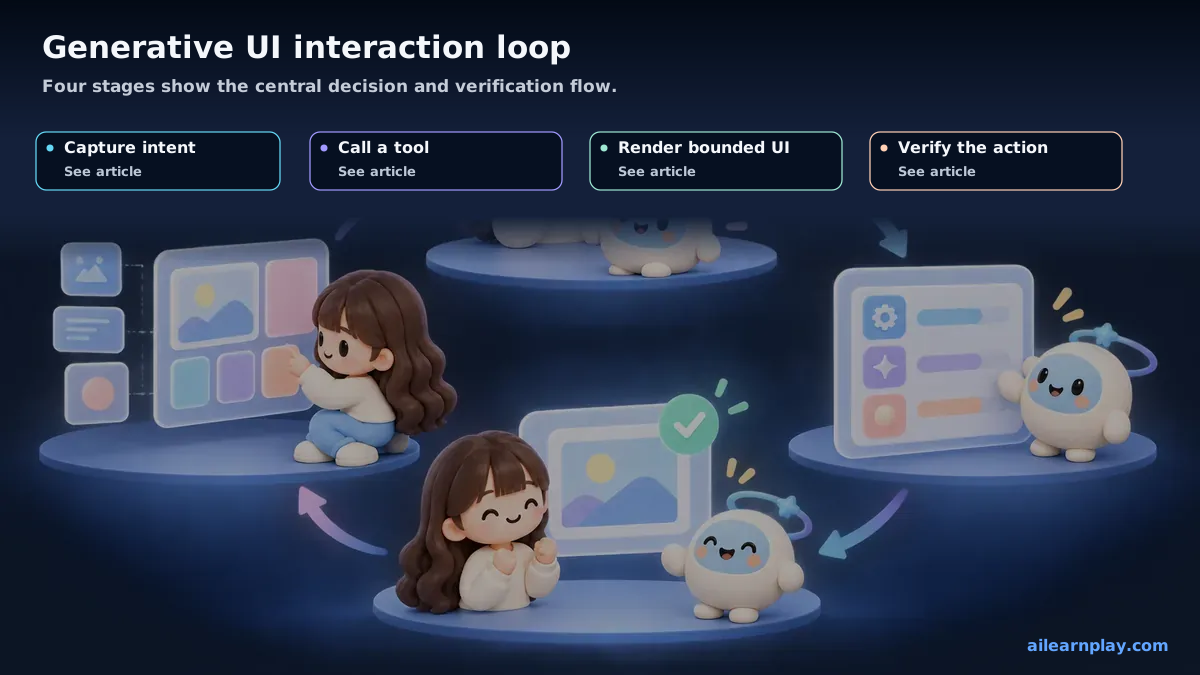
Generative UI is a mechanism by which a large language model (LLM) generates not just text but an operable user interface itself. The Vercel AI SDK’s official documentation describes Generative UI as “the process of connecting the results of a tool call (a function the model invokes to perform a specific task) to a React component (an interface part).” [1]
Traditional chatbots centered on answering questions with text. In Generative UI, asking about the weather might display a weather card with temperature and precipitation, and asking to book something might bring up a calendar selection screen—the answer itself becomes the UI.
As I understand it, the key point of this approach is that the model can choose the form of the response. It moves toward the model deciding, from the conversational context, when to answer with text and when to let the user operate a UI.
How it works: connecting tool calls to components
At the core of Generative UI are the “tools” you hand to the model. A tool is a function the model can invoke to perform a specific task, and the model decides from the conversational context when and which tool to use. [1]
In the weather-tool example shown in the Vercel AI SDK’s official documentation, the flow works as follows.
- Provide the model with a prompt and a list of tools
- The model decides whether to call a tool
- The tool runs and returns data (such as weather data)
- That data is passed to a dedicated React component (such as a weather card) for display
What matters here is that the tool result ties to a component designed specifically for that data, rather than a generic text display. It can also handle state-dependent rendering, such as switching the display between loading and complete. [1]
The current Vercel AI SDK UI documentation describes a structure that uses streamText and useChat to handle tool execution state and results as parts of a message. [1] Separately, streamUI, which streams components with React Server Components (a React mechanism that renders on the server and sends the result to the client), is documented as an experimental API in AI SDK RSC. [2]
Generative UI Appears in Development Frameworks and AI Chat Products
Based on the sources reviewed, the situations where Generative UI is used today can be broadly organized into two categories: “implementation through development frameworks” and “integration into AI chat products.”
Implementation in a development framework (Vercel AI SDK)
Vercel explains in its official blog that it introduced Generative UI support in AI SDK 3.0. [3] This lets developers render tool-call results as their own React components inside a chat app.
The representative uses cited in the official documentation and published examples are as follows.
- Parts that present data visually, such as weather cards
- Interactive charts and dashboards using libraries such as Recharts (a React charting library)
- Screens involving operations, such as bookings or search results
Vercel’s related documentation describes surrounding capabilities for AI agents and applications: Workflows for pausing and resuming long-running logic, Sandbox (an isolated, secure execution environment) for running user-generated code or AI agent output, and AI Elements, a UI component set for AI applications. [4][5][6] I read these as capabilities that fit a direction where Generative UI becomes part of continuously running applications, not only one-off displays.
Claude Artifacts and Claude Design Generate Interactive Output in Chat
Anthropic provides a mechanism by which Claude generates interactive applications within a conversation. In Artifacts, substantial standalone content can appear in a dedicated window separate from the main chat, and Anthropic lists code, single-page HTML websites, and interactive React components as examples. [7]
Anthropic’s official guidance describes artifacts as shareable apps, tools, or content, and explains that artifacts can also run as apps with embedded AI capabilities. [7] The difference from before is that you receive a running app on the spot, not just an answer.
Anthropic also released Claude Design as an Anthropic Labs preview product on April 17, 2026. It lets you create visual deliverables such as designs, prototypes, and slides through conversation with Claude; it is described as powered by Claude Opus 4.7 and offered as a research preview. Finished work is packaged into a form you can hand off to Claude Code. [8]
In a separate article, “Using Claude Design at the right stage,” I organize which stage to use Claude Design in. From the Generative UI angle, Claude Design can be positioned as an example of applying the “generate visual deliverables from conversation” flow to the design process.
Constraints and cautions to check before adoption
When considering Generative UI, I think there are several constraints worth checking at present.
First, generating UI carries a corresponding processing cost. Because it combines tool calls with component rendering, it adds design and verification effort compared with a simple text response. Where you draw the line between which responses become UI and which stay as text directly affects the implementation burden.
Second, the quality and consistency of the generated UI. Because the model chooses the UI according to the situation, unexpected displays or inconsistent design can occur. A method that binds results to components prepared in advance should keep this variability easier to contain.
Third, many features are still developing. Claude Design is described as a research preview, and Vercel’s Workflows, Sandbox, and AI Elements each require their own review of availability and limits. [4][5][6][8] Because specifications and availability may change, I recommend checking the latest information on target plans, limits, and pricing before putting anything into production.
Generative UI May Expand Beyond Display Components into Apps That Act on External Services
Going forward, I think it is likely that Generative UI will expand its role from a supplementary display within chat to a primary means of generating applications. This is a prediction, not an established fact.
I can point to two developments as grounds. One is that Artifacts can connect to external services through the Model Context Protocol (MCP, a standard for connecting to external data and tools), enabling interactive applications that read from and write to tools such as Asana, Google Calendar, and Slack. [7] They are moving from parts that only display toward apps that actually retrieve and operate on data. The other is that Vercel provides official capabilities for long-running logic and isolated code execution, which I read as a sign that Generative UI is beginning to be designed as part of continuously running systems rather than one-off rendering. [4][5]
At the same time, I do not think the point of humans designing UI disappears. Quality assurance for generated UI, accessibility (design usable by everyone), and consistency with the brand remain areas for human judgment. My view is that Generative UI will settle in a direction that automates “assembling prepared parts according to the situation” more than “building UI from scratch.”
Summary: Test Generative UI Quality and Verification Cost on One Bounded Component
Generative UI is a mechanism by which an LLM generates the UI itself rather than text, implemented by connecting tool-call results to dedicated components. It is currently being implemented both in development frameworks such as the Vercel AI SDK and in AI chat products such as Claude Artifacts and Claude Design. Because availability and limits can change across the surrounding product set, if you are considering it I recommend checking in the following order.
- Identify which responses in your product are worth turning into UI
- Separate the parts you leave to generation from the parts where you prepare components in advance
- Check the latest information on target plans, limits, and pricing before production adoption
Starting with narrowly scoped parts such as weather cards or charts, confirming the UI quality and verification cost, and then widening the scope is, I think, the realistic approach at present.
References
- Vercel, AI SDK UI: Generative User Interfaces, 2026
- Vercel, AI SDK RSC: Streaming React Components, 2026
- Vercel, Introducing AI SDK 3.0 with Generative UI support, March 1, 2024
- Vercel, Vercel Workflows, June 17, 2026
- Vercel, Vercel Sandbox, June 30, 2026
- Vercel, AI Elements, 2026
- Anthropic, What are artifacts and how do I use them?, 2026
- Anthropic, Introducing Claude Design by Anthropic Labs, April 17, 2026
For the latest releases and updates, check the official website and official documentation.