

AI Article Citation Rules: Separating Experience from External Facts



What you’ll learn
- Criteria for deciding when external facts, author experience, and opinion need citations
- Why accuracy-focused docs and experience-based blog posts use different citation rules
- How to rewrite a sentence that mixes experience and external facts so its evidence is traceable
Separate Citation Rules for Experience and External Facts
Citation requirements follow what supports a claim, not the content label alone. External specifications, numbers, and legal facts need traceable evidence, while confirmed author experience and clearly framed opinion do not receive the same treatment. When one sentence mixes an external fact with an opinion, separate them and place the citation directly after the claim it supports.
By the end of this article, you will have practical criteria for answering “Which claims need numbered citations, and which experiences or opinions should be framed as the author’s perspective?” in your own context.
External Facts, Numbers, and Legal Claims Need Traceable Citations
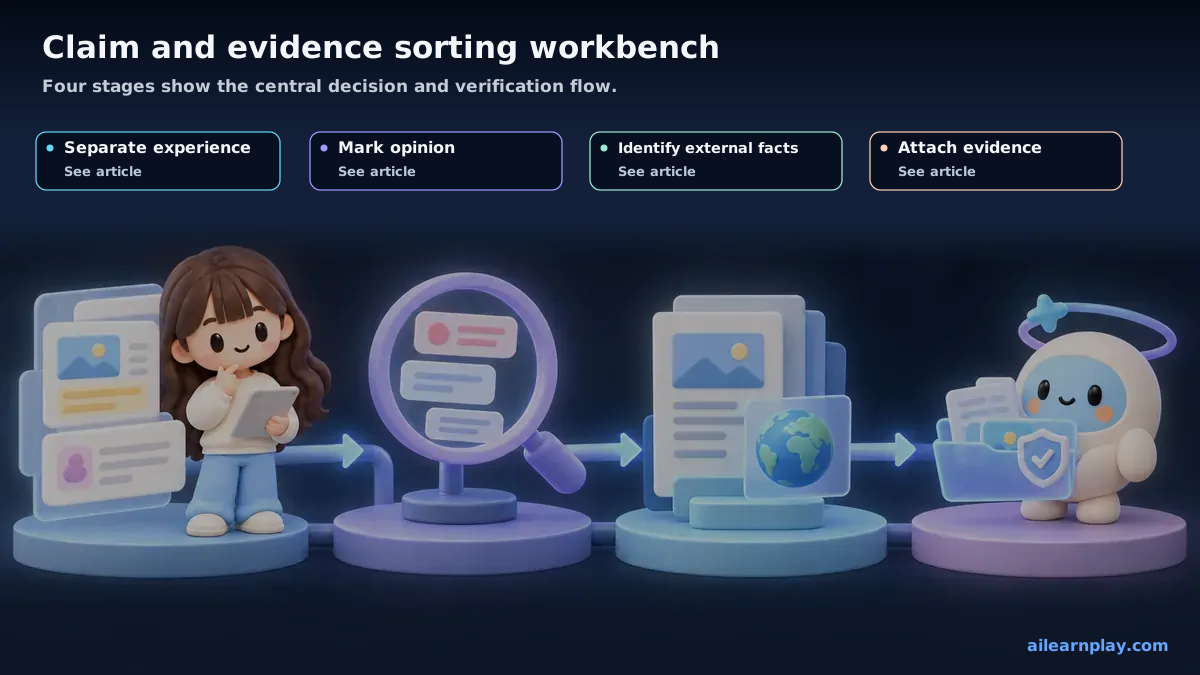
When writing a blog with AI support, personal experience, external product specifications, general claims, and judgment criteria can easily end up in the same paragraph. This article organizes practical rules for separating what can be written as experience from what needs citation as an external fact.
I keep the complete review sequence in the twelve-step review workflow. This article covers only the decision about which claims require citations.
Citation Rules for Documentation Articles
Documentation articles explain official product information, specifications, and procedures. When I write “according to the official specification, this works as follows” or “the version 3.0 release notes state that…,” I need to provide the supporting evidence as a reference.
Information that requires citation in documentation articles:
- Descriptions of specifications or features based on official documentation
- External statistics or survey data
- Contents of laws or regulations
- Factual information such as version numbers or release dates
Because accuracy is the top priority in documentation articles, any time external facts serve as the basis for a claim, references are included.
Citation Rules for Blog Articles
Blog articles are centered on the author’s experiences, thoughts, and interpretations. Experience, opinion, and interpretation are based on the author’s own observations and do not require citation.
Information that does not require citation in blog articles:
- Observations from things I actually tried
- The reasoning behind my judgments and choices
- My thoughts, opinions, and speculation
However, even in blog articles, when external facts serve as the basis for a claim, citation is required. Statements such as “a survey found that X percent…” or “as of version X, the specification is…” require references even in blog articles.
How to Rewrite Sentences Where Experience and Facts Are Mixed
The most difficult cases for citation judgment are when personal experience and external facts coexist within a single sentence.
A mixed example:
“When I first started using Claude, there were times when I could not process long passages in one go because of context length limitations. In the current version, the amount of context that can be handled has expanded considerably.”
This sentence contains both an experience element — “there were times when I could not process” — and a specification-based factual element — “the current version has expanded considerably.” The experience portion does not require citation, but when writing as specification information, a reference is required.
Rewritten example:
“When I first started using Claude, there were situations where I felt constraints when handling long contexts. (A citation number would go here if writing this as a specification fact.)”
By separating the experience portion (“I felt constraints”) from the specification information, it becomes clear which basis each part of the writing comes from.
Why Citation Is Difficult in Mixed Articles
The reason citation judgment is difficult in articles where experience and facts coexist is that a situation easily arises where “I think I’m writing from experience, but I’m actually relying on external information.”
For example, “the setup was complex and took a lot of time” can be written as experience. But “the setup requires the following steps” is a description based on the service’s specifications, which requires citation. Even when an author thinks they wrote something as experience, the content may actually be an explanation of external specifications.
A useful way to check for this is to ask: “Is the basis for this claim the author’s own observation, or information from an outside source?” If the basis is external information, citation is required. If it is based on the author’s own observation, citation is not required.
Summary: Separate Experience, Opinion, and External Facts Before Assigning Citations
The reason citation rules differ between Doc and Blog comes down to the different nature of each type. Doc aims to accurately convey external facts, so citations are broadly required. Blog is centered on the author’s experience and interpretation, but sections that rely on external facts as their basis still require citation. Keeping the question “Is the basis for this claim the author’s own observation, or information from an outside source?” in mind helps clarify when citation is needed.
Start with one central claim and classify it as author observation, interpretation, or external fact. For legal, regulatory, or changing product specifications, do not use this general framework alone to approve publication; prioritize primary sources and the appropriate specialist review.
This article is a general information summary and is not legal advice. Confirm practical decisions with a qualified specialist.