

Palantir FDE, DS, and GTM: Consultants vs. Onsite Engineers

What you’ll learn
- The responsibilities of FDE, Deployment Strategist, and GTM at Palantir and how they work together
- The decision criteria that separate FDE teams from consulting, onsite engineering, and contract development
- AI deployment roles and services visible globally and in Japan as of August 2026
- The risks of adopting the FDE label without product feedback, sufficient authority, or knowledge transfer
- A decision table for reviewing an internal team or external partner
FDE, DS, and GTM divide responsibility for returning field learning to the product and deployment model
FDE, DS, and GTM divide the work required to turn a field problem into a production system and return what the team learns to product development and the next deployment. A Forward Deployed Engineer (FDE) primarily owns technical implementation. A Deployment Strategist (DS) owns the business problem and adoption. Go-to-market (GTM) spans sales, partnerships, and deployment methods rather than naming one role parallel to FDE and DS.
By the end of this article, you will have practical criteria for answering “How should FDE, DS, and GTM differ from consultants and onsite engineers, and under what conditions should an organization adopt the model?” in your own context.
Palantir defines FDE as a product-development method as well as a role
Palantir’s Architecture Center describes Forward Deployed Engineering as a method that moves engineers closer to the problem and connects them with core product teams so field feedback becomes product capability.[1] The work does not end with a customer-specific deployment. Learning from one environment needs a route back into features that can serve many environments.
Palantir calls the engineer responsible for technical implementation in this model a Forward Deployed Software Engineer, or FDSE. The job description says the role understands a customer’s most important problems and designs and implements data-based solutions. Its scope includes system architecture, large-scale data work, operational applications, executive conversations, and team strategy. A small team owns the path from prototype to production, and writing code directly is part of the job.[2]
Because Palantir presents FDE as something broader than a noun for an engineer dispatched to the field, this article uses FDE for a person and the FDE operating model for the method. An onsite work arrangement alone does not create that operating model.
The underlying Ontology architecture—bringing operational objects, relationships, actions, and permissions into one layer—is covered in the first article in this series, Palantir Ontology as an operational layer.
A Deployment Strategist unifies the business problem, user behavior, and outcomes into one deployment plan
A Deployment Strategist, or DS, identifies what needs to be solved so data can change real operational action. Palantir’s job description includes discovering the questions users need to answer, finding the required data, creating a reliable way to prepare and update data with FDEs, designing user workflows, training users, and communicating with executives.[3]
The boundary with FDE is not technical versus nontechnical. Palantir also asks DS candidates for experience using programming and data-analysis tools.[3] The difference is what each role is primarily responsible for. FDE goes deep into production architecture and code; DS goes deep into the following questions:
- Which operational decision creates value when it changes?
- Who uses the system, at what moment, and where does the current workflow stop?
- Which usage, business metric, or behavior change demonstrates success?
- How should field requirements return to product improvement and the next deployment?
Replacing DS with generic project management removes responsibility for observing user behavior and revising the problem. Assigning all business discovery and alignment to FDE, however, can leave too little time for both implementation and adoption.
GTM connects bootcamps, sales, partners, and expansion
GTM is not one specific role. It is the activity of choosing which customer problems to address, showing value quickly, and converting that proof into a contract and broader usage. Palantir’s 2025 annual report identifies AIP Bootcamps—short working sessions using Palantir’s Artificial Intelligence Platform—where customers use real data to build workflows in days, along with developer entry points, direct customer teams, and industry partners as parts of its market expansion model.[4]
Palantir’s AIP Bootcamp description says customers and Palantir engineers work together to apply AI to important operations, establish initial use cases, and train users.[5] This is not merely a product demonstration. It is a GTM motion that tests technical implementation and the user’s workflow at the same time.
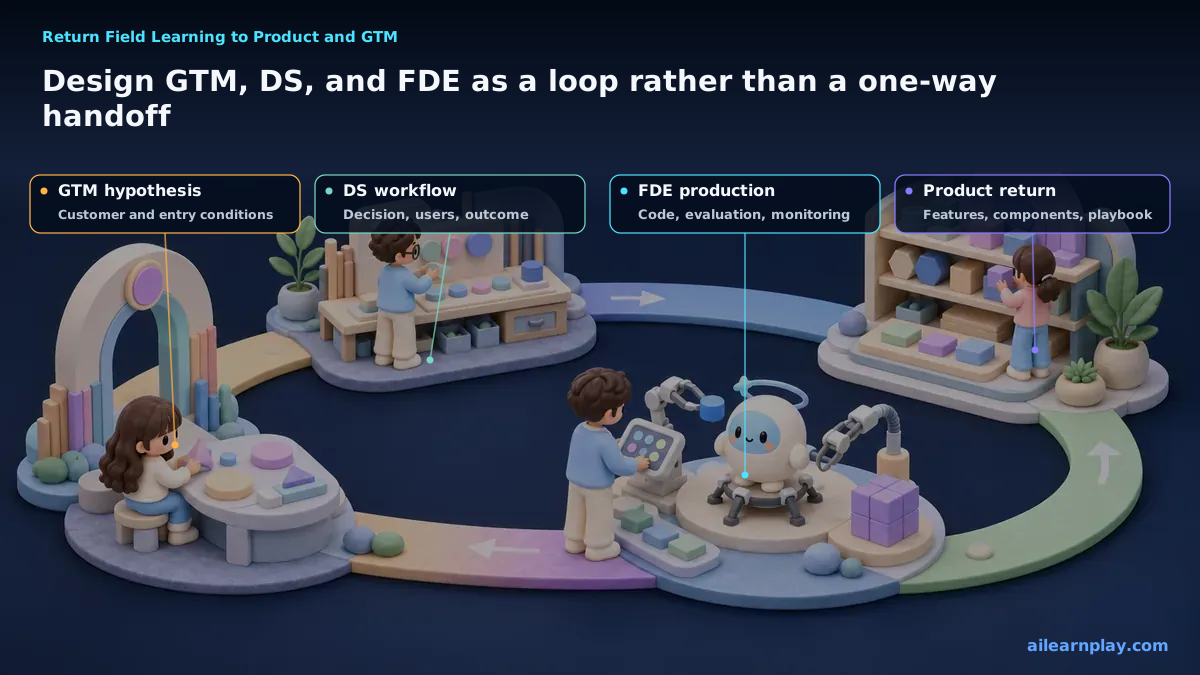
The relationship among FDE, DS, and GTM is not a one-way handoff from sales to delivery. GTM frames a value hypothesis and target customer, DS makes the field problem and adoption conditions concrete, and FDE implements the production system. Usage results return through DS and FDE to product, research, and GTM, updating features, evaluation methods, deployment practices, and target markets.
Consultants, onsite engineers, and FDE teams differ in accountability and where learning returns
Consulting and onsite engineering vary widely by company, contract, and engagement. A title alone cannot rank one model above another. The useful comparison is the primary deliverable, responsibility for implementation, and the destination of field learning.
| Model | Primarily owns | Typical deliverables | Relationship to implementation and operations | Where field learning returns |
|---|---|---|---|---|
| Strategy or operations consulting | Problem framing, options, transformation plan, and alignment | Analysis, recommendations, operating design, and execution plan | May hand implementation to another team or continue through execution | The customer’s transformation program and the firm’s methodology |
| Onsite engineer or development support carried out within the customer’s direction and contracted scope | Contracted development, maintenance, operations, and support | Designs, code, configuration, and operational records | Often continues within the customer’s reporting line and contracted scope | The customer system and the provider’s knowledge base |
| FDE operating model | A production system that produces an operational outcome and a completed deployment | Working workflow, code, evaluations, monitoring, and reusable components | A small team iterates from discovery through production and adoption | The customer’s operation plus the vendor’s product, evaluation method, and deployment motion |
The distinctive feature of FDE is not packing consultant and engineer duties into one person. It closes three activities inside the same short iteration:
- Revise the field problem and success conditions
- Implement a production-capable system and measure actual usage
- Convert customer-specific learning into a product or reusable deployment component
Without the third activity, even excellent customer-facing engineering is hard to scale as a product business merely by renaming it FDE. Conversely, an FDE operating model can work without continuous colocation when a team iterates closely with users and returns learning to the product.
Multiple AI companies use roles that connect experiments to production accountability
As of August 2026, AI companies beyond Palantir also list roles with a similar scope of responsibility. OpenAI’s Tokyo FDE role owns discovery, technical scoping, architecture, implementation, and production rollout, then returns adoption and evaluation findings to product and model roadmaps.[6] Anthropic lists FDE positions in the United States and Europe and Applied AI Engineer and Applied AI Architect positions in Tokyo. The names differ, but the roles focus on customer AI implementation.[7]
The content of the role is changing for AI. Palantir’s Forward Deployed AI Engineer owns customer generative-AI strategy and implementation, moves workflows that use AI trained on large amounts of text to generate and process language (a large language model, or LLM) into production, and returns field learning to AIP.[8] Model evaluation, controls for failure, and the user experience of generative AI now sit alongside data integration and operational application development.
Implementation itself is also shifting toward AI. In March 2026, Palantir made a product capability called AI FDE generally available. From everyday-language instructions, it can prepare data, edit an Ontology that represents operational objects and actions, and create reusable processing logic called Functions.[9] This does not simply eliminate the human FDE. It is more useful to expect routine construction to shrink while problem selection, test cases and expected outcomes, permissions, exception handling, user agreement, and reuse decisions become more important.
This demand exists because using AI and scaling it are different achievements. McKinsey’s 2025 survey found that nearly every respondent organization used AI, while about two-thirds had not begun scaling AI across the enterprise.[10] The role of an FDE team is not to introduce a model, but to combine existing data, workflows, security constraints, and user behavior into one production change.
Japan has FDE openings and service launches, alongside a risk of relabeling existing work
As of August 30, 2026, Palantir lists a Japan Government FDSE role and commercial and government DS roles in Tokyo.[11] OpenAI also lists a Tokyo FDE role requiring both Japanese and English, customer-facing technical deployment experience, production code, and generative-AI systems.[6] The trend extends beyond Japanese offices of global companies. LTS announced an FDE service in July 2026 that combines consultants with AI and software engineers from strategy through production operations, and Hmcomm announced the launch of an FDE business in May 2026.[12][13]
IPA’s DX Trends 2025 reports shortages across every category of AI talent in Japan. It also reports that 40.7% of companies said they did not need in-house developers capable of implementing AI-enabled software and systems. Fewer than half were proactively adopting generative AI, and workflow-level adoption remained below the United States and Germany.[14]
This creates two challenges. First, bringing in an external FDE while keeping AI developers outside the internal talent model prevents business units from taking ownership of evaluation criteria and operations. Second, renaming existing onsite support as FDE does not automatically add product feedback, reusable components, or a condition for customer self-sufficiency. An FDE program in Japan needs to specify what the customer’s business owner and internal engineers will learn, and when they will take over operations, rather than focus only on the number of external people.
FDE teams need design controls for bespoke work, insufficient authority, and concentration of knowledge
Customer proximity also creates characteristic risks:
- Bespoke work expands: Implementing every request directly turns a product company into a contract-development business that grows mainly by adding people and time. Each request needs a decision: return it to the product, isolate it as customer-specific, or decline it.
- Outcome accountability does not match change authority: An FDE can be accountable for results while authority over data, workflows, approvals, and user allocation remains with the customer. Both parties need named owners and stop conditions.
- GTM speed conflicts with production quality: A short bootcamp may show value, but production is incomplete without security review, test cases and expected outcomes, monitoring, incident response, and training.
- A few generalists become critical dependencies: When customer knowledge, architecture, implementation, and communication live in one person, the reasoning disappears when that person leaves. Pair FDE and DS, then document decisions for business, product, and security owners.
- Role boundaries and evaluation become ambiguous: If the organization does not choose how to balance revenue, delivery dates, code output, and adoption, priorities between GTM and production responsibility will change from one engagement to another.
Palantir’s adoption guide describes a mature state in which the customer’s internal team manages daily operations and develops new workflows, while Palantir engineers provide help when needed.[15] Completion should therefore include customer self-sufficiency, not indefinite FDE presence.
Summary: Five questions reveal whether a team has an FDE operating model
Before adopting FDE as a title, complete the following table for each engagement. Concrete answers to all five questions support an FDE operating model. If entries remain blank, explicitly defining the existing consulting, contract development, onsite engineering, or customer-success role will set expectations more accurately.
| Question | Required answer for an FDE operating model | Sign of a renamed existing role |
|---|---|---|
| Business outcome | Operational decision, user, the value measured before the change, and measurement period | Stops at “adopt AI” or “build a demo” |
| Production responsibility | Named owners from prototype through production, evaluation, monitoring, and incident response | Hands implementation to another team without sufficient transfer |
| Customer authority | Owner who can decide data use, workflow changes, approvals, and user training | External FDE carries outcome accountability alone |
| Product return | Meeting and owner for returning features, shared components, test cases and expected outcomes, and deployment practices | Customer-specific code remains inside the engagement |
| Self-sufficiency | Evidence and date for the internal team to take over operations and improvement | Continuing value is measured only in onsite headcount and duration |
The first action is to take one AI use case, create columns for GTM, DS, FDE, the customer’s business owner, and the product owner, and state what each will leave behind after 90 days. When the business cannot return field learning to a product, the customer has no owner for change, or bespoke development is the core recurring-revenue model, clearer responsibility for existing roles is more useful than the FDE label.
The skills model and engagement-based development program come next in the series: Developing Palantir-style AI talent in 90 days.
References
- Palantir, Overview — Architecture Center
- Palantir, Forward Deployed Software Engineer — Japan Government
- Palantir, Deployment Strategist
- Palantir Technologies Inc., 2025 Annual Report, February 2026
- Palantir, Q4 2023 Business Update — AIP Bootcamps, February 2024
- OpenAI, Forward Deployed Engineer — Tokyo
- Anthropic, Jobs
- Palantir, Forward Deployed AI Engineer
- Palantir, March 2026 Announcements — AI FDE is now generally available, March 12, 2026
- McKinsey & Company, The state of AI in 2025: Agents, innovation, and transformation, November 5, 2025
- Palantir, Open positions in Tokyo, Japan
- LTS, Full-scale FDE service launch for contact centers and BPO, July 27, 2026
- Hmcomm, Announcement of the next-generation AI implementation business “FDE”, May 15, 2026
- IPA, DX Trends 2025, June 2025
- Palantir, Foundry adoption — Phase 4: Hypergrowth
Job openings, product capabilities, and availability by region can change. Check each company’s official information before making a deployment or hiring decision.