

What Is Vibe Coding? Capabilities and Human Review Boundaries

What you’ll learn
- The narrow meaning of Vibe Coding and how it differs from broader AI-assisted development
- Why a disposable prototype can prioritize speed while production use requires wider review
- How to choose AI’s role from the purpose, possible impact, and available verification
Vibe Coding Means Building Through Conversation Without Closely Reading the Code
Vibe Coding is a way to tell an AI what to build in everyday language and keep revising from the visible result without closely reading the generated code. It does not mean every kind of development that uses AI. In its narrower meaning, the person deliberately lets go of understanding the code.
By the end of this article, you will have practical criteria for answering “How does Vibe Coding differ from broader AI-assisted development, and how should review change between a prototype and production” in your own context.
Human Understanding and Review Separate Vibe Coding from Broader AI Assistance
The expression spread after Andrej Karpathy used it in early 2025.[1] People can ask an AI to “make a signup page” or “move to the next screen when this button is pressed” and receive working code. Research also discusses building software through conversation in connection with Vibe Coding.[2]
The terminology still matters. This article calls the approach Vibe Coding when a person mostly judges visible behavior and rarely reads the code. It uses the broader term “AI-assisted development” when people retain review of the design, code, and test results.
| Approach | What people mainly inspect | Suitable situation | Problem that may remain |
|---|---|---|---|
| Vibe Coding | Visible screens and behavior | Disposable prototypes and personal experiments | Hidden defects, security problems, and a structure that is hard to change |
| AI-assisted development | Purpose, design, code, and test results | Sites and business functions meant to continue | Review requires time and technical knowledge |
| Human-led development | Detailed design and implementation | Systems with strict safety or performance needs | More production time and staffing |
The important question is not the label. It is which understanding and responsibility people retain.
Inspect Visible Behavior in a Prototype and Hidden Effects Before Production
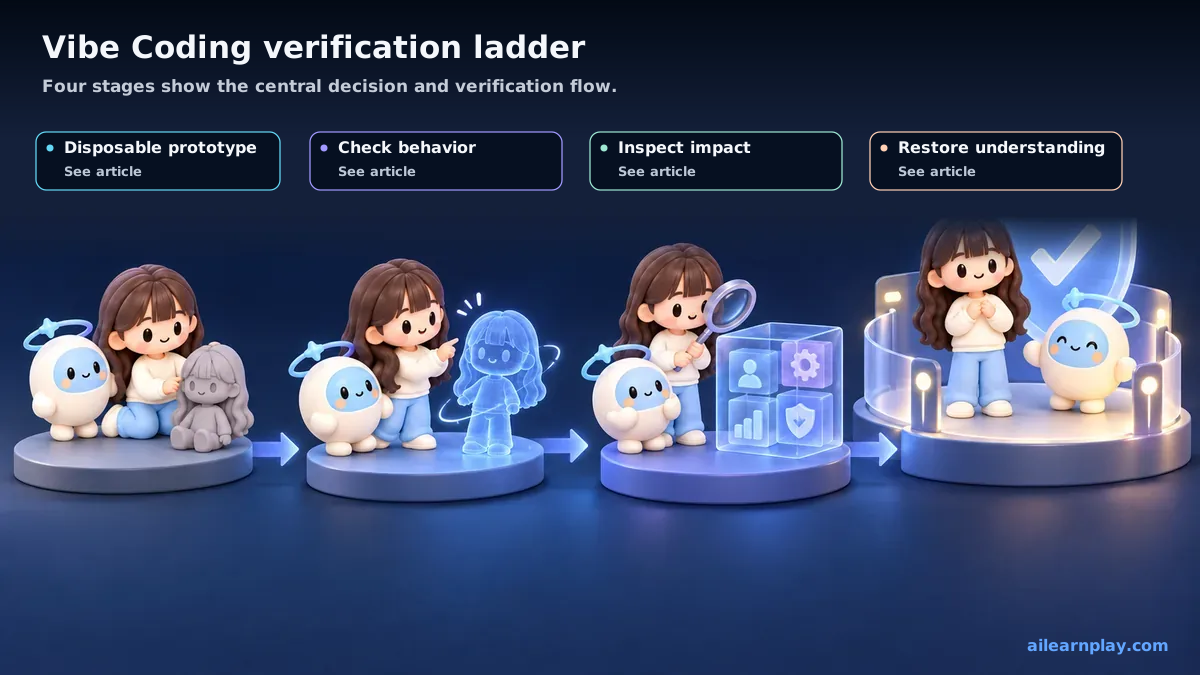
A prototype is a temporary creation used to learn whether an idea may be useful. If it can be discarded, does not handle personal information, and will not be published, Vibe Coding can be useful for trying a screen or interaction.
Production use changes the review. A working screen does not show whether one person’s information can be seen by someone else, a calculation is wrong, the service fails under heavy use, or a future maintainer can repair it. Before releasing AI-generated work, people should review:
- Purpose: whose problem the product solves
- Correctness: whether it handles both expected and mistaken input safely
- Information handling: whether it stores or sends personal and confidential information unnecessarily
- Maintenance: whether a problem can be investigated and the change can be reversed
- Responsibility: who approves release and who responds to a problem
A Useful Instruction States the Purpose and Passing Result, Not Only the Appearance
“Make it look cool” asks the AI to guess a preference. A clearer instruction is “Design a phone screen where a high-school student can find the signup instructions within 30 seconds.” It names the user, purpose, and passing result.
Four fields make results easier to compare without requiring technical knowledge:
- User: who will use it
- Purpose: what that person should be able to do
- Allowed change: which screens, words, or behavior may change
- Passing result: which action to try and what should happen
Specify colors or text size only when they matter. Deciding the purpose first lets a person judge whether the AI’s proposal serves it.
Choose AI’s Role from the Impact of Failure and the Available Verification
Use this table to choose a first use case.
| Question | If yes | If no |
|---|---|---|
| Can a failed result be discarded and rebuilt? | A prototype is easier to justify | Arrange detailed review first |
| Does it avoid personal information, payments, and contracts? | The possible impact is smaller | Require a specialist and accountable owner |
| Can you write the passing result in your own words? | You can compare the result | Clarify the purpose and conditions before building |
| Can you stop the work and restore the earlier state? | You can test on a small scale | Do not publish until recovery is planned |
A serious “no” means the work has exceeded the safe scope of code-unreviewed Vibe Coding. It does not mean avoiding AI. It is a signal to switch to AI-assisted development with human design and verification.
Summary: Start with a Disposable Prototype and Restore Human Understanding for Production
The first step is to choose a small prototype that handles no personal information or payments and can be discarded if it fails. Write the user, purpose, and passing result before asking the AI, then operate the result yourself. If the goal is public release or continued use, do not keep the code-unreviewed approach; involve people who can assess the design, safety, and test results.
References
- Merriam-Webster, vibe coding, Slang & Trending, updated June 4, 2026
- Advait Sarkar and Ian Drosos, Vibe coding: programming through conversation with artificial intelligence, arXiv, 2025