

Developing Palantir-Style AI Talent: An FDE/DS/GTM Playbook

What you’ll learn
- Shared foundations and role-specific depth for FDE, DS, and GTM
- A 90-day applied program that moves from a prototype to production using a real operational problem
- An assessment rubric that covers adoption, safe-use rules and responsibilities, and reuse in addition to AI quality
- A method for combining consultants, engineers, data specialists, and business staff
- Stop conditions for classroom-only, person-dependent, or fully outsourced development
Develop a small team that can carry field work through production
Palantir-style talent development builds a team that can choose a field problem, create a production-capable system, and return usage findings to the product and the next deployment. A Forward Deployed Engineer (FDE) primarily owns technical implementation. A Deployment Strategist (DS) owns the business problem and adoption, while go-to-market (GTM) work covers sales, partnerships, and deployment methods. Requiring one person to master all three areas makes both hiring and development difficult. Combine people with shared foundations and give each person depth in technical implementation, operational change, or market deployment.
The responsibilities of the three roles and their differences from consulting and onsite engineering are covered first in the FDE, DS, and GTM comparison.
By the end of this article, you will have practical criteria for answering “How can an organization develop and evaluate FDE, DS, and GTM capabilities safely through real work rather than classroom training alone?” in your own context.
FDE, DS, and GTM require shared foundations and different depths
Palantir’s Forward Deployed Software Engineer (FDSE) job description calls for programming, large-scale data work, system design, customer collaboration, and the ability to handle ambiguous problems.[1] DS candidates need to find important field questions and relevant data, build workflows, train users, and advise executives, along with technical experience such as Python and SQL.[2] OpenAI’s Tokyo FDE role also requires software used in live operations, generative-AI systems, customer work, and ownership from discovery through deployment.[3]
The roles overlap, but the required depth differs. The following skills map provides a basis for a development plan. Because GTM is not one job title, this article treats it as the group responsible for designing how an AI product reaches and expands across a market.
| Capability | Foundation for everyone | FDE depth | DS depth | GTM depth |
|---|---|---|---|---|
| Business problem | Explain the current state, users, decision, and constraints on one page | Decompose the problem into technical requirements and implementation order | Select the decision and behavior change that create value | Select target industries and repeatable value hypotheses |
| Data | Check source, meaning, quality, and permissions | Implement ingestion, transformation, connection, and quality monitoring | Confirm the data required for a decision and identify gaps with users | Include required data conditions when deciding whether to pursue a customer opportunity |
| AI | Explain model uncertainty and usage limits | Implement retrieval from relevant documents (RAG), systems that perform multiple steps automatically, evaluation, monitoring, and failure controls | Place AI and human decisions explicitly in the workflow | Define reproducible demo conditions and value communication |
| Software | Understand how to record changes, test them, and release them safely into live operations | Work on software used in actual operations, from user-facing screens to data-processing infrastructure | Use prototypes to test user behavior and requirements | Protect the boundary between custom work and standard capabilities during sales |
| Adoption | Define users, training, support, and usage metrics | Observe records of how people use the system and technical failures | Lead training, role change, and usage review | Add expansion conditions to the customer plan |
| Governance | Identify owners for data, permissions, explanation, and approval | Implement access control, evaluation records, monitoring, and recovery | Clarify human decisions and business accountability for exceptions | Reflect promises the team can support and review lead time in proposals |
| Product learning | Separate observed facts from interpretations in field requests | Return reusable components and capabilities to the product | Consolidate operational requirements shared across users | Return learning to market selection, deployment practices, and partner training |
FDE should not be reduced to a consultant who can code, DS to a project manager who communicates well, or GTM to sales that can discuss AI. Without the shared foundation, information disappears at handoffs. Without role-specific depth, everyone becomes a coordinator and nobody owns the hard decisions.
In the AI era, evaluation, operational change, and production accountability matter more than model vocabulary alone
Palantir’s Forward Deployed AI Engineer role includes implementing workflows that use AI trained on large amounts of text to generate and process language (a large language model, or LLM), machine-learning foundations such as evaluation, training, and problem decomposition, customer AI strategy, and production deployment.[4] Four priorities follow for a development program that goes beyond prompt writing:
- Create evaluations: Define correct examples, acceptable variation, dangerous errors, and conditions for user rejection
- Change the workflow: Specify who reviews the output, which system changes, and what gets recorded
- Operate in production: Own permissions, monitoring, cost, incident response, and changes to models or instructions
- Reuse learning: Preserve evaluation cases, connectors, operating procedures, and failure conditions, not just one engagement’s code
The World Economic Forum’s Future of Jobs Report 2025 says 63% of respondent employers identify skills gaps as a major barrier to business transformation. It also emphasizes combining technical skills such as AI and big data with analytical thinking, resilience, leadership, and collaboration.[5] FDE capability is distinctive because the same production engagement requires that combination.
Japan’s Digital Skill Standard version 2.0 also expands beyond AI use to cover data preparation and management, business-transformation design, and roles that involve stakeholders.[6] Before adding FDE as a new internal job family, combining existing business architects, data specialists, software engineers, cybersecurity specialists, and designers is often more practical.
A development team pairs FDE and DS candidates with a business owner and shared specialists
The minimum team starts with one FDE candidate, one DS candidate, and one owner of the target business operation. Product, security, and GTM specialists can support several teams as shared roles.
| Role | Owns during the 90 days | Accountability that must not be transferred |
|---|---|---|
| FDE candidate | Technical scope, data processing, AI evaluation, software used in live operations, monitoring, and recovery | Explaining why the system is technically safe to operate |
| DS candidate | Business problem, user observation, success metrics, training, and adoption | Validating the problem and intended behavior change |
| Business owner | Data use, workflow change, approvals, and user allocation | Final operational judgment and authority to change the workflow |
| Product owner | Classifying custom requests and shared capabilities, then updating the product plan | Deciding which reusable capability enters the product |
| Security and governance owner | Permissions, data, evaluation records, exceptions, and stop conditions | Defining the conditions for approval for live operational use |
| GTM owner | Target customer, value hypothesis, conditions required before launch, and expanding through partners | Defining what may be promised before evidence exists and which opportunities qualify |
Candidates do not need to remain in one role forever. Keeping FDE and DS explicit in the first engagement, then rotating part of the responsibility in a second engagement, helps each person understand the other’s decisions. Approval for live operational use and business accountability must not become ambiguous for training purposes.
The 90 days progress through understanding, limited deployment, and a self-sufficiency handoff
Palantir describes bootcamps for its Artificial Intelligence Platform (AIP) as hands-on sessions in which customers build alongside Palantir engineers. The stated aim is to move from zero to an initial operational use case in five days or less.[7]
Some DS openings also use Build to Apply. An applicant selects a problem, creates a workflow with Foundry and AIP, and explains it in a short demonstration.[8] Both designs assess the path from problem selection to a working artifact—a saved output that reviewers can inspect—rather than the amount of instruction completed.
When applying this approach internally, do not call a short prototype production. Divide the 90 days into three stages.
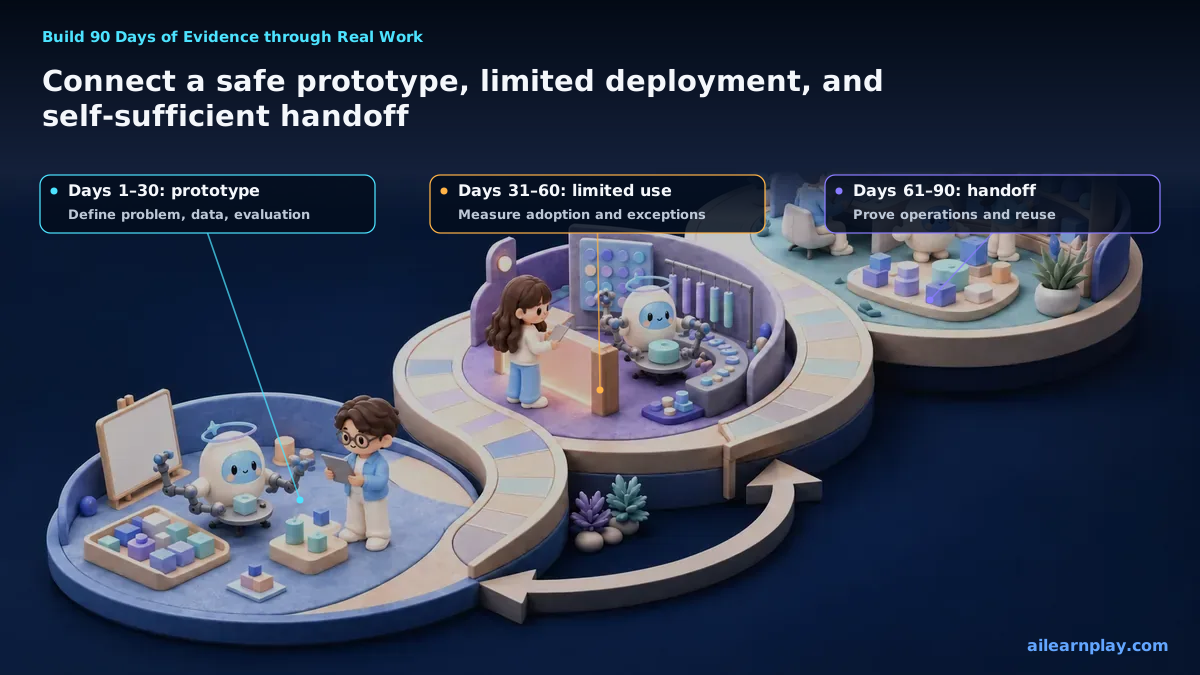
Days 1–30 define one operational decision and a safe prototype boundary
- Select one operational decision that occurs repeatedly
- Interview users and observe work, recording current duration, rework, and exceptions
- Document data source, meaning, quality, permissions, and information that must not leave its environment
- Create evaluation cases from a small set of representative examples and define stop conditions for dangerous failures
- Build a working path from input through human review in an isolated environment without production data
Completion is not a polished demonstration. The business owner approves the problem, the FDE candidate can explain technical constraints, and the DS candidate can explain the intended change in user behavior.
Days 31–60 measure quality, operations, and adoption in limited use
- Release to a restricted user group and record AI outputs, rejections, human corrections, and processing time
- Stop when quality, cost, latency, or security criteria are not met
- Review weekly with users and revise the problem, evaluation cases, and operating procedure
- Separate customer-specific implementation from components that another engagement can reuse
- Assign owners and recovery procedures for support, incidents, and model changes
This stage examines more than AI accuracy. It asks whether users continue using the system, exceptions remain safe, and changes to existing systems are complete.
Days 61–90 make a production decision and verify internal handoff with evidence
- Decide to continue in production, reduce scope, or stop based on evaluation results
- Have the operations owner perform monitoring, rejection, and recovery once without the FDE candidate
- Have the business owner review adoption metrics and exception records without the DS candidate
- Register shared components, evaluation cases, deployment procedures, and failure conditions as organizational assets
- Decide what the next engagement will reuse and which requests return to the product owner
Completion means the internal team can take over operations and the next engagement can begin with the previous artifacts. It does not mean the candidates continue holding every responsibility indefinitely.
Staged assessment measures the scope of evidence, not the amount of knowledge
Do not base development assessment only on certifications, training hours, or a persuasive demonstration. The following rubric scores each capability by the scope of available evidence.
| Stage | Business problem | Implementation and AI evaluation | Adoption and governance | Product learning |
|---|---|---|---|---|
| 0 Can explain | Explains terms and representative examples | Reproduces a small exercise | Lists basic risks | Records learning |
| 1 Can perform with support | Defines one problem with a mentor | Runs a prototype and evaluation in an isolated environment | Configures permissions and stop conditions with support | Classifies reusable candidates with a mentor |
| 2 Can own limited deployment | Agrees on users and success metrics | Owns software used in live operations, monitoring, and recovery for limited use | Explains usage records and exceptions to stakeholders | Transfers reusable components and failure conditions to another team |
| 3 Can develop others | Reviews problem selection across engagements | Reviews system design, evaluation, and operations and can make a stop decision | Turns responsibility boundaries and reviews into an organizational standard | Returns learning to the product roadmap and development materials |
Promotion requires evidence in every column at the target stage. A person whose technical evidence reaches stage 3 should not lead an FDE team alone if that person cannot agree on the business problem with its owner or help users adopt the resulting workflow. Conversely, strong communication without the ability to review software used in live operations or AI evaluation should be recognized as DS or GTM depth, not covered with an FDE title.
The organization must provide real engagements, mentors, reuse time, and career paths
IPA’s DX Trends 2025 reports broad shortages of AI talent in Japan and lower generative-AI integration into departmental workflows than in the United States and Germany.[9] Leaving development to individual study can increase the number of people who have tried AI without increasing the number who can own a production change.
The organization needs the following mechanisms:
- Real engagement allocation: Choose a problem with actual users and data constraints in a scope where failure will not immediately harm a customer or critical operation
- Weekly review: Have FDE, DS, business, security, and product owners examine failed evaluations, usage records, exceptions, and reuse candidates rather than only a demo
- Mentor time: Separate system-design and operational-change mentors, and reserve review time as normal work
- Reuse time: Schedule time after the engagement to convert code, evaluations, and procedures into shared components
- Parallel career paths: Treat FDE, DS, and GTM as technical, operational, and deployment specializations rather than a hierarchy, with aligned promotion and compensation
- Internal mobility plus hiring: Select candidates from engineering, data, consulting, product, and business teams, then hire only for missing depth
The Ministry of Economy, Trade and Industry’s Manabi DX Quest includes a program in which participants work in teams with regional companies for about two months.[10] Its progression from training into practical work applies to FDE development. Palantir also provides product learning through learn.palantir.com, but a product course is only one part of the common foundation. It does not replace business accountability or production operations.[11]
AI FDE can assist construction, but people must still learn problem selection and approval responsibility
Palantir’s AI FDE product capability assists with building data transformations, Ontology elements that represent operational objects and actions, and reusable processing logic called Functions from natural language. It respects existing permissions and shows which tools it used.[12] Used in a development program, this kind of AI agent can let candidates attempt more implementations in less time.
If the organization treats the amount generated by AI as the learning outcome, however, it may develop people who make changes without review. Assessment should instead ask whether the candidate can explain and verify the following:
- Context provided to AI and information intentionally withheld
- Tools and permissions authorized for execution
- Failures found through evaluation and reasons for each correction
- Operations requiring human approval and operations delegated to AI
- Rollback method and effect on users
AI can increase the number of implementation attempts, but it does not automatically accept accountability for the problem, acceptable failure, operational change, or product-return decision. Talent development therefore needs to shift from memorizing tool operation to evaluating and operating AI-generated changes.
Summary: Start the 90-day program with one operational decision and two candidates
Check the following items before launch:
- One decision occurs several times within 90 days, with identifiable users and a business owner
- One FDE candidate and one DS candidate are assigned, with technical and operational-change mentors
- An isolated environment, permitted data, permissions, and stop conditions are defined
- Baselines exist for quality, usage, operational effect, and cost
- The business owner, security owner, and product owner attend weekly review
- Time is reserved to package evaluation cases, shared components, and deployment procedures after the engagement
- The internal team has a plan to take over monitoring, rejection, and recovery at day 90
The first action is not sending a large cohort to generic AI training. Assign one operational decision to an FDE and DS candidate, then resolve the unchecked items in this list. If the program cannot provide an isolated environment, business owner, evaluation cases, or handoff destination, do not start the 90-day engagement. Establish the foundation and responsibility boundaries first.
References
- Palantir, Forward Deployed Software Engineer — Japan Government
- Palantir, Deployment Strategist
- OpenAI, Forward Deployed Engineer — Tokyo
- Palantir, Forward Deployed AI Engineer
- World Economic Forum, Future of Jobs Report 2025, January 7, 2025
- Ministry of Economy, Trade and Industry, Publication of Digital Skill Standard version 2.0, April 16, 2026
- Palantir, Q4 2023 Business Update, February 2024
- Palantir, Deployment Strategist, Build to Apply — US Government
- IPA, DX Trends 2025, June 2025
- Kyushu Bureau of Economy, Trade and Industry, Companies participating in the FY2025 Manabi DX Quest regional collaboration program, March 23, 2026
- Palantir, Advance your Foundry and AIP skills with new training courses on learn.palantir.com, November 20, 2025
- Palantir, AI FDE is now generally available, March 12, 2026
For the latest releases and updates, check the official website and official documentation.