

What Is Spec First? Reducing Rework in AI Implementation



What you’ll learn
- Why starting AI implementation without a specification creates rework
- How to specify what to build, how it should behave, and what it should not do
- How change risk and specification effort determine when to apply Spec First
Use Spec First to Fix Scope Before AI Implementation
AI implementation rework depends less on instruction length than on agreement about what to build, how it should behave, and what remains out of scope. On this site, confirming those three points before implementation made changes that worked but missed the intent easier to detect. Spec First fixes the necessary agreement before implementation according to the change risk.
By the end of this article, you will have practical criteria for answering “Which changes need a specification first, and what must be agreed to reduce rework?” in your own context.
Fix Purpose, Scope, and Exclusions Before Implementation
“Please add a contact form to this page.” When I give AI an instruction like this without further definition, AI implements whatever it interprets a contact form to be. It decides the fields to include, what happens after submission, how errors are shown, and everything else based on its own judgment.
When the result arrives, problems like these emerge: there is no email address field, clicking submit sends the user to a thank-you page rather than displaying a confirmation on the same page, or the design does not match what I had in mind. Each revision request triggers further adjustments, and arriving at something close to the original intent takes multiple rounds of back-and-forth.
This cycle happens because the initial instruction did not define what to build.
Spec First Agrees Purpose, Scope, and Exclusions Before Implementation
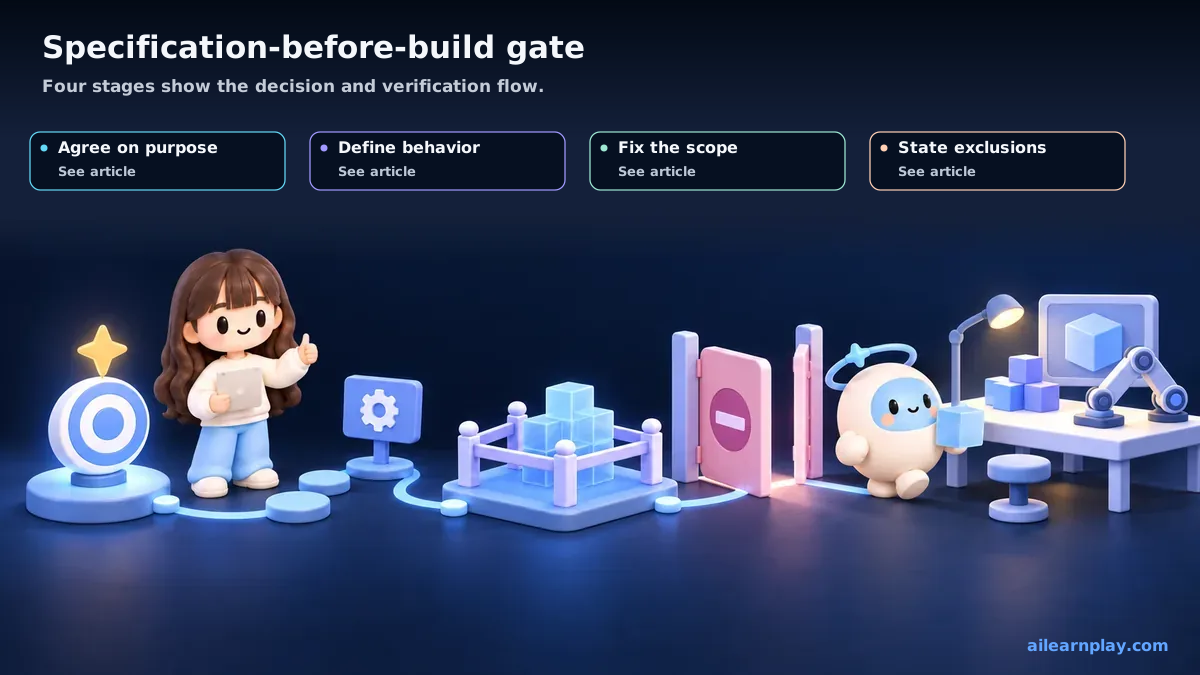
In this article, Spec First does not mean a single standardized method defined by one company. It means writing down requirements, constraints, and acceptance criteria before asking AI to implement. The specification does not need to follow a formal document format. Writing three things is enough to start: what to build, how it should behave, and what it should not do. When these points are established first, the understanding between me and AI is aligned before implementation begins.
When I add new features to this site, I always work through these three points before issuing an implementation request. For the contact form example, it might look like this.
## Contact Form Specification

### What to build
- A form with fields for name, email address, and message
- One submit button

### How it should behave
- After submission, display "Your message has been sent" as text on the same page
- Validation: name and email address are required; email address format is checked

### What it should not do
- No integration with external services (no post-submission processing in this implementation)
- No changes to the design (use existing styles as-is)
What Changes When a Specification Exists
Understanding is aligned at the start
When I provide a specification, AI either confirms it will proceed as described or asks a clarifying question before starting. Mismatches in understanding are surfaced before implementation rather than after, which reduces the situation where “the finished result was not what I intended.”
Review has a clear standard
After implementation is complete, I only need to verify that the result matches what the specification describes. Without a specification, each review requires me to re-establish what the correct behavior should be.
Revisions stay scoped
To revise the implementation, I can point to the specification: “I would like to change this part of the specification.” Without a specification to anchor changes, AI sometimes makes adjustments that are inconsistent with earlier decisions.
Balancing the Cost of Writing a Specification
Writing a specification takes time. Small changes—updating text, adjusting a color—do not need a specification every time.
A specification is most useful for implementation work that involves multiple components, work where AI has meaningful choices to make, and work that is likely to change after the initial implementation. I decide based on the scope and complexity of the task.
Summary: Agree on Purpose, Behavior, and Exclusions Before Implementation
In this article, Spec First means writing a specification first to reduce the number of revisions after implementation. Three points are enough to start: what to build, how it should behave, and what it should not do. Before refining how to phrase instructions for AI, clarifying what I want to build for myself is the starting point for making AI collaboration more consistent.
Start by writing one sentence each for what the next change builds, how it behaves, and what it excludes. A detailed specification can be excessive for a small, easily reversible prototype, so scale the document to the change risk.