

How to Prevent JA-EN Blog Drift with Structural Checks



What you’ll learn
- A synchronization workflow that connects canonical Japanese, an English draft, and the publication decision
- How to recognize three types of translation drift involving interpretation, heading structure, and terminology
- A checklist for reviewing structure and meaning separately before deciding to approve or return a translation
Synchronization Is Complete When Both Languages Support the Same Decision
The goal of bilingual synchronization is not to make both articles look alike sentence by sentence. It is to preserve the facts, conclusions, conditions, and exceptions established in Japanese so that either version gives readers the same basis for a decision. I therefore finalize the Japanese meaning first, then review English naturalness and fidelity as separate concerns.
In this site’s workflow, an English article could read naturally while its heading roles, link order, terminology, or claim strength had drifted from the Japanese. The underlying problem was treating machine-comparable differences, such as heading counts, as if they were equivalent to contextual differences, such as modality and exceptions.
By the end of this article, you will be able to connect Japanese finalization, English drafting, English editing, and bilingual review in one workflow, then use separate structural and semantic checks to decide whether an article can move forward or must return for revision.
Synchronize English from Canonical Japanese Meaning
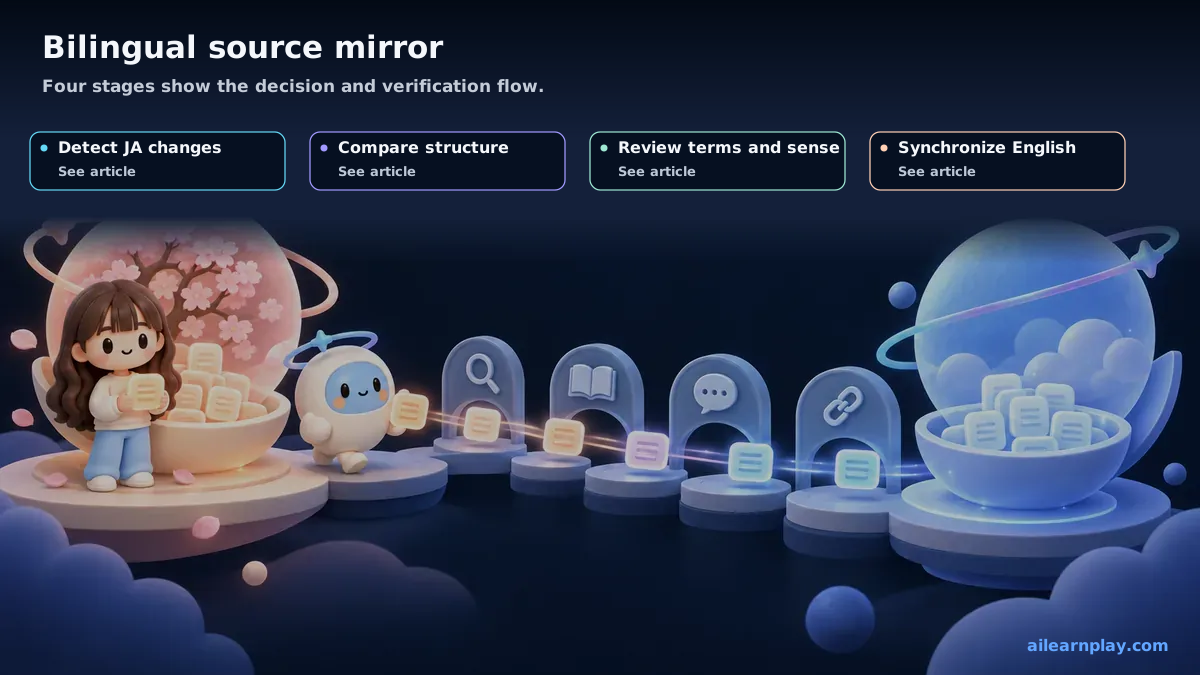
This site treats the Japanese article as the canonical version and manages the English article as a translation derived from it. As the number of articles grew, relying on memory alone to track changes and correspondence began to leave gaps. I split the responsibilities: AI produces the English draft, mechanical checks surface structural differences, and people finalize the Japanese meaning and approve semantic fidelity.
Making Japanese canonical does not force English into Japanese word order. It sets a boundary: English sentences can be reshaped for readability, but their facts, conclusions, conditions, exceptions, and responsible actors cannot change. If English editing exposes ambiguity or missing information in the Japanese article, I update the Japanese source first and then refresh the English draft.
Connect Japanese Finalization to the Publication Decision in Four Stages
The current blog workflow keeps the two locales synchronized in this order.
- Finalize the canonical Japanese article, including its facts, conclusions, conditions, and exceptions (
src/content/blog/ja/) - Create an English draft with the same meaning and structure from that finalized source (
src/content/blog/en/) - Edit the draft into natural English while comparing it with the canonical Japanese
- Run structural checks and an independent semantic review separately, and consider the pair publishable only when no unresolved difference remains
The i18n-sync rules act as guardrails for corresponding frontmatter (the metadata at the top of a Markdown article, such as title, description, and date), headings, section order, links, and related structure.
These rules do not approve the translation itself. Once English editing reveals a semantic gap, the existing English draft becomes stale and the workflow returns to the Japanese source. Including that return path prevents English from becoming an alternative source of truth.
Over-Interpretation, Structural Changes, and Terminology Drift Break Locale Alignment
Three kinds of drift recurred in practice. Each could look natural when the English article was read on its own, so detecting them required comparison with the Japanese source.
Prioritizing Naturalness Too Heavily Changed Claim Strength
A section I wrote in Japanese as “points to be aware of” was sometimes translated into English as “pitfalls to avoid.” The meaning is close, but “pitfalls” is a figurative danger expression that this site’s style policy avoids. In addition, the Japanese expression “〜と考えられます” (which conveys that something is the author’s interpretation, not a definitive claim) was sometimes translated as a definitive “this is.” The intent I expressed in Japanese — marking the reasoning as my interpretation — disappeared from the English version.
The elements to preserve here are the type and strength of the claim, not individual words or word order. A natural English rephrasing must still keep speculation as speculation and conditional conclusions as conditional conclusions. The review criteria now name those semantic elements explicitly instead of requiring a literal translation.
Changes to the Heading Structure Changed the Flow of the Article
In one article, where I had three H2 headings in Japanese — ”## Background of the problem,” ”## How I handled it,” and ”## Result” — the English version consolidated them into a single H2: ”## Background and Resolution.”
When the heading structure changes, the logical flow of the article changes. “Background,” “response,” and “result” are each sections with distinct purposes, and consolidating them removes the signposts that help readers follow the information.
Comparing heading levels and order can mechanically surface candidates for this problem. Matching counts are not sufficient, however, because a heading can be replaced with another that serves a different purpose. The final comparison therefore includes the purpose of each section.
Terminology Was Translated Inconsistently Across Articles
The site-specific term “harness (the set of rules, procedures, and validation that guides AI work in a project)” was translated as “framework” in one article, “scaffold” in another, and left as “harness” in yet another.
When the same concept is translated differently across articles, it becomes harder for readers to understand terminology consistently across the site. For search purposes, inconsistent translations of the same concept also make it harder to find related articles.
To keep terminology aligned, I separated terms that function as identifiers from terms that need reader-facing explanations. Site-specific terms such as harness, SKILL.md, and CLAUDE.md retain their spelling and receive an explanation on first use when needed. For frontmatter, the workflow distinguishes fields whose values require translation from fields whose structure must remain aligned.
Use Separate Structural and Semantic Synchronization Checklists
After translation, I narrow down structural differences before comparing meaning. The following checklist avoids repeating the same review under different names and keeps the boundary between mechanical checks and human judgment visible.
Narrow Down Missing Correspondence with Structural Checks
- H2–H4 levels and order correspond, and the items under “What you’ll learn” have the same count and order
- When tables, code blocks, footnotes, or references are present, their counts and positions correspond
- Internal links point to equivalent content, and the English article uses English locale paths
- Required frontmatter fields are present, and synchronized values such as dates and publication status match
- No structural finding reported by automated checks remains unresolved
Decide Publication Readiness with Semantic Checks
- Facts, numbers, conclusions, conditions, and exceptions correspond to the canonical Japanese
- Modality, negation, and responsible actors have not changed
- Examples and supporting details serve the same purpose, without adding unsupported evidence or benefits only in English
- Site-specific terminology is consistent, with corresponding first-use explanations where needed
- The English reads naturally and uses
I, rather thanwe,our, orus, when first person is necessary - Independent review finds no semantic difference or unresolved return item
Completing both sections is the entry point for the publication decision. If a semantic difference remains, the workflow returns to the Japanese source, then repeats English drafting and editing. Checkbox state on this page is temporary and resets when the page reloads.
Summary: Lock the Japanese Meaning, Check Structure Mechanically, and Use Human Judgment for Meaning
JA-EN synchronization is not an exercise in making two texts resemble each other. It is an editorial process for preserving the same decision-making information in two languages. Finalizing Japanese first, improving the English for readability, and then comparing meaning allows natural translation and content consistency to coexist.
In practice, structural checks narrow down missing correspondence, and semantic checks compare facts, conclusions, conditions, and exceptions. A remaining difference returns the workflow to the Japanese source; aligned meaning moves it to independent review. That explicit branch keeps translation approval from becoming a vague judgment.
Mechanical checks can identify where a reviewer should look, but they cannot approve the force of a claim or the meaning of an exception. Keeping that boundary in the workflow makes it possible to preserve idiomatic English and fidelity to the Japanese source as the article collection grows.