

WebMCP Explained: How AI Works with a Live Web Page

What you’ll learn
- What AI has to infer from the interface during conventional browser automation
- How WebMCP makes a site’s features, inputs, and outputs explicit to AI
- How JavaScript registration differs from describing an HTML form
- Where WebMCP sits beside MCP, OpenAPI, A2A, NLWeb, and conventional browser automation
- Why permissions, confirmation, evaluation, and fallback paths should be decided before adopting WebMCP
WebMCP proposes a clear way for a web page to tell AI what the page can do
WebMCP is a proposal that lets a website describe features such as “find a product” or “fill in this form” directly to AI. Because AI can use the feature inside the page a person is viewing, it has less need to infer the purpose of every button and field from appearance alone. The person can inspect the inputs and results in the same interface.
Here, WebMCP means the proposal from the W3C Web Machine Learning Community Group. The September 10, 2026 document is a Community Group draft, not a W3C Standard.[1] For the basic structure of MCP itself, see the MCP introduction.
By the end of this article, you will have practical criteria for answering “How does WebMCP differ from browser automation and MCP, and how can it be evaluated safely?” in your own context.
WebMCP replaces interface guesswork with an explicit contract from the site
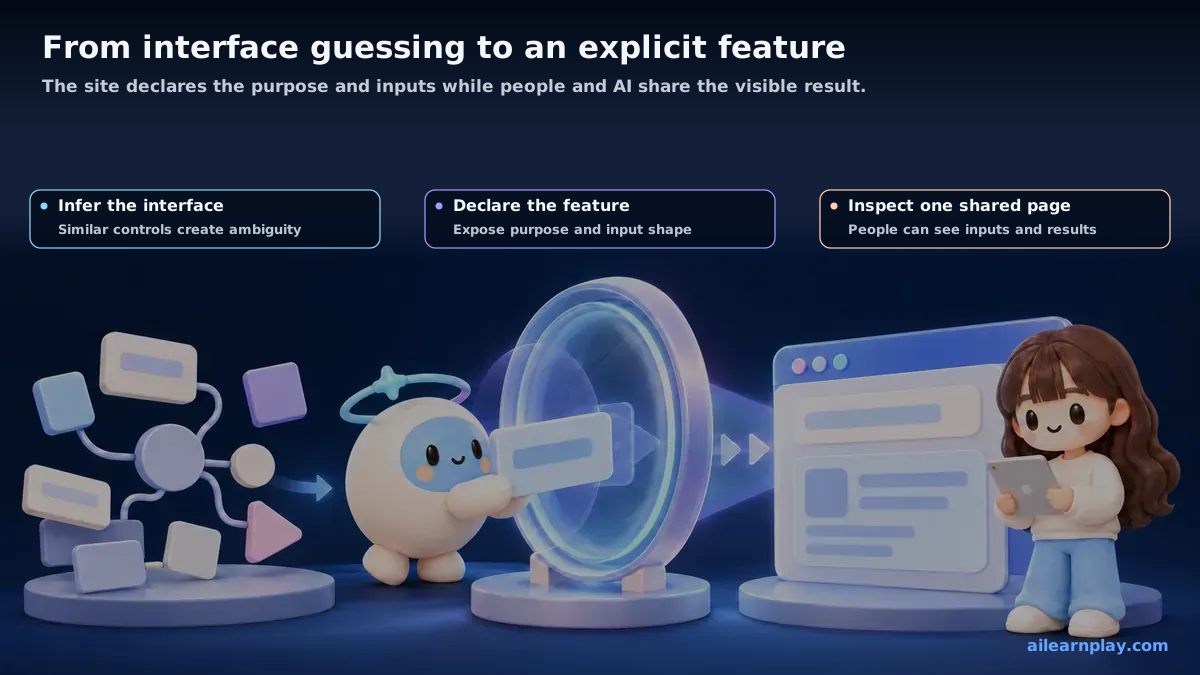
Conventional browser agents inspect a screen or the page’s internal structure and reproduce human clicks and typing. That internal structure includes the DOM, which organizes HTML elements, and the accessibility tree, which communicates roles such as button or field to assistive technology.
The agent still has to infer that one button means purchase and one field means surname. Similar controls, a redesign, or a long sequence can introduce ambiguity. Chrome’s explanation calls this way of seeing and operating the interface “actuation.”[2]
With WebMCP, a travel site can expose one “search for trips” feature together with its required inputs and the operation it will perform. The agent reads the purpose and input shape instead of guessing a button’s position.
A library analogy helps. Conventional automation may infer the borrowing process from shelves and signs. WebMCP is closer to the library stating that a book search accepts a title or author and returns matching records.
“Contract” here does not mean a legal agreement. It means shared rules about a feature’s purpose, accepted information, and returned result.
The visible interface does not disappear. The feature runs in the open page and can reflect search results or form state there. Sharing the page, signed-in session, and current input with the person is the main distinction from calling only a back-end API.
WebMCP also does not prescribe one universal transport between a browser and AI. An implementation can use MCP or another mechanism around it. The central idea is that the site declares a feature and the browser mediates it inside the current page-state and permission boundary.[1]
JavaScript and HTML forms provide two paths for complex and simple page features
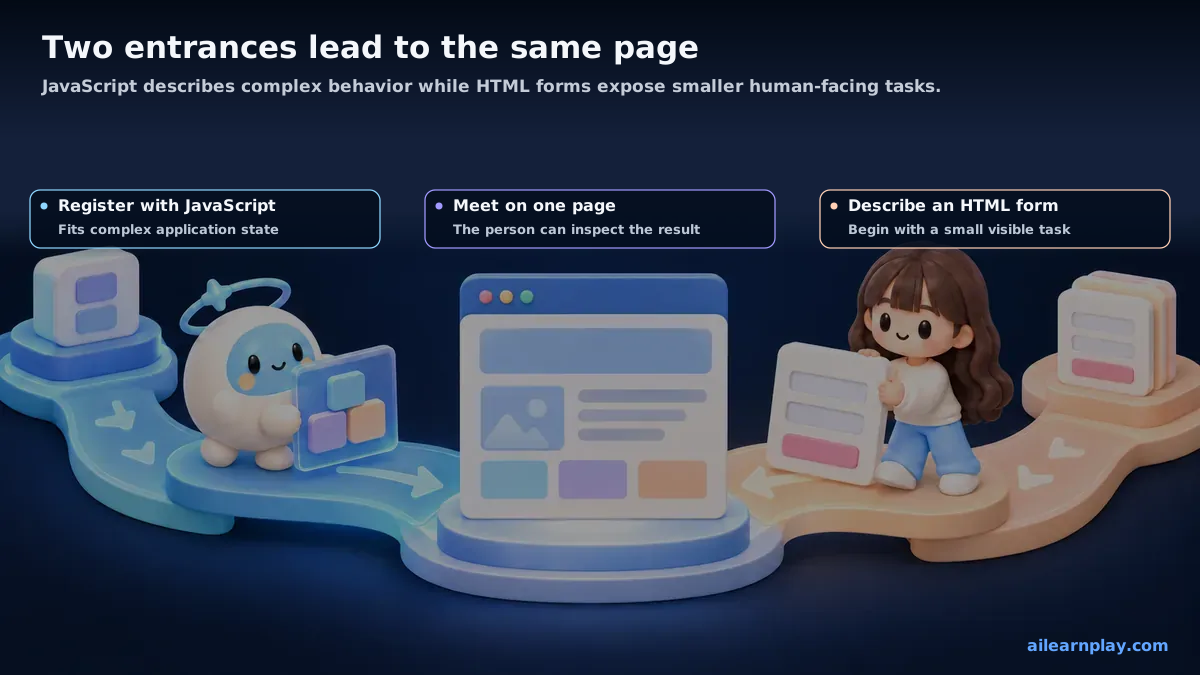
WebMCP offers a JavaScript path and an HTML-form path. In plain language, one packages application logic directly, while the other explains a form that people can already use.
| Path | What it uses | Suitable situation | Relationship to the human interface |
|---|---|---|---|
| JavaScript registration | A feature name, input shape, and operation as one unit | Search, editing, or other behavior tied to application state | Results can return to the same interface |
| HTML-form declaration | Added descriptions on an existing form and its fields | A small entry point such as search, inquiry, or filtering | The ordinary form remains usable without WebMCP |
The JavaScript path lets a developer register page behavior as a tool. AI reads its name and input shape and supplies structured input. The current draft covers registration, listing, execution, removal, and cancellation.[3]
The HTML path adds explanations of what a form does and what each field means. The browser uses that information to describe the required input to AI. A design can still leave final submission to the person.[4]
Beginners do not need to memorize API names to understand the design. Preserve the existing interface and make one AI-accessible entrance explicit at a time. A small search form can begin with the declarative path; behavior deeply tied to application state can use JavaScript registration.
Supporting WebMCP does not require a separate AI-only interface. It starts from search fields and confirmation screens a person can understand, then explains one underlying feature to AI in a less ambiguous form.
Ideally, human clarity and machine clarity improve through the same design.
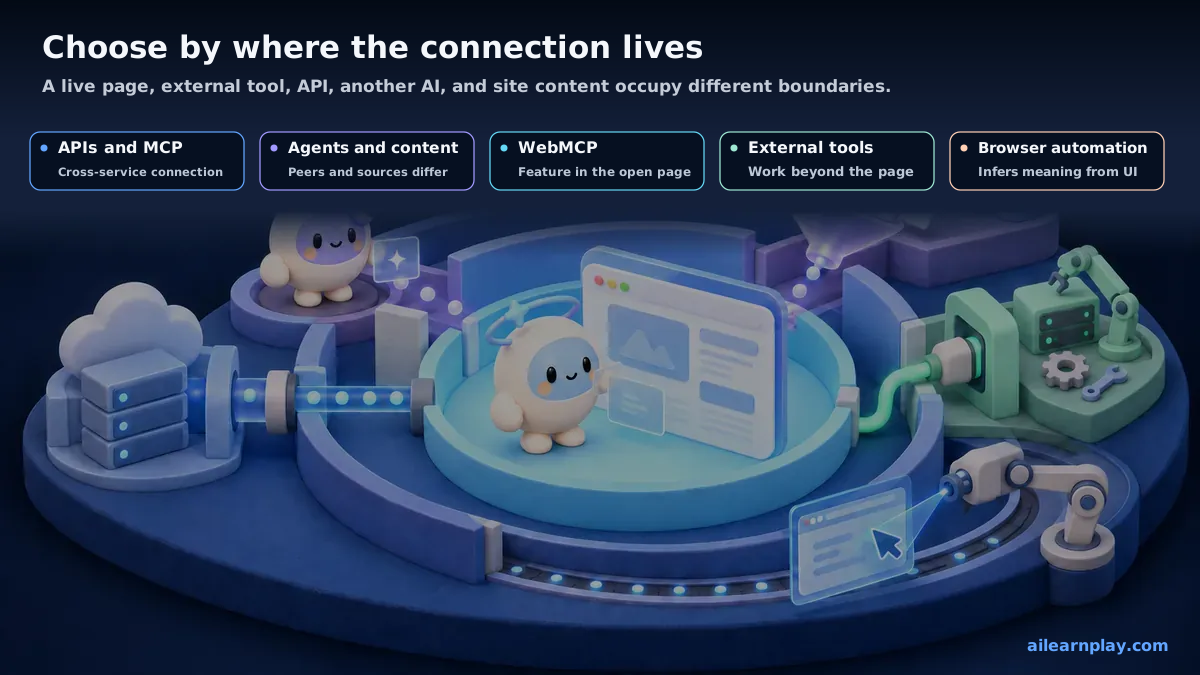
WebMCP, MCP, OpenAPI, A2A, and NLWeb differ in what they connect and where it lives
The adjacent terms become easier when compared by where a capability exists, how long it remains available, and which parties are connected.
| Technology | Primary connection | Best fit | Difference from WebMCP |
|---|---|---|---|
| WebMCP | The open web page and AI working inside it | A person and AI acting in the same interface and signed-in session | The page-bound entrance disappears when the page closes |
| MCP | An AI app and data or tools outside the page | Work used by several apps or continuing without the page | Complements back-end capabilities rather than centering live page state |
| OpenAPI | A web API provider and consumer | Describing API locations, inputs, responses, and authentication | Can describe an existing API used behind a WebMCP feature |
| A2A | Independent AI agents | Agents discovering one another, delegating work, and returning results | Coordinates agents rather than an open page’s feature |
| NLWeb | Website information and natural-language questions | Conversational discovery over products, recipes, places, or other content | Centers on questions about content rather than operating the open interface |
| Browser automation | A human interface and an automation program | Broad coverage, including sites without WebMCP | Reaches more sites but has to infer interface meaning |
Chrome compares MCP as a continuing connection to a server behind the interface and WebMCP as a temporary capability bound to an open tab.[5] MCP connects AI applications to external data and tools.[6] OpenAPI describes a web API contract in machine-readable form.[7]
A2A covers discovery, delegation, and result exchange between independent agents; its documentation presents MCP’s agent-to-tool role and A2A’s agent-to-agent role as complementary.[8] NLWeb uses formats such as Schema.org to give websites a natural-language question interface.[9]
NLWeb may fit conversational product discovery, WebMCP may fit manipulating filters on the open product page, and MCP or a conventional API may fit order history after the site has closed. The goal is not to force every connection into one protocol, but to choose from the boundary.
Clear inputs are not enough: design permission, confirmation, evaluation, and fallback first
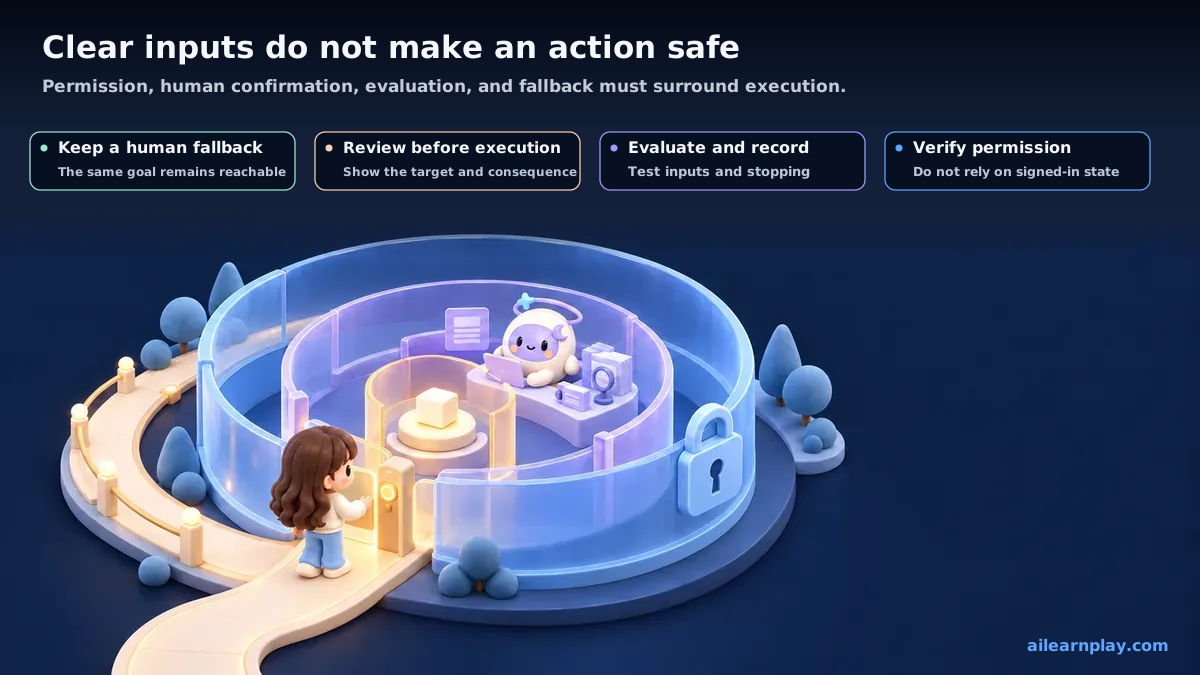
Defined feature names and inputs reduce guesswork, but they do not guarantee safety. A page contains the user’s signed-in state, so a poorly bounded feature can still contribute to an unwanted purchase, account change, or data disclosure. Indirect prompt injection is another risk: AI may mistake instructions embedded in external content for the person’s request.
Chrome’s preliminary guidance includes hints for read-only behavior, untrusted output, and consequential effects.[10] These hints communicate risk; they do not replace identity checks, authorization, or business rules.
| Condition | Design for the first evaluation | If it cannot be met |
|---|---|---|
| Effect of change | Begin with read-only or reversible search, display, or drafting | Do not expose purchasing, sending, or deletion |
| Identity and permission | Keep the server-side check of who may do what | Do not treat a signed-in page as sufficient permission |
| Human confirmation | Show the action, target, amount, or recipient before commitment | Do not finalize a consequential action automatically |
| Input and output | Keep fields and formats narrow and return only the needed result | Do not accept unrestricted prose or return the entire page by default |
| Evaluation | Check feature selection, inputs, ordering, and stopping after failure | Do not make a production decision from one successful demo |
| Fallback | Keep a human interface for the same goal without WebMCP | Do not make a critical operation depend on one browser |
Use ordinary deterministic tests for the page operation. Evaluate model-dependent behavior separately: whether AI selects the right feature, supplies valid inputs in the right order, and stops safely after an intermediate failure. Chrome’s evaluation guide likewise separates conventional tests from probabilistic evaluation at model touchpoints.[11]
Summary: WebMCP is still an experiment, so begin with one read-only feature and watch it mature
As of September 2026, the draft, browser support, prototypes, and production adoption need separate labels. WebMCP is not yet a standard broadly available to everyone without setup; it remains at a validation stage using enrollment or developer settings.
- Specification: It is a Community Group draft, so APIs and security design can change.[1]
- Chrome: Chrome 149 introduced a time-limited origin trial, with an experimental setting for a developer’s own machine.[2]
- Prototypes: Public examples include travel search, product configuration, order tracking, editing, and in-browser data analysis.[12][13]
- Adjacent services: Cloudflare announced a developer preview that adds a bridge to existing sites.[14]
These examples show a possible range of interactions. They do not prove production use with the same success rate or business effect. The strongest current fit is work where a person keeps the page open and inspects a visible result, such as search, filtering, diagnostics, or drafting.
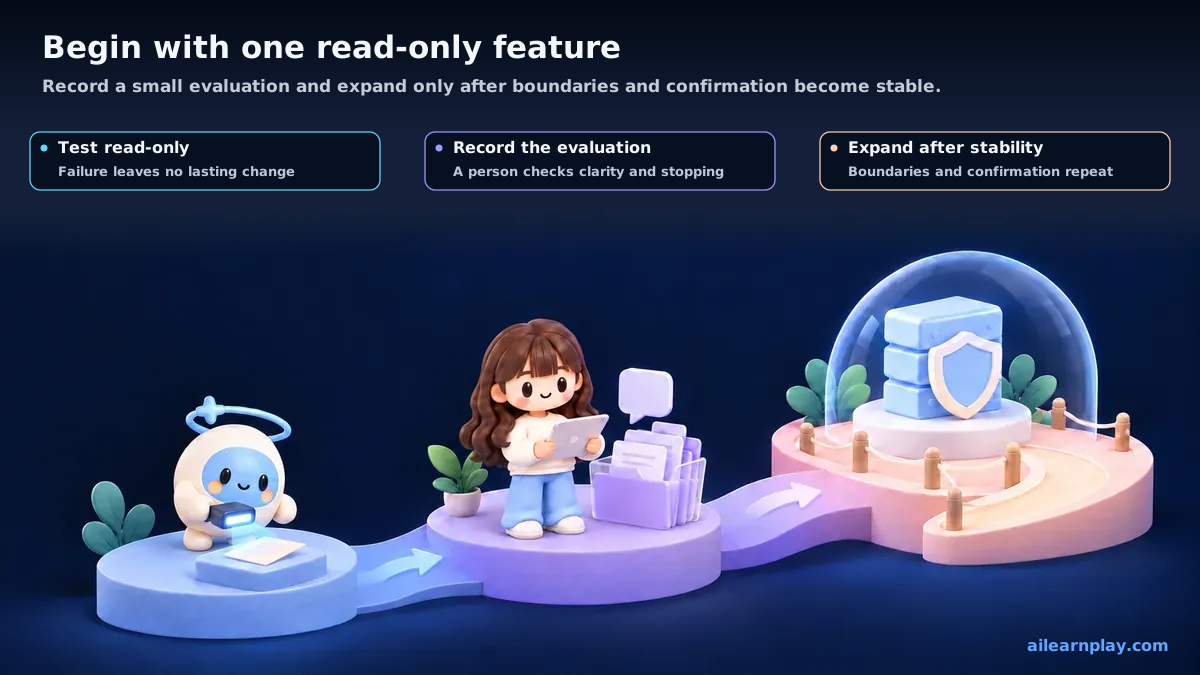
An evaluation should record more than whether the feature worked once. Check whether the person understood the result, invalid input was stopped, and the same goal remained possible in an unsupported environment.
Maturity means not only more features, but also consistent boundaries and confirmation behavior across browsers.
My expectation is that a mature WebMCP will complement MCP and APIs instead of replacing them. WebMCP can handle current interface state and visible confirmation, while MCP or APIs handle persistent data and long-running work.
The first step is one feature that only reads information, shows the result on screen, and leaves no lasting effect when it fails. Keep the human path, check the current draft’s exposure rules, and record both the feature visible to AI and the result. If work must continue after the site closes, begin with MCP or a conventional API instead.
This article is a general information summary and is not legal advice. Confirm practical decisions with a qualified specialist.
References
- W3C Web Machine Learning Community Group, WebMCP, September 10, 2026
- Chrome for Developers, WebMCP, updated August 7, 2026
- Chrome for Developers, Imperative API, updated September 1, 2026
- Chrome for Developers, Declarative API, May 18, 2026
- Chrome for Developers, When to use WebMCP and MCP, updated May 19, 2026
- Model Context Protocol, Specification (2026-07-28), July 28, 2026
- OpenAPI Initiative, Introduction
- A2A Protocol, A2A Protocol
- NLWeb, What is NLWeb?
- Chrome for Developers, WebMCP tool security, updated September 1, 2026
- Chrome for Developers, Test WebMCP with Evals, updated May 28, 2026
- Chrome for Developers, 15 updates from Google I/O 2026, May 19, 2026
- OpenAI, WebMCP Challenge
- Cloudflare, Give any website a WebMCP interface, August 6, 2026
For the latest releases and updates, check the official website and official documentation.