

What Is SkillOps? How Google Operates Agent Skills

What you’ll learn
- The similarities and differences between Google’s published practices and the SkillOps research paper
- How to compare runs with and without a Skill to check answer accuracy and completion time
- A minimum process covering maintainers, automatic checks when content changes, and recurring effectiveness checks
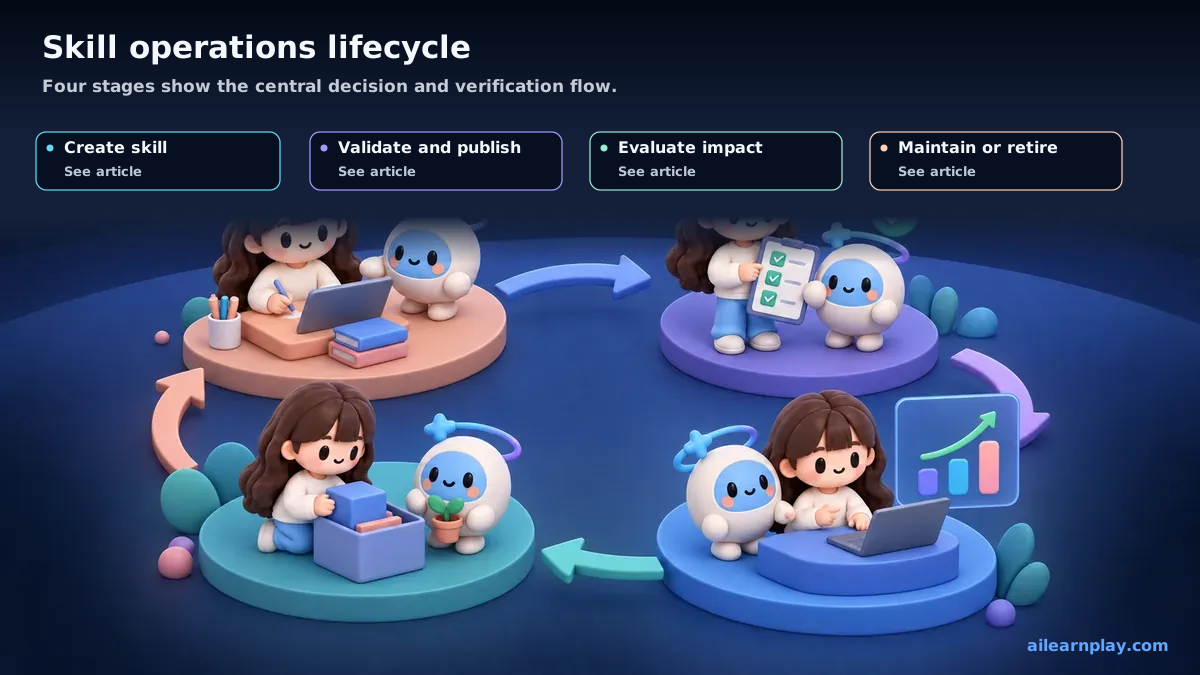
SkillOps Connects Skill Creation, Publication, Evaluation, and Maintenance
SkillOps manages the creation, publication, evaluation, and maintenance of Agent Skills, which are reusable instruction guides that give AI the steps and knowledge for a job. A growing collection raises questions about maintainers, continued correctness, and distributed versions. Google’s published practices show how creation, testing, release, ownership, and recurring evaluation can form one operating cycle.
By the end of this article, you will have practical criteria for answering “Who should own a Skill, which checks should it pass, and how should it stay current?” in your own context.
Google Published Its Operations Process
The Google Cloud article is titled “Behind the scenes: How we build, test, and scale Google Agent Skills.” Google Agent Skills turn knowledge about a particular field, such as Google Cloud, into instructions with a consistent format that AI can use and anyone can inspect.[1]
Google did not announce a product or new standard named “SkillOps.” The official article concerns quality control, evaluation, publishing, and ownership for continuously operated skills. This article uses SkillOps as a label for that practice of operating skills as software assets.
Separately, Hongji Pu, Xinyuan Song, and Liang Zhao used the name SkillOps in a research paper released on May 13, 2026. The paper proposes a method for finding duplicated or outdated instructions in a skill collection and maintaining the collection separately from day-to-day use.[2] The Google article and the paper are different publications.
The Scaling Challenge Google Agent Skills Faced
Google Agent Skills began as a cross-functional team led by people who communicate with developers and people who write technical documentation before Google Cloud Next 2026. After launch, product teams beyond Cloud also wanted to contribute skills, creating a need to let more people create and revise them without lowering quality.[1]
Google identifies vague instructions, broken links, and missing edge cases as problems. Because one poor skill can degrade the broader agent experience, the project does not treat a skill contribution as an unrestricted document submission. It combines standards, automated integration and delivery checks, continuous evaluation, and ownership.[1]
This case shows why SkillOps covers more than writing SKILL.md (the file that stores instructions plus basic information such as a skill’s name and description). Its scope includes who can change a skill, what must be checked before publication, and whether it still works after a connected service or AI model changes.
Google Connects the Skill Lifecycle Through Six Operating Mechanisms
Google’s published process can be organized into six mechanisms.[1]
| Mechanism | Google’s practice | Problem it addresses |
|---|---|---|
| Shared format | Use the same folder layout and naming rules | Each team uses a different format, making files hard to find |
| Connections to outside tools | Start with remote MCP, a shared connection method the company can manage centrally. Use direct computer commands or individual service connections only when necessary | Passwords and access permissions spread across locations, while teams build their own connection methods |
| Publication to GitHub | Build and check the internal version, then publish only material approved for external release | Internal documents, maintainer details, or test data are released by mistake |
| Automatic checks on changes | Check basic file information, names, locations, links, and safety rules | Broken links, nonexistent URLs, and malformed files go unnoticed |
| Recurring effectiveness checks | Compare results with and without the skill when submitted and every week | A connected service or AI change makes results worse |
| Clear maintainers | Separate the person responsible for the whole collection from each skill’s maintainer | A problem remains because no one knows who should fix it |
The process does not stop after linting, which mechanically checks file names and document structure. Correct formatting does not guarantee more accurate AI answers or shorter completion time. Google therefore checks “is it in the required form?” separately from “does it work better in practice?”
Generate the Public Version from an Internal Source
Google first builds and evaluates skills internally. Validated skills move to a public storage location on GitHub through defined extraction rules. The process removes internal documents, internal maintainer information, and test-case collections, leaving only material required for public distribution.[1]
This differs from editing public files directly. The internal version is the authoritative copy, and the public version is created from it. That boundary keeps internal management rules separate from publicly distributed material.
A practical adaptation could follow this sequence.
- Manage the skill, maintainer, tests, and private references in an internal file collection
- Check the format and actual behavior before accepting a proposed change
- Extract only publishable SKILL.md files, scripts, and references
- Recheck the export for secrets and internal links at the publication boundary
The key is not to store a published skill and all operational data in the same place. However, a public artifact (the published output) alone does not show who maintains it or under which evaluation conditions it passed, so the internal register must retain a durable mapping to the export.
Compare Accuracy and Efficiency With and Without a Skill
At Google, a skill author supplies multiple test cases. Each case includes a request to the AI and an expected result, then compares AI runs with and without the skill. The main measures are answer accuracy and work efficiency; efficiency includes how much information the AI processes and how long it takes. The team repeats the test in different AI execution environments to check whether the same result pattern appears.[1]
The resulting 2x2 can guide a release decision.
| Result | Interpretation | Example decision |
|---|---|---|
| Accuracy ↑, efficiency ↑ | The skill has the clearest value | Consider publication |
| Accuracy ↑, efficiency ↓ | Quality improves at a cost | Limit use to higher-risk work |
| Accuracy ↓, efficiency ↑ | It is faster but harms quality | Revise expectations or instructions |
| Accuracy ↓, efficiency ↓ | It provides no adoption benefit | Stop release and redesign or retire it |
For example, an evaluation of a skill for safely publishing a service to Cloud Run should not treat an error-free command as the only expectation. It could check minimum necessary permissions, the requested service region, required availability checks, and the absence of prohibited public settings, then measure whether the skill satisfies them more accurately than the no-skill result. This is my practical test based on Google’s evaluation method, not an individual evaluation case published by Google.
Own Skills as Products, Not Documents
Google states that “skills are products, not snippets”: a skill is a maintained product, not a short piece of text. Collection maintainers own the shared storage, automated checks, and design rules, while each skill has a long-term maintainer. If a connected service changes or a weekly check finds worse results, that maintainer updates the skill.[1]
Google also provides internal skills that assist authors and agentic workflows built with ADK (Agent Development Kit) that use multi-agent authoring and self-critique loops. In parallel with the public Google Agent Skills collection, an internal “DevRel Skills” initiative standardizes work such as content transformation, SEO optimization, and internal reporting.[1]
This example shows that skills can encode both external product expertise and internal standard operating procedures. Agent-assisted authoring does not replace ownership or evaluation gates. Automation can accelerate drafting and critique, while people and tests retain responsibility for release decisions.
Similarities and Differences from the SkillOps Research Paper
The SkillOps paper records five things for each skill: when it can be used, what it does, what it produces, how to check it, and known failure conditions. It also tracks which skills depend on, replace, duplicate, or coexist with others. Finally, it separates fixing the current job from maintaining, merging, repairing, or retiring the overall skill collection.[2]
| Dimension | Google’s published practice | SkillOps research paper |
|---|---|---|
| Primary concern | Organizational creation, checks, evaluation, publication, and maintainers | Finding and repairing duplicated or outdated instructions in the collection |
| Skill representation | Shared folder structure and instruction format | Usage conditions, processing, output, checking method, and failure conditions |
| Quality checks | Format, links, AI-assisted checks, and actual behavior | Usefulness, duplication, coexistence, risk, and missing checks |
| Time horizon | Effectiveness checks on submission and every week | Separate flows for the current job and the whole collection |
| Maintainer | Collection maintainers and individual skill maintainers | A maintenance system and existing AI |
Both approaches treat a skill as a software asset that must be tested and updated as its dependencies evolve, not as a prompt written once. Google explains an organizational production process, while the paper formalizes relationships among skills and automated library maintenance. No published statement establishes that Google adopted the paper’s SkillOps framework.
Begin with a Single Skill and Add Governance Gradually
Combining Google’s case with the research proposal suggests this practical adoption order.
- Assign an owner and purpose: Identify who updates the skill and decides when to retire it
- Add static checks at change time: Validate frontmatter (metadata at the start of SKILL.md), naming, structure, links, and prohibited information
- Create with-and-without evaluation cases: Compare accuracy, tokens (units of input and output information AI processes), and completion time
- Re-evaluate weekly or monthly: Detect degradation after API, model, or harness changes
- Register redundancy, compatibility, and failure: Make merge, repair, and retirement decisions, not only additions
- Separate internal and public versions: Automate export rules and leakage checks
This site manages shared skills in shared/skills/ and checks alignment between skills and runtime adapters with npm run harness:check. A possible next improvement is to associate each skill with an owner, evaluation prompts, expected results, and the last evaluation date, then retain the measured difference between baseline and skill-assisted runs. This would adapt Google’s published principles to the current harness (the foundation that collects rules, procedures, and validation for AI), not reproduce Google’s internal implementation.
The Published Sources Leave Evaluation Thresholds Undisclosed
Google’s article makes the operating principles concrete but does not publish the models used for evaluation, pass thresholds, number of evaluation cases, weekly-job implementation, or ownership-transfer procedure. It explains the 2x2 assessment but does not provide per-skill accuracy gains or token-reduction figures.[1]
The SkillOps paper reports 79.5% task success on ALFWorld with a 200-skill library, but a text-based household-task benchmark cannot be directly generalized to Google’s operations or an ordinary enterprise environment.[2] A team should treat the published case as design evidence, not a completed standard to copy, and establish its own evaluation criteria and maintenance interval on a small skill set.
Summary: Start SkillOps by Comparing One Skill Against a Baseline
What Google published on August 4, 2026, was not a new product named SkillOps but the operating process used to add Google Agent Skills without sacrificing quality. Its core mechanisms are a shared file structure, centrally manageable connections, generation of a public version from an internal source, automatic checks on changes, effectiveness checks on submission and every week, and divided responsibility between collection maintainers and individual skill maintainers.
In concrete terms, Google generates a safe public version from an internal source, compares accuracy and completion time with and without each skill, and checks again after connected services or AI models change. Adding the research paper’s treatment of duplication, conditions for coexistence, and missing checks creates one operating flow for creation, publication, usage monitoring, repair, merging, and retirement.
The first action is to choose one low-impact skill and record its maintainer, no-skill baseline, expected result, and next evaluation date. Google’s public material does not disclose pass thresholds or ownership-transfer procedures, so each organization must define those conditions for its own work and risk level.
References
- Remigiusz Samborski, Behind the scenes: How we build, test, and scale Google Agent Skills, Google Cloud Blog, August 4, 2026
- Hongji Pu, Xinyuan Song, Liang Zhao, SkillOps: Managing LLM Agent Skill Libraries as Self-Maintaining Software Ecosystems, May 13, 2026
For the latest releases and updates, check the official website and official documentation.