

Claude Code vs Codex: How to Choose by Workflow Stage

What you’ll learn
- The basic differences between Claude Code and Codex that official sources establish
- Criteria for choosing a tool at the discussion, design, implementation, verification, and handoff stages
- How to look beyond model performance and include the work environment and verification method
Choose Claude Code or Codex by Workflow Stage
The useful dividing line between Claude Code and Codex is not a blanket model ranking. It is how much judgment the task needs while work is in progress and how directly the result can be verified. On this site, I use that axis to separate conversational problem framing and design from scoped implementation, verification, and handoff work.
By the end of this article, you will have practical criteria for answering “Which tool fits discussion, design, implementation, verification, and handoff work?” in your own context.
Claude Code and Codex Differ in Usage, Approval, and Execution Environment
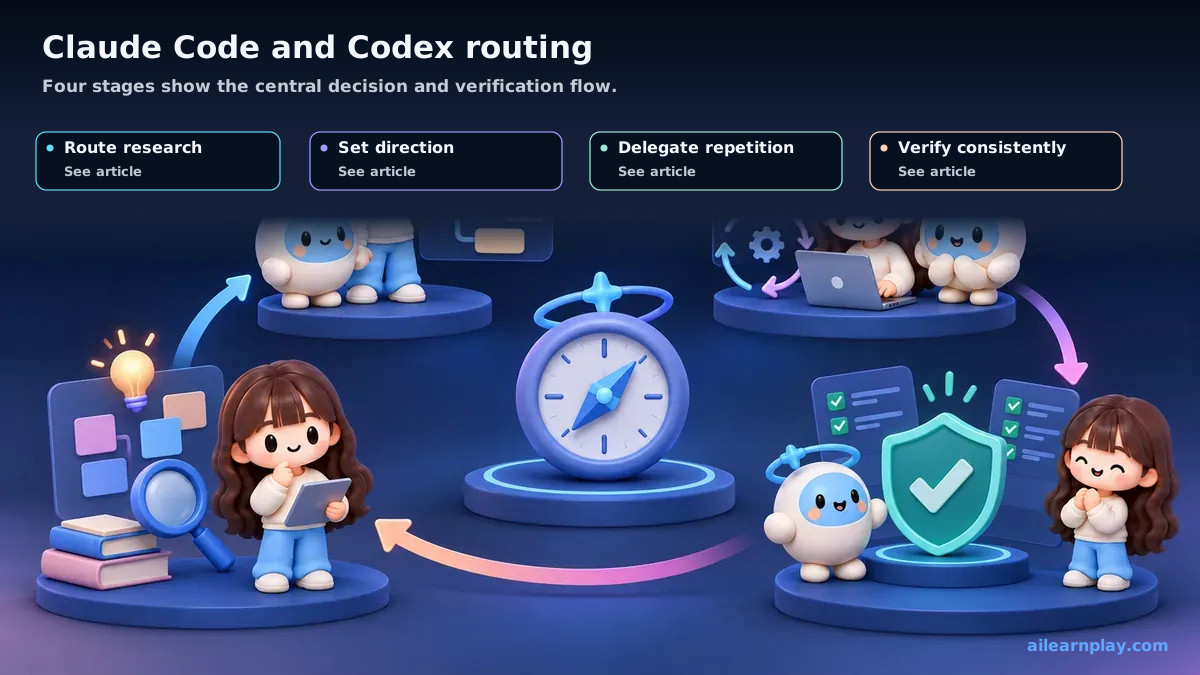
Claude Code is a development assistant used from a terminal or related interfaces to understand a codebase, edit files, run tests, and work with Git through conversation.[1] Its workflow includes approval before changes depending on permission mode, session resume, and multiple interfaces for development work.[1][2]
Codex is a coding agent that reads a repository, edits files, runs commands, and produces reviewable diffs. Codex CLI supports interactive work, session resume, review, and non-interactive execution, and Codex can layer repository and directory-specific instructions through AGENTS.md.[3][4]
Both can be used as coding assistants. The useful comparison is not only the model name. It also includes the work location, approval model, instruction files, verification loop, and how easy the result is to review.
Where Claude Code Fits
Claude Code fits well when the question is still unsettled. Examples include:
- Comparing design options
- Discussing the framing or structure of an article
- Understanding the intent of existing code
- Making small changes through conversation
- Surfacing risks and alternatives before choosing a direction
At this stage, the correct output is not only an implemented diff. I still need to decide what matters, which option to choose, and how far the change should go. Claude Code is useful because I can discuss the project in context and then move into edits when the scope is clear.
The caution is that a long discussion can blur the original goal and the eventual edit scope. Before implementation starts, I need to restate which files should change, what condition defines completion, and what should stay untouched.
Where Codex Fits
Codex fits well when the success criteria can be written down. On this site, I find it useful for work such as:
- Reading
AGENTS.mdandshared/rules/, then applying them to target files - Keeping Japanese and English article pairs structurally aligned
- Aligning frontmatter (metadata at the top of an article file, such as title, description, and date)
- Checking references, tags, categories, and review state
- Running harness (the repository layer of agent rules and safety checks) validation commands such as
npm run harness:check - Reviewing the result as a Git diff
This kind of work is easier to describe as an expected output, constraints, stop conditions, and verification commands. Because Codex can combine AGENTS.md with approvals and sandboxing (restricted execution scope), it is easier to make the work follow repository rules.[4]
The caution is that Codex is not best described as “the tool for broad delegation.” It is better described as the tool for tasks whose completion can be checked. If I hand over an ambiguous improvement request, it may touch files or structure I did not intend to change.
Compare Claude Code and Codex by Workflow, Execution, and Verification
For this site, the working split looks like this:
| Evaluation axis | Claude Code fits better when | Codex fits better when |
|---|---|---|
| State of the question | The goal or judgment criteria are still unclear | Target files and success criteria are clear |
| Main value | Issue framing, alternatives, and design discussion | Implementation, editing, verification, and diff creation |
| Prompt shape | Background, uncertainty, and options to compare | Expected output, constraints, target files, and verification conditions |
| Review method | Review the reasoning and decision path | Review the Git diff, test result, and validation log |
| Main caution | Restate scope before moving into edits | Avoid vague requests with no completion criteria |
This table is not a permanent ranking of Claude Code and Codex. The experience changes with the model, plan, execution environment, repository structure, and permission settings. The practical question is whether the current task is still clarifying judgment or already moving toward a checkable definition of done.
Do Not Decide By Model Quality Alone
When the model used with Codex improves, long context, tool use, and multi-file editing can become easier to delegate. OpenAI’s model page describes GPT-5.5 as a model for complex professional work and coding.[5] Still, stronger model capability does not automatically mean a task should be delegated.
In practice, these conditions matter just as much:
- The repository contains the rules the agent should follow
- The editable scope is clear
- Verification commands or review steps exist
- No major human judgment point is unresolved
- External product information has been checked against official sources
If those conditions are not true, I prefer to clarify the issue first in Claude Code or define the specification myself before handing implementation to Codex.
Summary: Switch Between Claude Code and Codex After the Goal and Verification Are Clear
Claude Code and Codex are more useful as a pair than as mutually exclusive choices. Claude Code is useful when I need to clarify a question, discuss design or wording, and produce judgment material. Codex is useful after the target files, success criteria, and verification method are clear, because it can turn that definition into a reviewable diff.
On this site, the default split is: use Claude Code for discussion and design, and use Codex for rule-driven edits with verification. It is not a fixed rule. For each task, I check clarity of purpose, edit scope, verifiability, permission control, and reviewability before choosing the tool.
The first action is to write one line each for the goal, edit scope, completion condition, and verification method before choosing a tool. Product features and model behavior change, so I do not generalize this workflow into permanent product limitations; I reassess it with the same criteria.
References
- Anthropic, Claude Code quickstart, Claude Code Docs
- Anthropic, Authentication, Claude Code Docs
- OpenAI, Codex CLI, ChatGPT Learn
- OpenAI, AGENTS.md, ChatGPT Learn
- OpenAI, GPT-5.5 Model, OpenAI API Docs
For the latest releases and updates, check the official website and official documentation.