

Four Rules for Editing AI Drafts into Business Japanese


What you’ll learn
- How to identify exaggeration, colloquial adverbs, danger metaphors, and personal-blog phrasing in AI drafts
- How to replace overly strong wording with specific, neutral Japanese suitable for business documents
- A revision sequence for applying the same criteria across an entire article
Rewrite Exaggeration, Colloquialisms, Metaphors, and Personal-Blog Phrasing
Editing an AI-assisted Japanese draft for business use means adjusting the strength of the wording without changing the facts or judgments. On this blog, exaggeration, colloquial adverbs, danger metaphors, and personal-blog phrasing repeatedly required revision. A final pass using those four categories makes strong claims and vague expressions easier to find.
By the end of this article, you will have practical criteria for answering “How can I soften overly strong AI-draft wording without changing its meaning?” in your own context.
Edit AI Drafts into Business Japanese with Four Categories
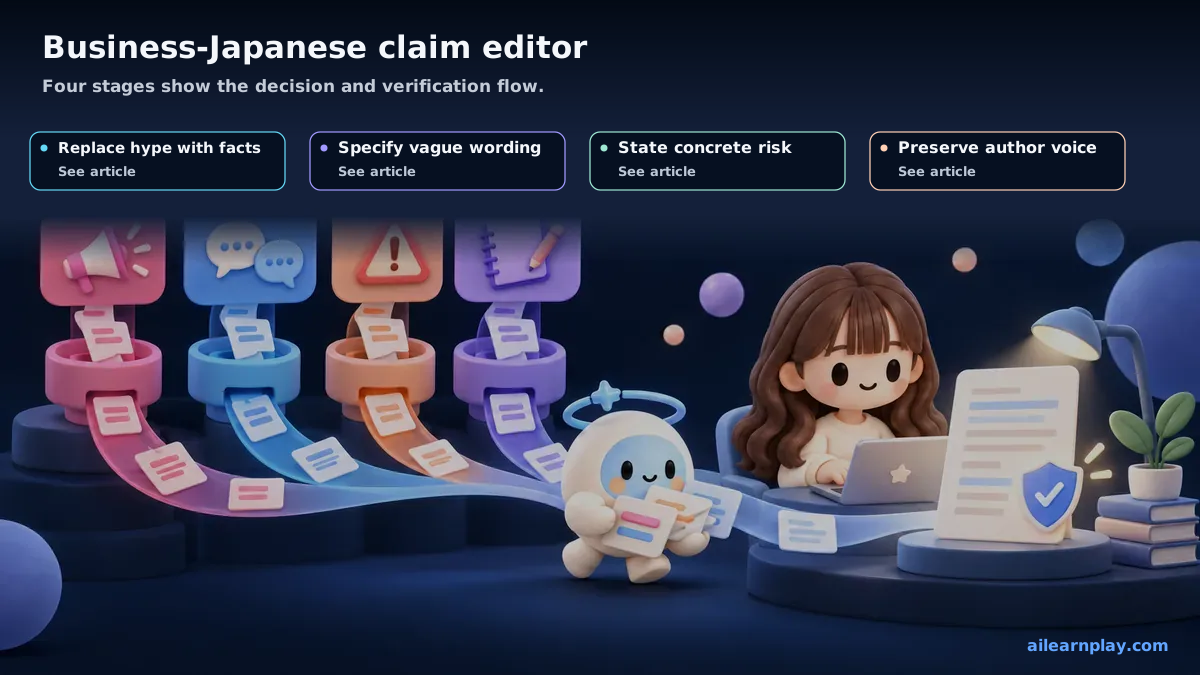
When editing an AI-created draft into business materials or web content, it is common to feel that something is off: the text feels difficult to read or is not suitable to share as an internal document. This article categorizes four common expression patterns in AI-created drafts and provides concrete rewriting examples for each.
Why Revision into a Business-Appropriate Japanese Style Is Necessary
AI-created Japanese drafts can be influenced by training data that includes blog posts, social media, and personal writing. Even though these expressions may be natural in those genres, they often require adjustment before being used in internal reports, technical specifications, or web content.
A useful criterion is to ask: “Would this Japanese sound natural in a focused five-to-ten-minute explanation to an AI- or IT-literate colleague?” The goal is not to make the prose sound like a technical report, but to reduce cognitive load while preserving facts and conditions.
Replace Exaggeration with Verifiable Description
AI tends to use expressions such as “revolutionary,” “overwhelming,” or “like magic” to emphasize effect or value. These are difficult to use in business documents and can feel out of place to readers.
Exaggeration examples
- “Improve operational efficiency through a revolutionary approach” → “An approach that improves operational efficiency”
- “Processes at overwhelming speed” → “Processes in a short amount of time”
- “Solves complex problems like magic” → “Solves complex problems in few steps”
By writing factually about what changes and how, the content can be conveyed accurately without excessive praise.
Replace Colloquial Adverbs with Specific Time, Scope, or Degree
Adverbs such as “sakkuto” (casually), “zakkuri” (roughly), and “gattsuri” (thoroughly) are natural in casual conversation but are not appropriate for business documents. They often find their way into AI-created drafts.
Colloquial-adverb examples
- “Can be set up casually” → “Can be set up easily”
- “To explain roughly” → “As an overview”
- “Verified thoroughly” → “Verified in detail”
When substituting an adverb, it helps to think about what is being conveyed — speed, simplicity, or depth — to choose the right replacement.
Replace Figurative Danger Language with Concrete Risk
Expressions such as “pitfalls,” “landmines,” and “quicksand” attempt to convey problems in a vivid way, but in business documents they tend to lack specificity and create an unnecessarily negative impression.
Risk-language examples
- “Watch out for configuration pitfalls” → “Points to note during configuration”
- “This choice can easily become a landmine” → “This choice carries risks that should be confirmed”
- “Got stuck in a configuration quagmire” → “A problem occurred that required more time than expected for configuration”
Writing directly about what the problem is and how it can be avoided provides more concrete and useful information for readers.
Replace Personal-Blog Phrasing with Workplace Facts
Headings and phrases such as “I tried using X,” “I got hooked on X,” and “A story about trying out a new tool” are well established in personal blogs, but as headings for technical documents or web content, they tend to convey little information.
Workplace-fact examples
- “I tried using Astro” → “The process and results of building a site with Astro”
- “A story about getting hooked on Claude” → “Problems that arose while using Claude and how I handled them”
- “I tried a new tool” → “The evaluation procedure and selection criteria for the tool”
Including “what,” “how I confirmed it,” and “what the result was” in a heading increases the information a reader gets before reading the article.
Detect Prohibited Language, Check Context, Replace It, and Reread
When a person edits an AI-created draft for its purpose and audience, the following procedure tends to be efficient.
- Read through the entire text once and mark any parts that feel off
- Classify which of the four patterns each marked part falls into
- Judge whether it fits the document’s purpose, audience, facts, and organizational style before rewriting
- Read through again after rewriting to confirm that the text reads naturally in polite style
Also check the following while editing.
- Whether the original claim or meaning has changed
- Whether the wording fits the reader, purpose, and publication medium
- Whether content written as experience matches the facts
- Whether organization-specific wording or confidential information is included
- Whether a person can approve the text as the final version
When asking AI to suggest revisions, providing the instruction “Please suggest Japanese wording suitable for business documents. Avoid exaggerated expressions, colloquial adverbs, figurative danger expressions, and personal blog-style phrasing” helps align the direction of revision.
Summary: Use Four Wording Categories to Align Facts and Claim Strength
Problem wording in AI-assisted Japanese drafts can be grouped into four patterns: exaggeration, colloquial adverbs, figurative danger expressions, and personal-blog phrasing. Asking whether the prose would sound natural in a focused explanation to an AI- or IT-literate colleague avoids both stiff report language and overly casual blog language. The four categories surface candidates; a person still checks the facts, conditions, and readability.
Start with one strong expression in the draft and separate the fact, judgment, and condition before rewriting it. Do not apply a general wording rule to official product names, quotations, or other text whose exact form must be preserved.