

How to Build a Blog Writing Skill with Voice and Quality Rules

What you’ll learn
- Why a Skill is useful when AI drafts lose author perspective or repeat style problems
- How to define author voice, prohibited expressions, E-E-A-T (experience, expertise, authoritativeness, and trustworthiness), and quality checks in SKILL.md
- How to make repeated editing criteria reusable before human editing and review
Define Author Voice and Quality Rules in a Blog Writing Skill
An operational blog-production Skill separates AI drafting support from human editing and publication responsibility, then turns author perspective, style, evidence, and quality checks into reusable procedures. On this blog, polished drafts still repeatedly lost the author’s judgment or wording conditions. The Skill therefore records applicability and review steps, not only replacement phrases.
By the end of this article, you will have practical criteria for answering “What should a blog-production Skill define so the same editing criteria can be reused?” in your own context.
Separate AI Writing Assistance from Human Publication Responsibility
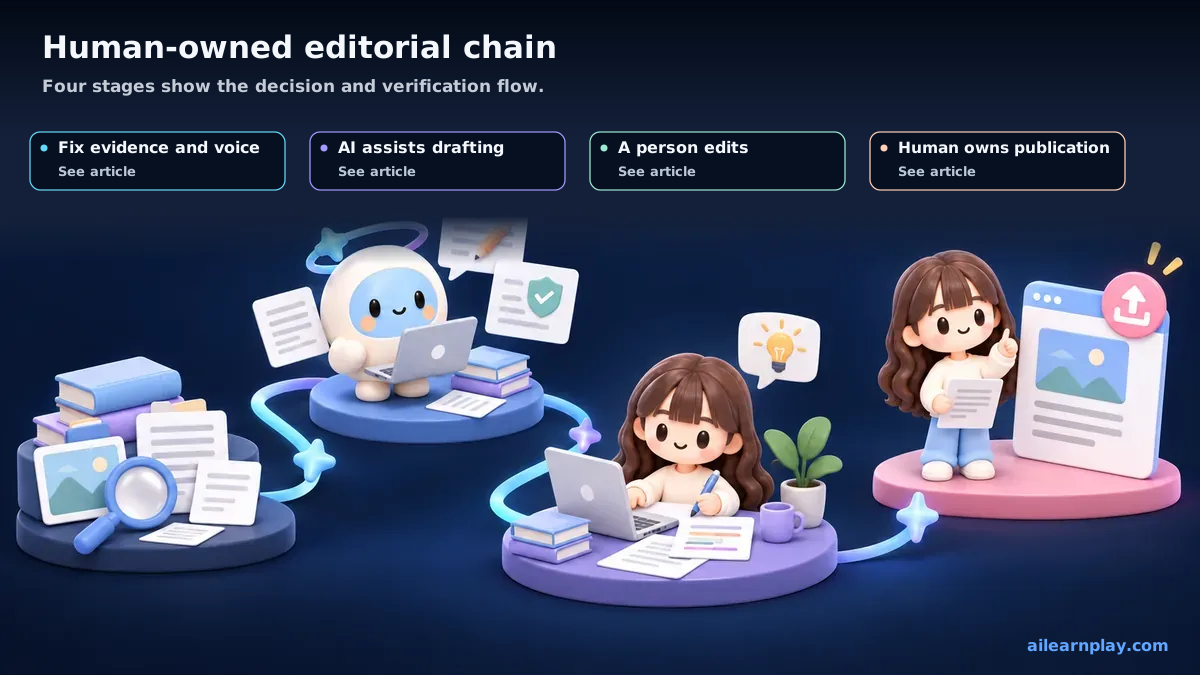
This site uses AI to organize article structure and create first drafts. However, I do not publish AI output as a finished article as-is. I reread the content, check whether it matches my experience, verify facts and claims, revise the wording, and then decide whether it is ready to publish.
Drafts created with AI can include generic phrasing, statements that do not match the author’s actual experience, excessive claims, or inconsistent style. To keep draft quality within a manageable range and make human editing and review easier, I created a file called my-blog-writing SKILL.
This skill does not replace the author with AI. It defines the division of work: AI supports structure organization and first-draft creation, while a person decides the intent, adds experience, checks facts, edits the article, and makes the publication decision.
I cover general skill-file design in Defining Specialized AI Tasks with SKILL.md. This article stays focused on the author voice, prohibited expressions, and review checks specific to blog writing.
Here, SKILL refers to the task-definition file I use inside this site. This article is not a guide to a specific vendor’s official Skill feature.
What my-blog-writing SKILL Is
my-blog-writing SKILL is a file that defines the procedure, writing style, prohibited expressions, and checkpoints for AI-assisted draft creation and the subsequent human editing and review process.
The concept is similar to a recipe. It describes what to do, in what order, what expressions to use, what to avoid, and what format makes the draft easiest for a person to review. When AI references this file before drafting, it follows the defined standards without requiring me to re-explain the rules in every conversation.
SKILL.md Defines Author Perspective, Style, Prohibited Language, and Quality Checks
Refer to the Author with the First-Person “I”
The first rule I defined was: “When referring to the author, always use ‘I.’ Do not refer to the author in the third person in the body of an article.”
Before I created the skill file, AI-generated drafts sometimes contained third-person expressions like “Shiori examined…” or “The author has concluded that…” By explicitly defining the rule that only the first-person “I” is used when writing from the author’s perspective, this problem went away.
Use Polite Japanese and “I” as the English First Person
For Japanese, I defined “use polite style (desu/masu form) consistently.” For English, I defined “use only ‘I’ as the first person; do not use ‘we,’ ‘our,’ or ‘us.’”
Without explicit instruction, polite style in Japanese can shift to plain style (da/de aru form) mid-article. In English, “we” was frequently appearing even though the writing represents one author’s perspective. Defining both as rules significantly reduced style inconsistencies.
Prohibited Language Reduces Exaggeration, Colloquialism, and Ambiguity
I defined the following categories as prohibited expressions.
- Exaggerated expressions: “revolutionary,” “overwhelming,” “like magic”
- Colloquial adverbs: “sakkuto” (casually), “zakkuri” (roughly), “gattsuri” (thoroughly)
- Figurative danger expressions: “pitfall,” “landmine,” “quicksand”
- Personal blog-style title patterns: “I tried X,” “I got hooked on X”
- Imperative or provocative titles: “Stop doing X,” “The truth about X”
Defining these as a list reduces the frequency of problem expressions at the draft stage. That makes it easier for the subsequent human review to focus on content, facts, and the author’s intent.
E-E-A-T Review Checks Experience, Evidence, and Publication Responsibility
E-E-A-T (Experience, Expertise, Authoritativeness, Trustworthiness) is a set of criteria for evaluating article credibility. The skill file includes a checklist defining what each element should contribute to an article.
The item I emphasize most is “Experience.” I explicitly define the rules: “Do not write about things I have not actually experienced as if I had” and “Use expressions that distinguish between investigation and information synthesis versus firsthand experience.”
How Article Quality Changed Before and After Defining the Skill
Before the skill file existed, every time I asked AI to create an article draft, I would add instructions such as “write in polite style,” “avoid exaggerated expressions,” and “use only ‘I’ as the first person.” If any part of the instruction was omitted, the quality of that aspect would drop.
After defining the skill file, the only instruction needed per article became “reference my-blog-writing SKILL and create a first draft.” All the rules apply as soon as the skill file is referenced, so quality variation caused by omitting instructions is eliminated.
The skill file is also stored as a file in the repository, so its revision history is trackable. This makes it easy to manage the principle that “when someone adds or changes a rule, it applies to articles from that point onward.”
Summary: Keep Author Perspective and Quality Checks in the Skill, but Publication Decisions Human
my-blog-writing SKILL is a file that defines author perspective, writing style, prohibited expressions, and an E-E-A-T checklist. Referencing the skill file unifies the standards used when AI creates drafts and humans edit and approve them, eliminating the need to repeat the same instructions every time. The design intent is to keep draft style within a consistent range and make the draft easier for the author to edit.
Start with one issue repeatedly corrected in past drafts and write its applicability and verification method into the Skill. A Skill can improve drafts and surface review candidates, but it does not automatically verify facts, approve author experience, or decide publication readiness.