

Managing Enterprise AI Coding Costs



What you’ll learn
- How to separate AI coding costs into fixed seats, variable usage, and business outcomes
- What to check in the different billing and limit structures of Claude, Codex, and GitHub Copilot
- A monthly process for user selection, three-layer budgeting, and license reallocation
Manage AI costs across seats, usage, and outcomes
A higher invoice does not immediately mean that employees used too much. The response depends on whether the company has unused licenses, more additional usage, or usage that did not produce a business outcome. Aligning Claude, Codex, and GitHub Copilot across contracts, usage, and outcomes makes it possible to decide who should receive access, where limits belong, and what a monthly review should examine.
By the end of this article, you will have practical criteria for answering “How can different product charges be managed through contracts, usage, and outcomes?” in your own context.
Separate AI Cost into Contract, Usage, and Outcome Units
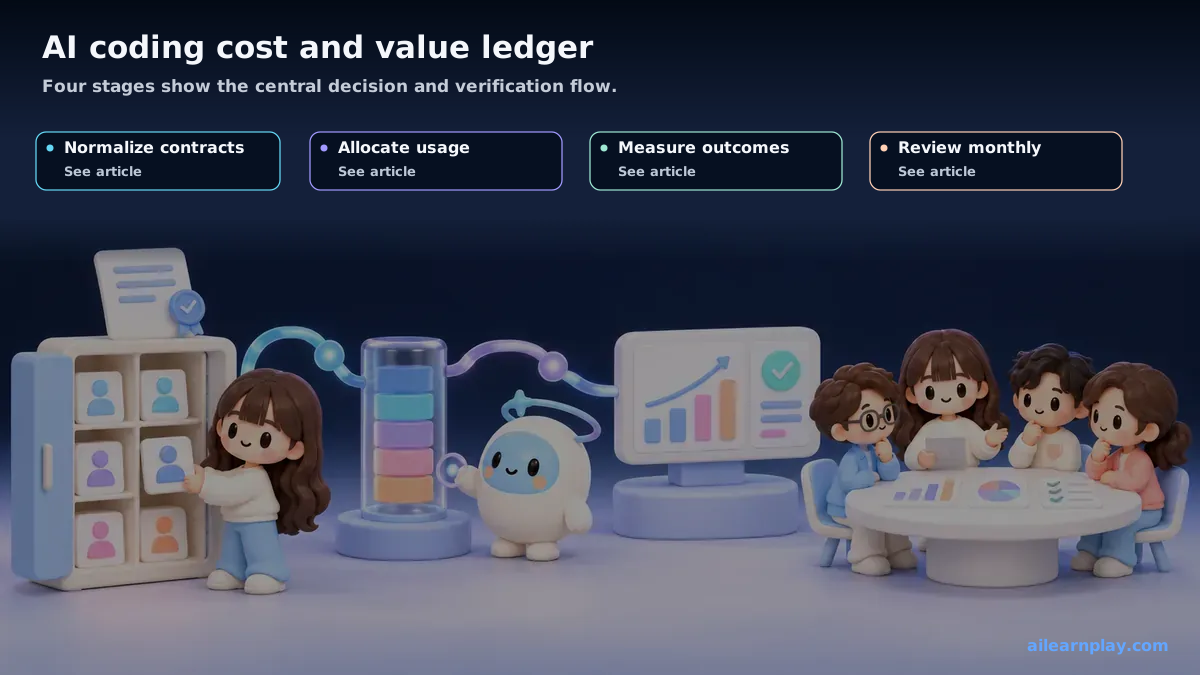
Enterprise AI cost management should measure contracts, consumption, and value separately. A total invoice cannot distinguish an unused license from high usage that produces valuable work.
| Management unit | Main question | Representative metrics |
|---|---|---|
| Fixed seat cost | Who should receive which plan? | Number purchased, number assigned, percentage of people who used it, cost of unused licenses |
| Variable usage cost | Who used which feature and AI model beyond the included amount? | Balance used for prepaid or additional usage, amount of AI processing, overage, spend by user and department |
| Business outcomes | Which outcomes correspond to the spend? | Completed work, percentage accepted after review, rework, time from request to completion |
The FinOps Foundation describes a progression from early generative AI measures such as cost per unit of processing toward cost per assist, AI-performed action, or resolved case.[1] The same progression applies to employee-facing AI coding assistance.
Compare Seat, Usage, and Additional-Balance Billing on One Basis
Claude, Codex, and GitHub Copilot draw the boundary between fixed and variable charges differently. Before signing a contract, confirm the plan your company will use and whether any legacy contract terms apply.
| Product and plan | Main published billing structure | What administrators should verify |
|---|---|---|
| Claude Team | Standard is $20 per seat per month with annual billing and Premium is $100. Monthly billing is $25 and $125 respectively, and seat types can be mixed[2] | Do not give every user Premium; assign tiers according to usage |
| Claude Enterprise | $20 per seat per month, plus usage for Claude, Claude Code, and Cowork at API rates. Organization, group, and individual spend limits are available[2][3][12] | Keep fixed seat cost and consumption in separate budgets rather than relying only on a shared credit balance |
| Codex / ChatGPT Business | Standard seats cost $20 per user per month annually or $25 monthly. They include baseline Codex usage, and workspace credits fund additional usage[4][5] | New Business workspaces cannot add Codex-only seats, so compare Standard seats with Enterprise |
| Codex / ChatGPT Enterprise | Depending on contract terms, manage ChatGPT seats alongside Codex-only seats that have no fixed seat fee and convert tokens (units of text a model processes as input and output) into credits[5] | Review group and user limits, credit balance, and input, output, and cached-input breakdowns |
| GitHub Copilot Business | $19 per seat per month with 1,900 AI Credits per seat pooled across the enterprise. Additional usage costs $0.01 per credit[7] | Check duplicate seats, uneven use of the pool, and per-user limits |
| GitHub Copilot Enterprise | $39 per seat per month with 3,900 AI Credits per seat. GitHub Enterprise Cloud is required[7] | Compare the value of Enterprise-only capabilities with Business overage |
The table uses public US-dollar prices and excludes tax, regional pricing, contract terms, and promotions. GitHub Copilot is also transitioning from the older Premium Requests system to AI Credits, so administrators should not reuse legacy management material without checking it.[7]
Confirm the Claude contract generation first
Claude currently has Team Standard and Premium seats, the current Enterprise seat-plus-consumption model, and legacy seat-based Enterprise agreements. Current Enterprise usage is not included in the seat fee, and administrators can design spend limits at the organization, group, and individual levels.[3][12]
Check the seat types displayed in the administration console and the billing model that will apply after renewal before setting a budget. Applying the legacy idea of an included allowance per seat to current Enterprise contracts can understate variable cost.
Manage the balance used for additional Codex work
For enterprise Codex use, the amount of information AI processes is converted into credits, the balance used for additional work. OpenAI’s administration console can show people who used Codex, balance consumption, processing volume, runs, and generated lines of code, then break them down by user, AI model, input, output, and reused input where supported.[6]
When a Business workspace uses automatic reload, set a monthly reload limit in addition to the minimum and target balances. Leaving the monthly limit blank permits unlimited automatic reload purchases.[8]
Combine the Copilot shared pool with individual limits
GitHub Copilot combines the AI Credits contributed by each seat into a shared enterprise pool. User-level budgets operate while users draw from the pool, while cost center, organization, and enterprise budgets primarily control additional metered charges after the pool is exhausted.[9]
This structure makes a common user-level limit, followed by approved exceptions for specific roles, more useful for fair allocation than a single enterprise ceiling alone.
Select users by workflow rather than request order
License candidates should be selected by work frequency, measurability, data and permission risk, and review capability—not seniority or enthusiasm alone. The following author-created framework works across the three products.
| Evaluation dimension | Question to ask | Condition that raises priority |
|---|---|---|
| Frequency | Does the person repeat the same development, review, or research workflow? | A concrete workflow occurs every week |
| Measurability | Can results before and after adoption be compared? | Completion time, review count, or throughput can be recorded |
| Review capability | Can the user or team verify AI output? | Tests, code review, and approvers are defined |
| Data fit | May the relevant code and document collections be used with the enterprise plan? | Data classification and approved scope are clear |
| Substitutability | Does the purpose overlap with an existing tool? | The primary use case is not already covered by another seat |
Classifying candidates into three groups makes allocation and reassessment easier.
- Power users: Use agents, code review, and multi-file changes routinely. Candidates for a higher cap or higher-tier seat
- Standard users: Use completions, chat, and small edits regularly. Start with a standard seat and shared default limit
- Evaluation users: Have not yet established a use case. Start with a time-bound pilot and restricted repositories
User selection is not a judgment of employee ability. Treat it as a check on workflow-to-license fit and provide a path to reapply after training so that the initial grouping does not become permanent.
Put budgets at organization, department, and user levels
Spend controls should combine an organizational safety ceiling, departmental allocation, and individual anomaly protection. A single company-wide cap can stop everyone when usage grows in one area.
| Level | Purpose | Example control |
|---|---|---|
| Organization | Protect the maximum invoice | Set a monthly hard limit and notification owners |
| Department or cost center | Assign budget accountability to work units | Separate limits for engineering, data, design, and other functions |
| Individual | Stop mistakes and unexpected parallel runs | Set a standard limit and approve exceptions only for power users |
Define the exception process at the same time. A request should include the workflow, amount, duration, expected outcome, and approver. When a user reaches a limit, review consumption and outcomes before choosing a temporary increase, permanent increase, or workflow redesign.
Separate billing metrics from value metrics
A monthly dashboard should review cost, adoption, and quality or value in that order. Treating more tokens or more generated lines as success can reward verbose output and unnecessary execution.
| Perspective | Minimum metrics | Decision enabled |
|---|---|---|
| Cost | Total, fixed seats, variable spend, spend by user | What drove the invoice |
| Adoption | Assigned seats, monthly active users, last activity | Which seats are unused and who needs enablement |
| Usage | Model, feature, execution surface, spend by department | Which workflows are expensive |
| Quality | Test pass, review rejection, revision count | Whether output is usable in the workflow |
| Value | Cost per completed workflow, time saved, throughput | Whether spend is connected to outcomes |
GitHub provides counts of people who used the product daily, weekly, and monthly, use of chat and AI-performed work, the percentage of suggested code accepted, and the progress of change proposals from creation to acceptance. It makes these available in an administration screen and through a connection for external reporting.[10] Claude reports similar activity. OpenTelemetry, a shared measurement standard, can break processing volume and estimated cost down by user, team, AI model, instruction guide, added capability, and AI-performed work.[11]
These metrics are useful observations of activity, but they do not prove productivity on their own. Combine them with existing engineering measures such as incidents, quality, and review workload.
Start optimization with unused seats
Optimize in an order that minimizes quality risk and makes the effect easy to observe.
- Reallocate unused seats: Check last activity and monthly active rate, then reflect leave, transfers, and expired use cases
- Choose one primary product per user: When assigning multiple advanced seats, verify that each product has a distinct role
- Match models and features to work: Separate routine edits, design, review, and long-running agents instead of making expensive capabilities the permanent default
- Focus the information sent to AI each time: Reduce long conversations, unrelated files, and instructions that load for every job
- Limit simultaneous work and automation: Define how many jobs may run at once, retry count, stopping conditions, and human approval points
- Evaluate outcomes for high-usage users: Do not cut high spend uniformly; use cost per completed workflow and quality to decide whether to expand or redesign usage
Reducing context does not mean removing safety instructions or quality criteria. Reducing Claude Code token use covers practical context controls in more detail.
Standardize the monthly operating cycle
Information-systems staff, engineering leadership, finance, and cloud-cost management staff should review the same report in the following order.
- Reconcile contracted and assigned seats with departures, transfers, and leave
- Review active users, unused seats, users at limits, and top consumers
- Inspect the models, features, workflows, and business outcomes behind top consumption
- Decide on seat recovery, tier changes, limit changes, training, or workflow improvements
- Record exceptions and reasons, then review their effect in the next cycle
- Check official sources for pricing, credit, and administration changes
Separate cost administration from content auditing. Access to a spend dashboard does not necessarily grant access to a person’s conversation content. OpenAI similarly states that spend controls are operational controls and do not change the privacy or visibility of private chats.[8]
Decide operating conditions before choosing a product
Start product selection with the company’s development environment, existing agreements, required management unit, and security controls.
- If GitHub already serves as the center of developer identity and repository administration, Copilot seat management, last activity, and usage metrics can align naturally with existing organization boundaries
- If the company wants to manage consumption across Chat, Claude Code, and Cowork with organization, group, and individual limits, evaluate the shared usage controls in Claude Enterprise[12]
- If ChatGPT and Codex will share one company-managed area and administrators need credit-based visibility across the Codex app, code editor, and cloud execution, evaluate ChatGPT Enterprise administration
Even when adopting more than one product, a company does not need to give every employee the same combination. Select a primary product and limit alternatives to users who can demonstrate a distinct workflow advantage. This reduces duplicate cost and support overhead. For Codex permissions, repositories, and product-surface planning, see Codex administration and security.
Summary: Start AI Cost Management with Five Contract Fields
Enterprise AI coding costs cannot be managed with token counts alone. Separate fixed seat cost, variable usage, and business outcomes, then convert each vendor’s credits and tokens into common financial metrics.
At rollout, select users through concrete workflows, measurable outcomes, review capability, and data fit. After rollout, review organization, department, and user limits, unused-seat reallocation, and cost per completed workflow every month. A useful first action is to inventory the current contract in five columns: seat price, included allowance, overage rate, configurable limits, and available usage metrics.
Available usage metrics alone do not prove a business outcome. If completed work and quality criteria are not yet defined, limit the first review to billing anomalies and unused-seat reallocation.
This article is a general information summary and is not legal advice. Confirm practical decisions with a qualified specialist.
References
- FinOps Foundation, Capability: Unit Economics, FinOps Framework
- Anthropic, Plans & Pricing, Claude
- Anthropic, How am I billed for my Enterprise plan?, Claude Help Center
- OpenAI, Managing billing and seats in ChatGPT Business, OpenAI Help Center
- OpenAI, Codex now offers pay-as-you-go pricing for teams, April 2, 2026 (updated June 24, 2026)
- OpenAI, Global Admin Console, OpenAI Help Center
- GitHub, About billing for GitHub Copilot in organizations and enterprises, GitHub Docs
- OpenAI, Managing credits and spend controls in ChatGPT Business, OpenAI Help Center
- GitHub, Budgets for usage-based billing, GitHub Docs
- GitHub, GitHub Copilot usage metrics, GitHub Docs
- Anthropic, Track team usage with analytics, Claude Code Docs
- Anthropic, Manage groups and group spend limits on Enterprise plans, Claude Help Center
For the latest releases and updates, check the official website and official documentation.