

A 12-Step Pre-Publication Review for AI Drafts

What you’ll learn
- Why article creation, mechanical checks, and human approval must be separated
- A twelve-step process covering claim extraction, citations, URLs, numbers, and structural checks
- How to prevent the creating AI from marking
passedand reserve publication decisions for people
Decide Whether an AI Draft Is Ready Through a Staged Review
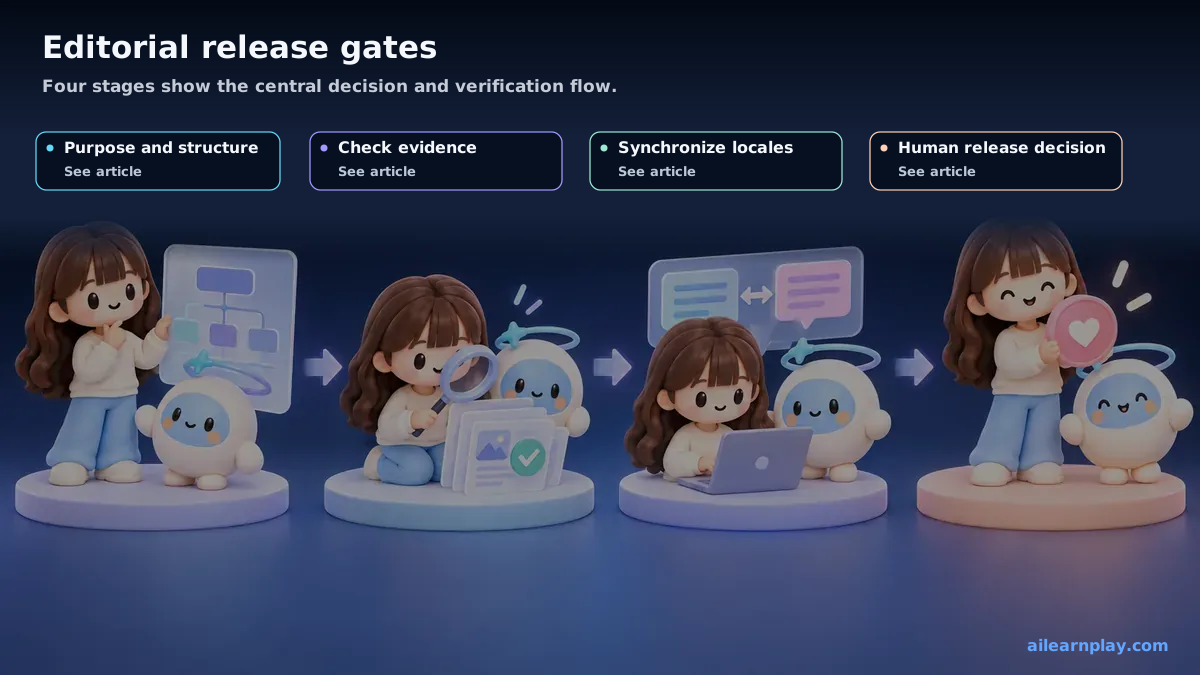
Publishing AI-assisted articles safely requires separate stages for structural and link checks, editorial review of facts and bilingual fidelity, and approval by a person who accepts publication responsibility. Clean formatting does not prove that fact review, author-experience review, or publication judgment is complete. On this site, the AI that creates a draft does not approve it; readiness is decided through twelve review stages.
By the end of this article, you will have practical criteria for answering “In what order should automated checks and human judgments run, and who approves publication?” in your own context.
AI Article Review Separates Evidence, Experience, and Publication Responsibility
AI can write inaccurate information in a confident tone. Numbers, link URLs, and the details of laws or regulations carry particular risk if published without verification.
In articles that cite external facts, it is also necessary to confirm that reference numbers in the body correspond to the correct entries in the reference list. A link can exist without actually supporting the claim attached to it.
The Creating Agent Does Not Approve Its Own Draft
passed does not mean “the Markdown structure is correct.” It means “this article has been judged ready to publish.” For that reason, I did not implement a flow where the agent that creates a new article can mark its own output as passed.
The creating agent can handle structural consistency checks such as:
- whether required frontmatter (the metadata at the top of a Markdown article, such as title, description, and date), slug (the short identifier used in a public URL or internal article link), date, series, series order, and tags follow the rules
- whether the JA/EN pair has aligned structure, dates, series membership and reading order, and heading order
- whether body citation numbers correspond to the reference list
- whether internal links and repository command claims match the current implementation
- whether mechanical checks detect a duplicate candidate against an existing article
The following judgments should not stay only with the creator:
- whether a reference truly supports the claim in the article
- whether a statement framed as author experience matches the author’s actual experience
- whether a similar article is still useful as a separate article for readers
- whether wording, conclusions, and publication timing match the author’s intent
- whether the remaining work is a fix or an actual publication approval
This separation keeps new articles at review_status: needs_review during creation. Structural problems should be resolved as much as possible, but publication approval remains with the approval ledger and human judgment.
Separate Publication Review into Structure, Evidence, Human Judgment, and State Gates
The pre-publication review separates what machines can check from what people must decide.
review:contentchecks frontmatter, citation numbers, reference format, and publication-blocking structural issues.review:repo-claimschecks claims that can be compared against repository implementation, such as npm scripts, local settings, and build versus deploy descriptions.review:duplicatesreports articles that are too close to existing articles in the same locale.review:ledgercollects claims, duplicate candidates, and repository-evidence questions that require human judgment into an approval ledger.
With this design, an agent does not declare “this can be published.” It can state “the structural checks have been addressed, but publication approval remains.” That distinction matters for article quality control.
The Review Workflow Starts with Purpose Definition and Ends with Publication Judgment
The Author Defines the Article’s Purpose and Claim
Before asking AI to create a draft, a person decides who the article is for, what it should communicate, which experiences or opinions to include as the author, and how much external information to cover. This decision becomes the basis for draft quality and the later review criteria.
Confirm the Article Type
Confirm whether the article is a documentation page or a blog post. Review standards differ by type. For documentation, source-backed accuracy is the top priority. For blog posts, which may include the author’s experience and interpretation, review involves distinguishing between the experience portions and the factual portions.
Read the Entire Article Through Once from the Beginning
Do not edit at this stage. Get a sense of the overall flow of the article and mark any sections that seem to need verification. Editing and verification at the same time makes it easy to miss things.
Extract Claims That Need Verification
From the body, extract sections that contain specific numbers, statistics, statements based on outside information, or assertions that would affect reader judgment if wrong. These are claims that require fact-checking.
Decide Whether Citation Is Needed
Determine whether each extracted claim is the author’s personal experience or opinion, or an external fact or statistic. If the claim relies on an external fact or statistic as its basis, a reference is required. The author’s experience or opinion does not require citation, but it still requires author confirmation.
Confirm That Reference Numbers Match the Body
In articles that contain references, confirm that the [1], [2], and similar numbers in the body correspond to the correct numbers in the reference list at the end of the article. Mismatched numbers prevent readers from tracing the source.
Confirm That URLs Exist
Open reference URLs in a browser and confirm that the pages actually exist. AI can generate URLs that do not exist. If a URL returns a 404, find the correct URL or remove it from the references.
Confirm That Calculations and the Basis for Numbers Are Correct
If the article contains calculations or derived values, confirm that the calculations are correct. Ratios and percentages are particularly important to verify.
Remove or Qualify Unverified URLs, Numbers, and Experience Claims
Fix the problems identified in Steps 3 through 7. For a URL that cannot be confirmed, a number whose primary source cannot be found, or an experience the author cannot confirm, remove the statement or rewrite it with narrower wording.
Run Structural Checks
Run npm run review:content to mechanically check frontmatter, citations, references, and review state. If the article describes local commands or implementation details, run npm run review:repo-claims to compare those claims with the repository implementation.
Check Duplication and Internal Links
Run npm run review:duplicates to check whether the article is too close to an existing article in the same locale. Also check internal links, looking not only for Markdown files on disk but for valid public routes.
Confirm the Publication Gate
Run the harness (the set of rules, procedures, and validation that guides AI work in a project) and review guardrails, then confirm the following as the final check before publication.
- The title does not contain imperative or provocative expressions
- The body does not include unverified claims about the author’s background or achievements
- No Critical publication-blocking review issues remain
- Publication approval by someone other than the article creator remains visible
Publish After Human Review
Run npm run review:ledger to output the items requiring human review. A person reviews the article body, evidence, duplicate candidates, and author-experience claims. Only when the article can be approved should the approval ledger record the reasoning and evidence, and the article move to passed.
Summary: Separate the Article Creator from the Publication Approver
The purpose of this implementation is not to stop AI-assisted work. It is to make the boundary of AI-assisted work explicit. Structural consistency, links, frontmatter, and comparison with repository implementation can be automated. Whether an article should be published, whether an author-experience claim is accurate, and whether a similar article is worth keeping are human judgment areas.
Keeping new articles at needs_review separates article creation from publication approval. The creating agent prepares a well-structured draft, and a person takes responsibility for approving publication. That division is the basis for quality control when increasing the number of AI-assisted articles.
The first action is to assign each of the twelve stages to automated validation, an editor, or a publication approver. Even when more checks become automated, the truth of author experience, the value of keeping a similar article, and publication responsibility must not be closed by machine output alone.