

Review Criteria for Code Created by Coding Agents: Priorities by Change Type

What you’ll learn
- Why code created by coding agents should be grouped into external connections, data changes, calculations, and display work
- The verification priority for each change type and the risks people should inspect first
- A review sequence for checking the diff, execution result, and scope of impact
Review Code Created by Coding Agents Based on Impact and Reversibility
The depth of review for code created by a coding agent should follow its external impact and how difficult the change is to reverse. In my work on this site, reviewing every change at the same depth allowed higher-priority items such as external connections and data updates to become less visible. Grouping changes into external connections, data changes, calculations and transformations, and display work makes the review order clearer.
By the end of this article, you will have practical criteria for answering “How deeply should I review each type of code change?” in your own context.
Increase Review Depth with the Impact of a Code Change
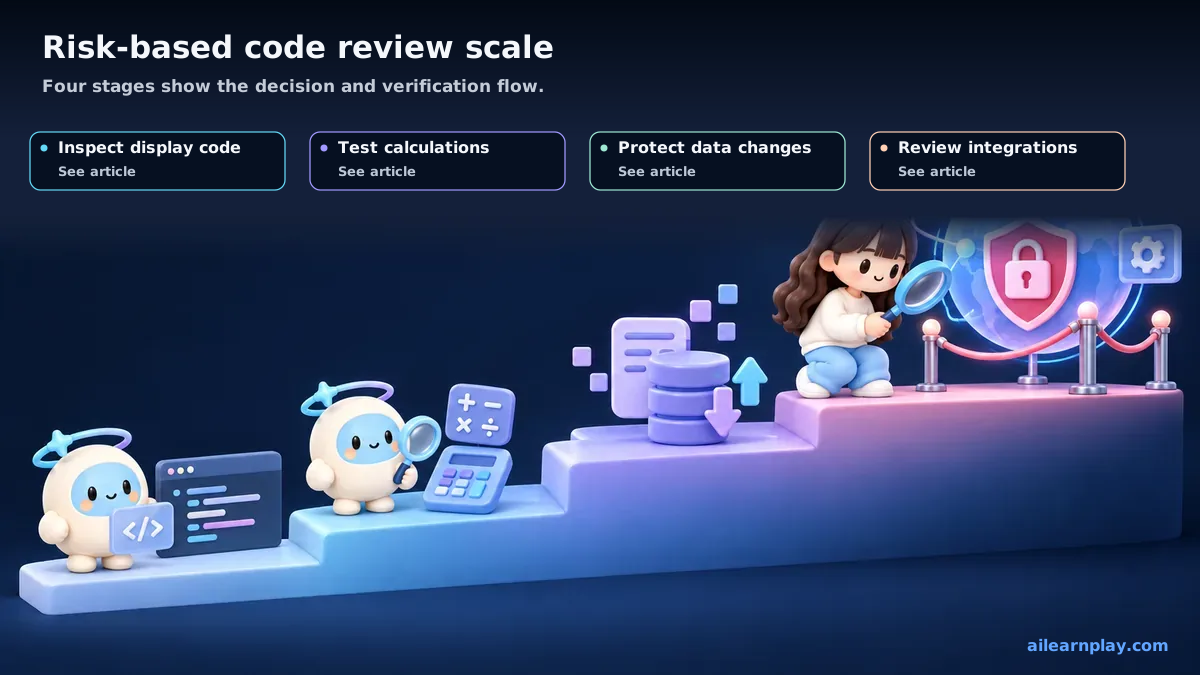
Reviewing every line of code created by coding agents becomes impractical as the volume grows. At the same time, accepting all of it without any review carries risk. This article organizes verification priorities like a review table for use after implementation, grouped by code type and based on my own experience. Adjustments will be needed depending on the nature of your project.
Code Types and Verification Priority
Priority: High — External Service Connection Configuration
Code that includes API keys, credentials, or connection settings for external services requires verification every time.
Specifically, I check where API keys are stored and whether authentication is configured correctly. Coding agents generally write code with the right structure, but key handling can end up in unexpected places. In one case, an API key was written directly into a configuration file that was then included in a Git commit. Because external services are involved and problems can take significant time to resolve, this category is always the first to verify.
Priority: High — Logic That Modifies or Deletes Data
Processes that update a database, overwrite files, or remove records require verification before running.
I check whether conditions are set correctly — for example, whether something intended to apply only to a specific user is not accidentally applying to everyone — and whether a confirmation step exists before deletion. Since these operations are difficult or impossible to reverse after execution, they are a high priority for review.
Priority: Medium — Calculation and Transformation Logic
Numerical calculations, data format conversions, and aggregation logic get verified through sample cases.
Coding agents usually get the structure of these operations right, but checking how boundary values are handled — zero, empty, maximum — is a useful step. Verifying every possible combination is not realistic, so I test a small number of representative cases and likely edge cases.
Priority: Low — Display and Design Code
Code related to layout, styling, and visual presentation is primarily verified by viewing the rendered result.
I open the page and check whether it looks as intended. Checking the visual output is more efficient than reading the underlying code in detail for this category.
Use an Appropriate Verification Method for Each Change to Code Created by Coding Agents
- Before receiving code, I identify which category it falls into.
- When API keys or credentials are involved, I check where they are stored and whether the file is excluded from version control.
- For data modification logic, I read the conditions to confirm they apply within the intended scope.
- For calculation logic, I run the code with representative values and check the output.
- For display code, I open a browser and verify the rendered page.
Summary: Increase Review Depth with External Impact and Difficulty of Reversal
Reviewing all code created by coding agents in detail is not necessary, but adjusting the depth of review based on the scope of impact and the difficulty of reversing a change is a practical approach. Checking what affects external services or cannot be undone first, and applying lighter verification to lower-risk code, is the framework I have found most useful in practice.
Start by classifying the diff into one of the four change types, then inspect external connections and data changes first. This priority order is a general starting point and does not apply unchanged in domains such as healthcare, finance, or safety controls, where a display change can also have serious consequences.