

What Is AI Learning Playground? Practical Enterprise AI Learning



What you’ll learn
- The site’s coverage of AI foundations, organizational adoption, development, and governance
- How systematic documentation differs from blog articles about practice and decisions
- How to choose a reading path for your goal and follow bilingual content and updates
AI Learning Playground Organizes Practical AI Knowledge by Goal
AI Learning Playground is a learning site for people who use generative AI at work. It organizes foundations, organizational adoption, AI system development, and governance by goal, with decision criteria, implementation steps, and verification methods in Japanese and English. Separating the roles of documentation and blog articles helps you choose an entry point for your current goal and return to prerequisites when needed.
By the end of this article, you will have practical criteria for answering “Where should I begin in AI Learning Playground to reach the knowledge needed for my current goal?” in your own context.
How to Use and Maintain AI Learning Playground
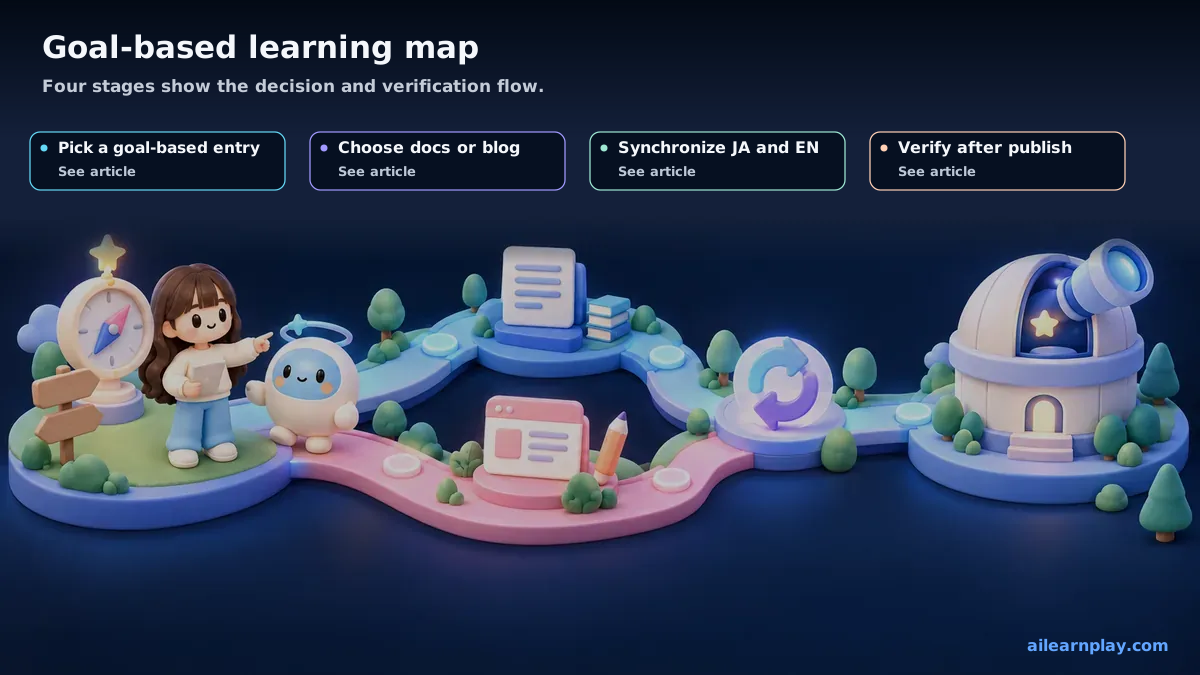
Even when generative AI can produce code or text, work can stall at debugging, data handling, quality checks, or organizational approval. You do not need to memorize everything. You need a foundation for deciding what to check next, what to delegate to AI, and where a person must make the decision.
The main audience includes people beginning to use AI at work, product managers, marketers, designers, and AI-assisted developers. Becoming a software engineer is not the only goal. The site aims to help you run safe experiments in your role and explain the results.
Use Documentation and Blog Articles for Different Needs
The site contains structured documentation and blog articles that explore specific questions.
| Type | Best use | How to read it |
|---|---|---|
| Documentation | Learn a field from its foundations | Begin with the section introduction, then continue to the chapters you need |
| Blog | Examine a decision, comparison, implementation example, or operational lesson | Choose an article close to the problem you need to solve |
If a blog article does not contain all the prerequisites for a procedure, return to the related documentation to check its terms and assumptions. When applying documentation to practical work, use the blog’s decision criteria and failure cases as supporting context.
Choose a Reading Path for Your Goal
You do not need to read everything from the beginning. Choose the entry point closest to your current problem.
| Goal | Start here | What you can examine |
|---|---|---|
| Understand generative AI fundamentals | Generative AI | Models, prompts, and foundational usage |
| Advance AI adoption in an organization | AI Transformation | Adoption, workflow design, and transformation |
| Start developing with AI | Terminal | Command-line and development-environment fundamentals |
| Implement an AI system | RAG | Designs that combine retrieval and generation |
| Evaluate risk and controls | AI Governance | Security, legal, and operational considerations |
| Use coding agents | Claude / ChatGPT and Codex | Tool-specific capabilities and practical workflows |
Begin with a small, reversible experiment. For actions involving company data, production systems, or customers, follow your organization’s policies and approval process first.
Japanese Is the Source and English Stays in Sync
Japanese is the source of truth for the site’s articles and documentation. The English version preserves the same claims, heading structure, procedures, and cautions. I adapt wording when a direct translation would be unnatural, but I do not change the intended audience or conclusion.
When a broken link, outdated interface label, or meaning mismatch appears in either language, I review the corresponding pages as a pair rather than changing only one version.
Verification and Updates Continue After Publication
Information that depends on external services or institutions can change. Publication is not the end of the process. I periodically check references, Japanese–English alignment, code examples, and update dates. Articles that depend on external material prioritize primary sources and identify the verification date and change-sensitive details.
Automated checks alone do not determine whether an updated article is ready to publish. A person reviews claims that cannot be verified mechanically, including personal experience, outcome claims, and legal or security guidance.
Summary: Choose One Reading Path for Your Goal and Test It on a Small Scale
AI Learning Playground organizes practical AI knowledge into foundations, adoption, development, governance, and tool usage.
- Use the documentation to learn a field in sequence.
- Use the blog to investigate a specific decision or implementation example.
- Start with the section closest to your goal, then return to any prerequisite material you need.
- Prioritize organizational policies and human review for actions that affect a company or its customers.
Choose one reading path above and turn what you learn into a small experiment.