

Ontology, Knowledge Graphs, RAG, and GraphRAG: How to Choose

What you’ll learn
- What ontology, knowledge graphs, RAG, and GraphRAG each manage
- How to divide one business question across meaning, facts, passages, and relationship paths
- How the roles appear in life sciences, web search, internal search, and supply-chain analysis
- How to choose a small starting point from where the answer lives and how deeply relationships must be followed
- Which permissions and evidence people must manage when AI chooses where to search
Ontology, knowledge graphs, RAG, and GraphRAG play different roles in handling knowledge
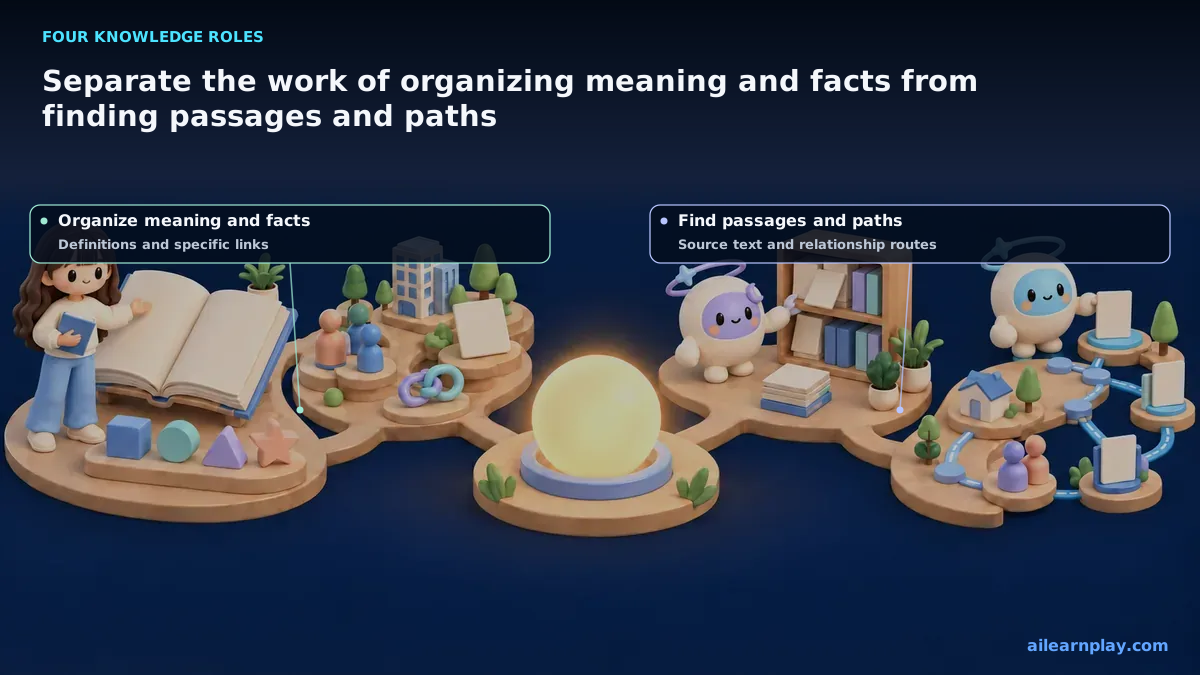
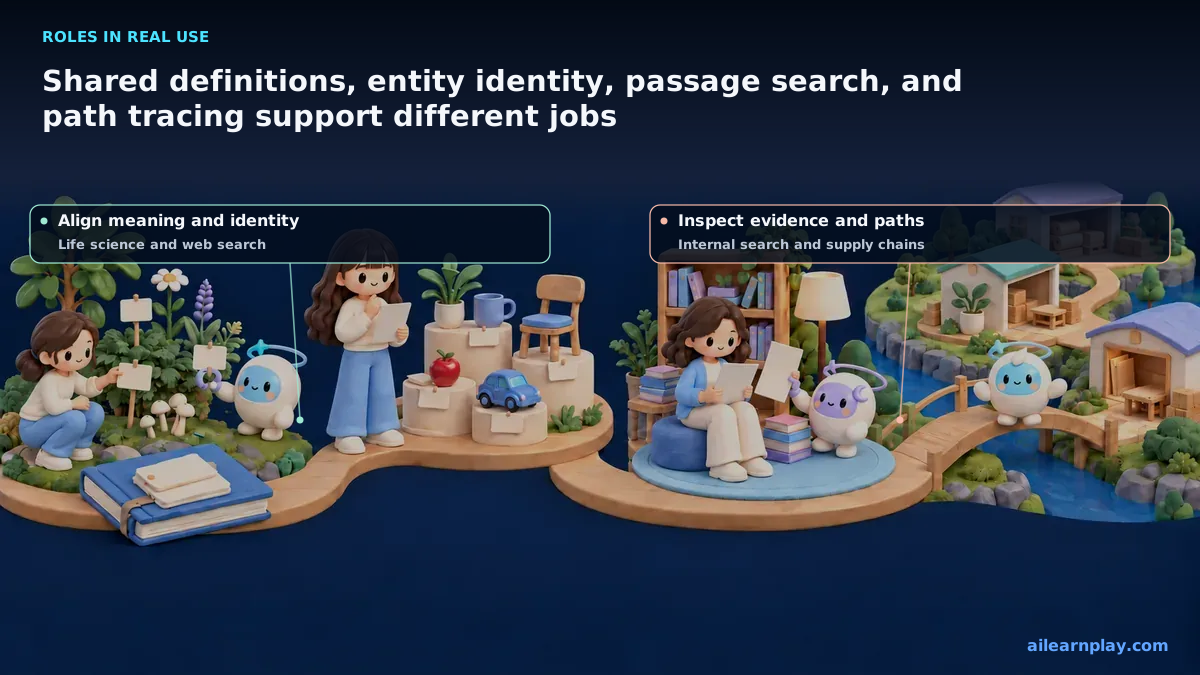
An ontology aligns the meaning of words. A knowledge graph records particular facts and connections. RAG finds passages related to a question. GraphRAG follows relationships or groups of documents to collect evidence. Their names often appear together, but they are not four competing products. Once the roles are separated, it becomes easier to choose only the machinery a question actually needs.
By the end of this article, you will have practical criteria for answering “How should I distinguish ontology, knowledge graphs, RAG, and GraphRAG and select only what a question needs?” in your own context.
One contract question can require meaning, facts, passages, or relationship paths
Consider a question about a company’s contracts. An ontology defines what terms such as “customer,” “contract,” and “subsidiary” mean so departments do not silently use them differently. Tom Gruber’s widely cited explanation describes an ontology as an explicit specification of a conceptualization: it gives concepts and distinctions a consistent formal meaning.[1]
A knowledge graph records particular facts with their sources, such as “Company A holds Contract 123” and “Company B is a subsidiary of Company A.” A broad survey of knowledge-graph research treats modeling, recognizing the same entity, context, and quality management as central concerns.[2]
RAG, or retrieval-augmented generation, finds external information relevant to a question and passes that material to a language model. The original 2020 paper combined knowledge inside the model with passages retrieved from Wikipedia.[3] The important idea is not a particular database: it is the job of finding useful passages before composing an answer.
GraphRAG is a family of RAG approaches that uses graph relationships or graph-derived groups during retrieval. Microsoft’s approach extracts entities and relationships from text, groups closely related entities, and prepares summaries. It can then search around one entity or examine themes across the collection.[4][5] Other systems traverse an existing business knowledge graph, so the name alone does not tell us which graph is used, who approved its relationships, or how it is searched.
| Concept | What it manages | Contract example | What it does not do by itself |
|---|---|---|---|
| Ontology | Meanings, types, relationships, and constraints | Defines customer, contract, subsidiary, and how they relate | Records Company A’s current contract |
| Knowledge graph | Particular entities, attributes, relationships, and sources | Records that Company A holds Contract 123 and Company B is its subsidiary | Writes the answer |
| RAG | Retrieval of relevant passages for answer generation | Finds the contract and cancellation clause as evidence | Guarantees a relationship absent from the documents |
| GraphRAG | Retrieval through relationship paths or document groups | Traverses subsidiaries, contracts, and incidents to gather risk evidence | Treats every extracted relationship as an approved fact |
An ontology can exist before individual facts are entered. A small knowledge graph can operate without a formal ontology, and RAG can work without a graph. Some GraphRAG systems build a retrieval-only graph from documents. Using GraphRAG therefore does not automatically produce an approved enterprise knowledge graph.
Life sciences, web search, internal search, and supply chains make the roles concrete
Life sciences, web search, internal search, and supply-chain analysis already assign these approaches different jobs. Their use cases reveal whether a system is managing definitions, facts, passages, or relationship paths.
Gene Ontology aligns biological terms and relationships
Gene Ontology supplies shared concepts for molecular functions, biological processes, and cellular locations. The ontology defines categories and relationships; individual gene products are annotated with references and evidence types. Its official site describes it as a foundation for computational analysis of large-scale molecular biology and genetics experiments.[6]
The lesson is that a glossary alone is not enough. Shared definitions, mappings to records, evidence, and update procedures are maintained together.
Google’s Knowledge Graph distinguishes real-world entities
Google introduced the Knowledge Graph to Japanese search in 2012. When the same words could name a film, city, or person, it distinguishes candidates and presents summaries and related items.[7] The key job is identifying an entity and following its attributes and relationships, not simply matching a string.
Morgan Stanley combines document retrieval with evaluation
According to OpenAI’s case study, Morgan Stanley Wealth Management uses AI @ Morgan Stanley Assistant for internal knowledge search. The organization evaluates realistic questions, asks experts to grade answers, and runs daily regression tests to check whether previously correct answers remain correct after changes.[8]
This shows that connecting a model to documents does not complete a RAG system. People must continue checking which passages are retrieved and whether answers remain grounded in them.
LINEA is developing GraphRAG for multi-level supplier research
An AWS case study describes LINEA combining company data, trading relationships, and news in a graph. The service is designed to follow suppliers across several levels with Amazon Neptune and use Amazon Bedrock to interpret questions and produce answers. At publication, it remained in development toward broader adoption in fiscal 2027.[9]
Here the answer is not one company description. It depends on a path through a supplier, that supplier’s sources, and related news, which makes relationships part of retrieval.
Choose by whether the answer lives in a passage, a relationship, a collection, or an exact calculation
Before choosing a data format, ask where the answer is and what must be crossed to reach it.
| Concept | Suitable uses | Unsuitable or lower-priority uses |
|---|---|---|
| Ontology | Aligning terms across departments; reusing meanings and constraints; deriving classifications from rules | Narrow document search; a rapidly changing domain without an owner; classifications simple tags already handle |
| Knowledge graph | Following ownership, dependency, trade, or impact across several links; matching aliases; sharing sourced relationships | A list that fits in one table; fixed totals; work without an owner for relationship maintenance |
| RAG | Questions grounded in policies, manuals, contracts, or research; search over changing documents; cited summaries | Exact calculations; database updates; exhaustive collection-wide comparison; answers that are relationship paths |
| GraphRAG | Cross-document research; multi-step relationships; collection-wide themes; analysis grounded in both paths and passages | Simple search over a small collection; low-latency, low-cost screens; unreliable relationship extraction; high-risk decisions without review |
Microsoft’s responsible-AI information likewise describes GraphRAG as suitable for a thematically coherent document collection rich in entities. It calls for expert review and traceable sources.[10]
None of these approaches replaces exact sales totals or inventory updates. Use database queries for complete numerical aggregation and permissioned business workflows for state changes. A task that is simpler and easier to verify without generative AI does not need to be forced into RAG.
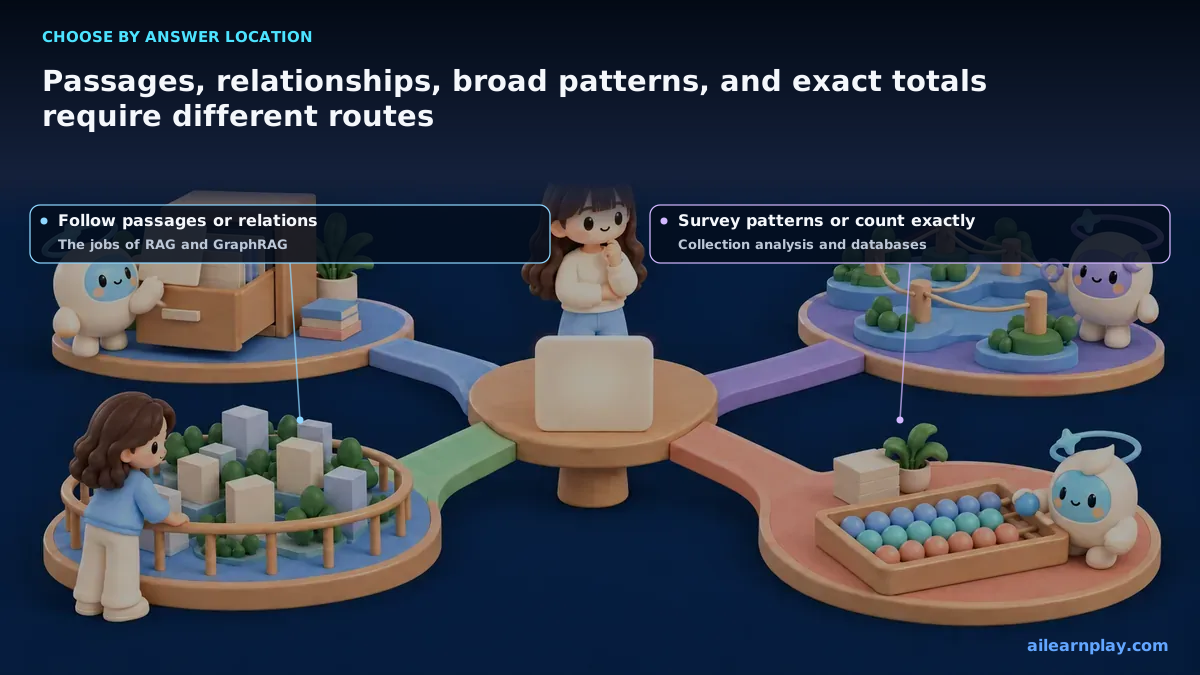
Start with small search and add a graph only after a relational gap is observed
Choose from representative questions, not from a favored technology.
| Representative question | First approach to try | When to add more |
|---|---|---|
| “What is the deadline for a leave request?” | Keyword search or RAG | Improve retrieval and document attributes if wording hides the policy |
| “Which services and teams are related to this incident?” | A knowledge graph, or RAG with graph search | Add incident passages as GraphRAG evidence when text must support the path |
| “What does customer mean in each department?” | Terminology alignment and a small ontology | Add shared identifiers, mappings, and a change process when several systems reuse it |
| “Which issues and people recur across all investigation reports?” | Evaluate ordinary RAG as a baseline | Compare GraphRAG if a few similar passages miss recurring connections and themes |
| “What was revenue by product last month?” | Database aggregation | Give the verified total to a model only when an explanation is needed |
Weak RAG retrieval does not automatically justify GraphRAG. Better document boundaries, titles and dates, combined keyword and meaning-based search, or result reordering may solve the problem. A graph becomes useful when evaluation shows that relevant passages are found but the connections among entities are missing, or that collection-wide questions repeatedly see only a narrow part of the collection.
Ontology work benefits from the same restraint. Begin with the types, relationships, and constraints required for one recurring question. Promote only definitions reused by several workflows or systems into a shared asset.
The AWS Context Ontology Accelerator article covers one AWS implementation for meaning and relationships. The Palantir Ontology article explains a layer that also handles state changes, permissions, and records. This article stays vendor-neutral and focuses on choosing a role from the shape of a question.
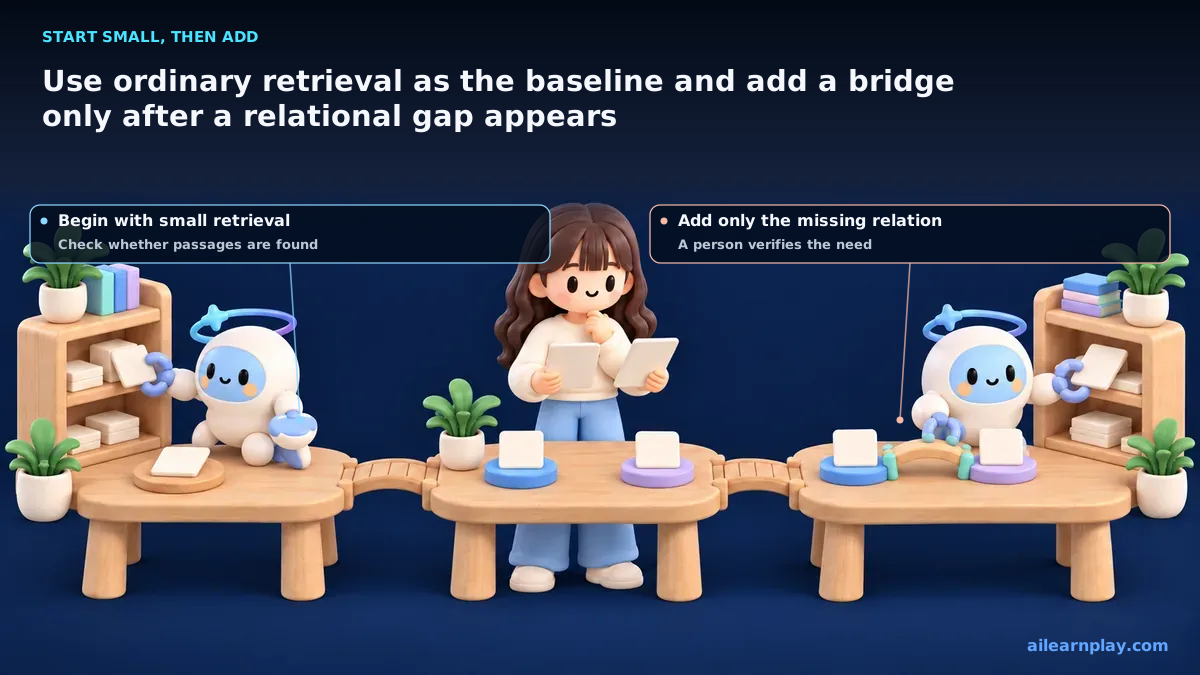
Summary: The first step is one representative question with human checks on evidence and permission
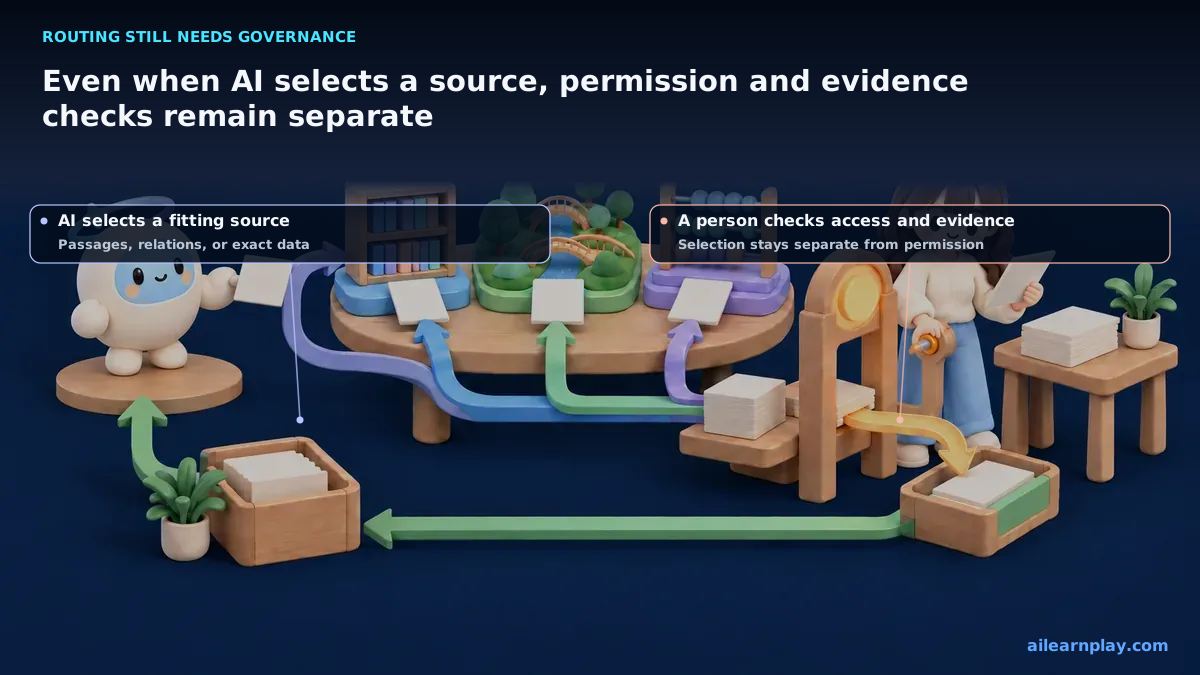
My expectation is that GraphRAG will not replace ordinary RAG everywhere. Systems will route questions among text search, databases, knowledge graphs, and other tools. A short policy lookup needs passages, an impact investigation benefits from relationship paths, and an exact total belongs in a database.
Even when AI selects a source, a recorded relationship is not permission to view or change the related object. People still need to control access boundaries, inspect the evidence behind an answer, and confirm consequential actions. Microsoft’s GraphRAG is a research-oriented implementation, and its documentation advises teams to watch indexing cost and version changes and to start small.[11]
The first action is therefore not vendor selection. Pick one question people genuinely need answered. Decide whether its answer lives in one passage, across several relationships, in patterns over a collection, or in an exact calculation. Keep ordinary search or RAG when it works.
If the task is a simple list, exact total, or approved business update, prefer a database or existing workflow. Do not expand graph adoption when no one owns relationship maintenance, evidence tracking, permissions, and continuing evaluation.
References
- Tom Gruber, Ontology, 2009
- Aidan Hogan et al., Knowledge Graphs, 2020
- Patrick Lewis et al., Retrieval-Augmented Generation for Knowledge-Intensive NLP Tasks, 2020
- Darren Edge et al., From Local to Global: A Graph RAG Approach to Query-Focused Summarization, April 2024
- Microsoft, Query Engine
- Gene Ontology Consortium, The Gene Ontology Resource
- Google, ナレッジグラフ “モノ”を認識する検索エンジンに向けて, December 5, 2012
- OpenAI, Morgan Stanley uses AI evals to shape the future of financial services
- Amazon Web Services, 株式会社リネア様のAWS生成AI事例:GraphRAGで実現するサプライチェーンリスク検知と管理への取り組み, October 24, 2025
- Microsoft, GraphRAG: Responsible AI FAQ
- Microsoft, GraphRAG
For the latest releases and updates, see the official websites and documentation.