

AI Draft Review Workflow: Automated Checks and Human Judgment

What you’ll learn
- Why AI drafting, automated checks, and human publication judgment are separate responsibilities
- Which problems can be detected automatically, including links, reference numbers, prohibited wording, and frontmatter (article metadata such as title and publication state)
- A human review process for freshness, evidence fit, author experience, and publication responsibility
Combine Automated Checks with Human Publication Judgment
Preparing an AI-assisted article draft for publication requires separating automated format checks from human review of meaning and evidence. On this site, automation checks links and reference numbering, while people judge freshness, evidence fit, author experience, and publication readiness. Expanding automation does not transfer final responsibility to the machine.
By the end of this article, you will have practical criteria for answering “How should automated checks and human review be divided without obscuring publication responsibility?” in your own context.
Review AI Drafts with Automated Checks and Human Judgment
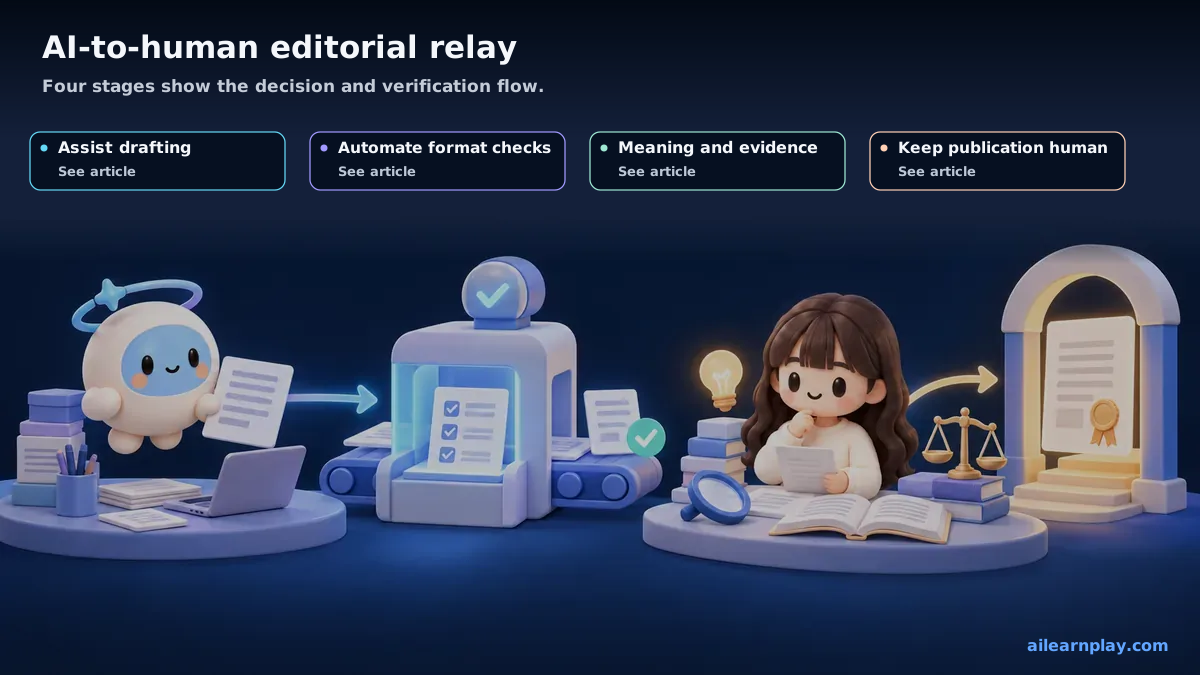
This site uses AI for part of the article production process. A person defines the topic, claim, experience, and publication standard, and AI supports structure organization and draft creation.
The resulting draft is checked with a separate AI or script. However, automated checks do not guarantee article quality. They detect issues that are easier to judge mechanically, such as format, links, and frontmatter (the metadata at the top of a Markdown article, such as title, description, and date), and the results are used during human review.
Final accuracy, source validity, alignment with the author’s experience, wording, and publication decisions are checked by a person. This article organizes what can be automated in this review flow and what still requires human judgment.
Separate Draft Assistance from Check Assistance Before Human Review
One AI process supports article draft creation. A separate AI process supports checking the draft for formal issues against a list of items and criteria provided to it.
This separation makes it easier to detect formatting errors and configuration issues from a different angle before human review.
Automated Checks Catch Link, Reference, Language, and Frontmatter Violations
Detecting Broken Links
The automated link check verifies that links in the article body resolve correctly. It detects cases where a link points to a nonexistent page or the URL format is incorrect.
Verifying Reference Number Consistency
When the body contains citations such as [1], the reviewer checks whether those numbers correspond to entries in the references section at the end of the article. It detects cases where a number is missing from the list or where an entry in the list is not referenced in the body.
Checking for Prohibited Expressions
The prohibited-language check compares the article with expressions excluded by project rules. Specific terms that overstate an effect or make an unsupported claim are checked mechanically.
Verifying Frontmatter Format
The frontmatter check verifies required fields and their expected formats. This covers date format, slug (the short identifier used in a public URL or internal article link) structure, and the presence of required tags.
Automated Checks Cannot Judge Freshness, Evidence Fit, or Author Experience
Content That Is Outdated
Automated review cannot determine whether the information in an article is still accurate at the time of reading. Content that was correct when written may become outdated due to product specification changes or evolving circumstances. Periodic review for currency requires human judgment.
A Source That Exists But Does Not Support the Claim
Even when a reference link is functional, the reviewer cannot verify whether the linked document actually supports the claim it is attached to. Confirming that a source supports an argument requires reading both the source and the claim.
Content That Does Not Match the Author’s Actual Experience
For articles grounded in personal experience, whether the content accurately reflects what actually happened can only be confirmed by the author. AI in a reviewer role has no way to verify alignment with the author’s firsthand account.
How I Combine Automated and Human Review
My current approach divides the work as follows:
- Format, structure, and link checks are handled by automated review.
- Factual accuracy — especially for claims that rely on external information — is checked by me.
- Content grounded in personal experience is verified by me before publication.
Automated review is well-suited to finding mechanical, structural problems. It is not a mechanism for guaranteeing content accuracy. Understanding that boundary and applying the appropriate method to each type of check is the basis for a practical quality management process.
Summary: Automate Format Checks but Keep Meaning, Evidence, and Publication Decisions Human
AI-assisted automated review is an effective tool for detecting formatting errors and configuration issues. For factual accuracy, correspondence between claims and their sources, and consistency with the author’s actual experience, human review remains necessary. Designing a quality process means understanding what can be automated and what cannot, and assigning each type of check to the appropriate method.
Start with one item in the current review process and classify whether it has a mechanical pass/fail condition. A passing automated check does not establish that a source supports a claim, an experience is genuine, or the article is ready to publish, so those human decisions must remain.