

AI Driven vs AI Native: Differences and When to Use Each

What you’ll learn
- How AI Driven improvement of existing work differs from AI Native redesign around AI
- How to compare their design starting point, role of AI, and transformation difficulty
- How four conditions, including existing assets, change scope, and risk, guide the choice
AI Driven and AI Native Start from Different Transformation Goals
The deciding axis between AI Driven and AI Native is whether to improve an existing operation or redesign work and products around AI. Strong dependencies on existing assets, data connections, approval paths, and recovery procedures make staged AI Driven change the practical starting point. AI Native becomes relevant when a new workflow can be designed together with its evaluation and operating model.
By the end of this article, you will have practical criteria for answering “How should AI Driven and AI Native be selected based on existing assets, change scope, and risk?” in your own context.
What Is AI Driven?
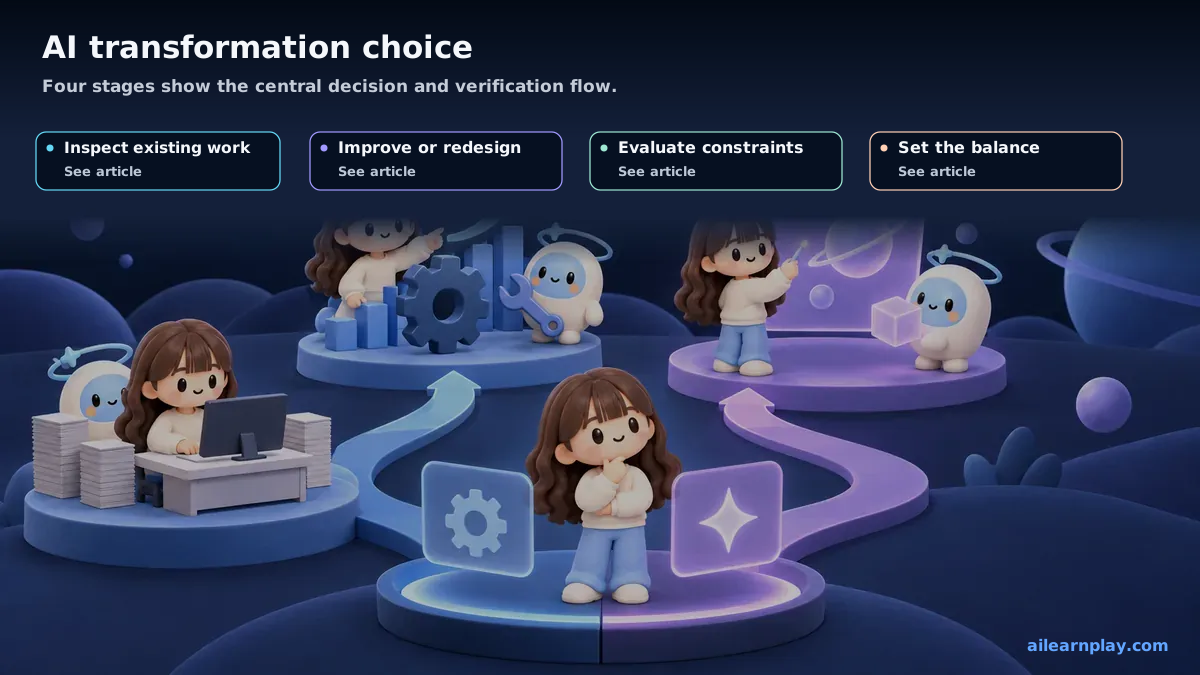
In this article, AI Driven means starting from existing operations, organizations, and business models, then using AI to improve them. This is an author-created comparison frame, not a universal industry maturity model.
It describes a transformation process in which organizations that already have an established business foundation gradually integrate AI as a tool to strengthen their existing work.
This includes organizations with existing businesses and customer bases that incorporate AI into parts of their operating processes, decision-making, and customer experience. AI Driven is easier to understand as a transformation that extends existing strengths rather than as a standalone AI-native business.
Because AI Driven starts with existing systems, data, and responsibilities, integration and migration order become central decisions. The required scope depends on the constraints of the current operation.
What Is AI Native?
In this article, AI Native means designing a new organization, product, or process with AI use as an initial assumption.
Instead of adding AI later, the design includes data collection, evaluation, human review, and exception handling from the beginning. A new design still has constraints from law, customer requirements, existing data, cost, and operating responsibility.
In this article, I use “AI Native” as an author-created classification for companies, products, and operations designed around AI. This does not mean that every company in this group officially describes itself with that term.
AI Native organizations can design products and operations around AI, but their actual challenges vary by business stage, customer base, and regulatory environment.
AI Driven Improves Existing Work; AI Native Redesigns the Work
AI Driven Starts from Existing Business; AI Native Starts from New Design
AI Driven begins from the direction of “strengthen existing operations with AI.” AI Native begins from the direction of “design from scratch with AI as the foundation.”
Even when both are using AI, the starting point differs — and that difference affects technology stack choices, organizational structure, and how decisions are made.
AI Driven Uses AI as Support; AI Native Designs Its Role from the Start
In AI Driven, AI is a tool that assists and enhances operations. Human judgment remains primary, with AI raising its accuracy and speed.
In AI Native, the boundary between AI processing and human approval is designed from the start. AI does not have to make the primary decision; high-impact work may put Human-in-the-Loop review at the center. Neither approach is inherently better—the right balance depends on the organization’s goals and risk tolerance.
AI Driven Faces Integration; AI Native Faces Reliability and Regulation
AI Driven organizations tend to face the costs of integrating with legacy systems and the challenge of transforming organizational culture. Incorporating AI into existing workflows requires not just technical connectivity, but also upskilling staff and establishing operating structures.
AI Native organizations tend to face challenges around scaling and monetization. The agility that comes from designing with AI as a foundation is a strength, but establishing trust and meeting regulatory requirements can take time.
Choose by Existing Work, Data, Regulation, and Recovery Conditions
| Condition | Start with AI Driven when | Consider AI Native when |
|---|---|---|
| Existing operation | Procedures, customer experience, or responsibilities must remain | A new operation or product is being designed |
| Data and systems | Existing data or core-system integration is required | Data collection and evaluation can be designed from the start |
| Regulation and approval | Current approval paths need a staged transition | New approval and audit paths can be designed |
| Recovery from failure | The process must fall back to the existing workflow | A new non-AI fallback can be prepared |
If any of these conditions creates a strong dependency on existing assets, a scoped AI Driven change is usually easier to govern than a full redesign. A new business is not automatically AI Native if evaluation, permissions, audit, and stopping conditions remain undefined; it may still be an experiment.
Use Existing Assets to Set the Balance Between AI Driven and AI Native
For organizations with an existing customer base, brand, and industry knowledge, the AI Driven approach is a realistic option. In industries where regulation and integration with existing systems matter, teams may need to transform operations in stages instead of assuming a full shift to AI Native. This is my assessment of implementation conditions, not a claim that one approach has been proven more effective in specific industries.
When designing a new product or business, starting with AI Native thinking makes sense because AI can be built in from the beginning. That said, a full transition to AI Native is not realistic for most established organizations.
McKinsey’s Rewired explains that turning AI into company value requires technology to be combined with data, organization, culture, and change capabilities.[1] The source does not define this article’s AI Driven/AI Native classification; it supports the narrower point that organizational transformation is more than technology adoption.
Author’s perspective: For organizations with existing operations, I think the practical direction in most cases is to learn from AI Native’s speed and design principles while advancing transformation as an AI Driven organization. This reflects my reading of multiple cases and reports, not a finding from a single study.
Summary: Choose AI Driven or AI Native After Checking Existing Assets and Recovery Conditions
AI Driven and AI Native are labels in this article for separating the starting point of a design, not a ranking. Check them in this order:
- Identify the existing operation and customer experience that must remain
- Confirm dependencies on existing data and systems
- Define human approval, audit, and stopping conditions
- Decide whether failure falls back to an existing process or a newly designed alternative
Use AI Driven as the starting point for staged changes around existing assets. Use AI Native as the starting point when a new workflow can be designed together with its evaluation and operating model. An organization can also use both: AI Driven in an established business and AI Native for a new product.
References
- McKinsey & Company, Rewired: How Leading Companies Win with Tech and AI, 2026